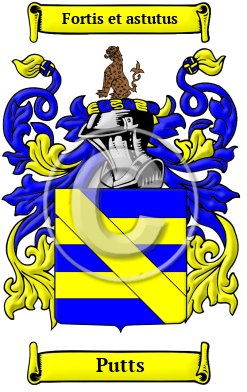
| ![Show Contents]() Putts History, Family Crest & Coats of Arms Putts History, Family Crest & Coats of Arms
Etymology of PuttsWhat does the name Putts mean? The name Putts is of Anglo-Saxon origin and came from Phillip. A common medieval English form of the name Phillip is Philpot. This form was often shortened to the diminutive form Pot or Pott. It is from this form of Phillip that the surname Putts is derived. The personal name Phillip was popular thanks to the influence of St. Phillip, one of the twelve apostles of Christ. 1 There is, however, another possible etymology, that better explains some instances of the name. Pott was an Old English word which meant hole or pit. It was sometimes used topographically to indicate residence near such a geographical feature. This makes this surname polygenetic; that is, derived from more than one source and having more than one initial bearer. Early Origins of the Putts familyThe surname Putts was first found in Hampshire where Godwin Pot was registered at Winton in 1115. Years later, Richard Pott was listed in the Liber Wintoniensis of Cambridgeshire c. 1150 and later again, Petronilla Potes was registered in the Court Rolls of Colchester in 1311, as was Roger Potte in 1352. 2 The Hundredorum Rolls of 1273 proved the family was scattered throughout ancient Britain: Colin Pot in Lincolnshire; Richard Pot in Essex; Reginald Pot in Huntingdonshire; and William Pote in Norfolk. 1 Richard de la Potte, Attepotte was listed in the Curia Regis Rolls for Sussex in 1221 and later in 1228; Gilbert atte Potte was found in the Subsidy Rolls for Surrey in 1332; and Margaret atte Potte was found in the Subsidy Rolls for Sussex in 1296. 2 Another source claims "Potts was the name of an old Northumbrian clan." 3 And still father to the north in Scotland, "Richard Pott in Eskdaill was charged with the theft of four cows in 1513, and Thomas Pot in Reddene and Rafe (Ralph) Pott in Kelso are in record in 1567." 4 The Poot and Poots variants are "now numerous in Ulster most of which, though not sufficiently well established to be classed as 'principal names' in the co-called census of 1659, were already to be found in that province at that time." This noted author goes on to cite the name as being ultimately of English origin. 5 Early History of the Putts familyThis web page shows only a small excerpt of our Putts research. Another 111 words (8 lines of text) covering the years 1592, 1605, 1612, 1618, 1640, 1641, 1644, 1648, 1660, 1673, 1675, 1686 and 1721 are included under the topic Early Putts History in all our PDF Extended History products and printed products wherever possible. Putts Spelling VariationsBefore English spelling was standardized a few hundred years ago, spelling variations of names were a common occurrence. Elements of Latin, French and other languages became incorporated into English through the Middle Ages, and name spellings changed even among the literate. The variations of the surname Putts include Potts, Pott, Pot, Poot and others. Early Notables of the Putts familySir Thomas Putt, 1st Baronet (1644-1686) of Combe in the County of Devon, Member of Parliament for Honiton; and his son Sir Thomas Putt, 2nd Baronet (c. 1675-1721); Sir William Pott of Norfolk; Sir John Potts, 1st Baronet (c. 1592-1673), an English politician who sat in the House of Commons from 1640 to 1648 and in 1660; and Dr. John Potts (or Pott), originally from Cheshire, was a physician and Colonial Governor of Virginia...
Another 73 words (5 lines of text) are included under the topic Early Putts Notables in all our PDF Extended History products and printed products wherever possible.
| Putts migration to the United States | + |
A great wave of immigration to the New World was the result of the enormous political and religious disarray that struck England at that time. Families left for the New World in extremely large numbers. The long journey was the end of many immigrants and many more arrived sick and starving. Still, those who made it were rewarded with an opportunity far greater than they had known at home in England. These emigrant families went on to make significant contributions to these emerging colonies in which they settled. Some of the first North American settlers carried this name or one of its variants:
Putts Settlers in United States in the 18th Century- Michael Putts, who arrived in Pennsylvania in 1761 6
The motto was originally a war cry or slogan. Mottoes first began to be shown with arms in the 14th and 15th centuries, but were not in general use until the 17th century. Thus the oldest coats of arms generally do not include a motto. Mottoes seldom form part of the grant of arms: Under most heraldic authorities, a motto is an optional component of the coat of arms, and can be added to or changed at will; many families have chosen not to display a motto.
Motto: Fortis et astutus
Motto Translation: Bold and Crafty.
- Bardsley, C.W, A Dictionary of English and Welsh Surnames: With Special American Instances. Wiltshire: Heraldry Today, 1901. Print. (ISBN 0-900455-44-6)
- Reaney, P.H and R.M. Wilson, A Dictionary of English Surnames. London: Routledge, 1991. Print. (ISBN 0-415-05737-X)
- Guppy, Henry Brougham, Homes of Family Names in Great Britain. 1890. Print.
- Black, George F., The Surnames of Scotland Their Origin, Meaning and History. New York: New York Public Library, 1946. Print. (ISBN 0-87104-172-3)
- MacLysaght, Edward, The Surnames of Ireland. Ireland: Irish Academic Press, sixth edition, 1985. Print. (ISBN 0-7165-2366-3)
- Filby, P. William, Meyer, Mary K., Passenger and immigration lists index : a guide to published arrival records of about 500,000 passengers who came to the United States and Canada in the seventeenth, eighteenth, and nineteenth centuries. 1982-1985 Cumulated Supplements in Four Volumes Detroit, Mich. : Gale Research Co., 1985, Print (ISBN 0-8103-1795-8)
 |