| ![Show Contents]() Prokter History, Family Crest & Coats of Arms Prokter History, Family Crest & Coats of Arms
Etymology of ProkterWhat does the name Prokter mean? The ancient name of Prokter finds its origins with the ancient Anglo-Saxon culture of Britain. It comes from a name for a steward. Prokter is an occupational surname, which belongs to the category of hereditary surnames. Occupational surnames were derived from the primary activity of the bearer. In the Middle Ages, people did not generally live off of the fruits of their labor in a particular job. Rather, they performed a specialized task, as well as farming, for subsistence. Other occupational names were derived from an object associated with a particular activity. This type of surname is called a metonymic surname. This surname comes from the Old English word proketour, which is a contracted form of the Old French procurator. Early Origins of the Prokter familyThe surname Prokter was first found in Cambridgeshire where they held a family seat from very ancient times. Early History of the Prokter familyThis web page shows only a small excerpt of our Prokter research. Another 127 words (9 lines of text) covering the years 1521, 1536, 1537, 1540, 1578, 1584, 1632, 1692 and 1890 are included under the topic Early Prokter History in all our PDF Extended History products and printed products wherever possible. Prokter Spelling VariationsSound was what guided spelling in the essentially pre-literate Middle Ages, so one person's name was often recorded under several variations during a single lifetime. Also, before the advent of the printing press and the first dictionaries, the English language was not standardized. Therefore, spelling variations were common, even among the names of the most literate people. Known variations of the Prokter family name include Procter, Proctor and others. Early Notables of the Prokter familySir Edward Proctor who married into the distinguished family of Beauchamp.
Thomas Proctor (fl. 1578), was an English poet, the son of John Proctor, first master of Tunbridge grammar school.
John Proctor (1521-1584), was an English divine and historian, a native of Somerset, was elected scholar of Corpus Christi, Oxford, in January 1536-1537, and fellow...
Another 52 words (4 lines of text) are included under the topic Early Prokter Notables in all our PDF Extended History products and printed products wherever possible. Migration of the Prokter family to IrelandSome of the Prokter family moved to Ireland, but this topic is not covered in this excerpt.
Another 57 words (4 lines of text) about their life in Ireland is included in all our PDF Extended History products and printed products wherever possible. Migration of the Prokter familyFor political, religious, and economic reasons, thousands of English families boarded ships for Ireland, the Canadas, the America colonies, and many of smaller tropical colonies in the hope of finding better lives abroad. Although the passage on the cramped, dank ships caused many to arrive in the New World diseased and starving, those families that survived the trip often went on to make valuable contributions to those new societies to which they arrived. Early immigrants bearing the Prokter surname or a spelling variation of the name include : Thomas Procter settled at Placentia, Newfoundland, in 1725; Mark Procter settled in St. John's in 1816; James Procter settled in Grand Bank in 1850.
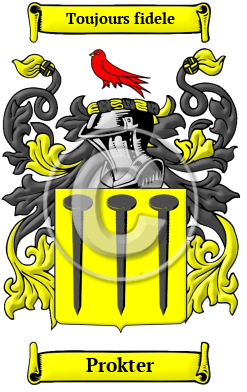
The motto was originally a war cry or slogan. Mottoes first began to be shown with arms in the 14th and 15th centuries, but were not in general use until the 17th century. Thus the oldest coats of arms generally do not include a motto. Mottoes seldom form part of the grant of arms: Under most heraldic authorities, a motto is an optional component of the coat of arms, and can be added to or changed at will; many families have chosen not to display a motto.
Motto: Toujours fidele
Motto Translation: Always faithful.
 |