| ![Show Contents]() Poor History, Family Crest & Coats of Arms Poor History, Family Crest & Coats of Arms
Etymology of PoorWhat does the name Poor mean? Poor is a name of ancient Norman origin. It arrived in England with the Norman Conquest of 1066. The Poor family lived in Devon. Their name, however, is a reference to one of two places, Picardy, France, or Puers, Belgium, either of which could have been the family's place of residence prior to the Norman Conquest of England in 1066. At this time those who hailed from Picardy were referred to as Pohiers, and it was in this form that the name was probably first brought to England. Another source notes "Poore was the equivalent not of 'pauper,' but of 'puer' or the Norman 'poer,' a knight or cadet of good family." 1 Early Origins of the Poor familyThe surname Poor was first found in Devon. However, some of the family held a family seat at Durrington in Wiltshire since early times. "The church [of Durrington] is an ancient edifice with a pulpit of richly carved oak, and several of the pews are also embellished with carving, particularly the family pew of the Poores, which has a ceiling of oak, with an escutcheon of armorial bearings." 2 Roger le Poer (died 1186), was "one of the conquerors of Ireland, belonged to a family which is said to have derived its name from Poher, one of the ancient divisions of Brittany. In the reign of Henry II, William le Poer held lands in Oxfordshire, Herefordshire, and Gloucestershire, and Robert le Poer in Oxfordshire. Roger, Robert, William, and Simon le Poer are all said to have taken part in the conquest of Ireland." 1 His son Robert le Poer (fl. 1190), was one of the marshals in the court of Henry II. About the same time, Herbert Poor or Pauper (died 1217), was Bishop of Salisbury, son of Richard of Ilchester and a few years later, his younger brother, Richard Poor, Poore, Poure or Le Poor (died 1237) was Bishop of Chichester, Salisbury, and Durham. Walter le Poher was found in Lincolnshire in 1162 and later, Hugo le Puhier was listed in the Pipe Rills for Shropshire (Salop) in 1166. Hugo Puher was found in the puipe Rolls for Worcestershire in 1170 and in Northumberland, John le Poer was listed in the Feet of Fines for 1199. In Derbyshire, Roger le Puiher was listed in the Curia Regis Rolls for 1204. 3 "Geoffrey and William Pouere, customary tenants of the Bishop of Ely at Wetheringsett (Suffolk) in 1221 (ElyA) were not likely to be Picards. In London, Henry Puer or Poer (1300 LoCt) was probably of this nationality, but whether Geoffrey le Power (1299 ib.) and John le Poer (1300 ib.) came from Picardy or were nicknamed 'the poor' cannot be determined." 3 Early History of the Poor familyThis web page shows only a small excerpt of our Poor research. Another 221 words (16 lines of text) covering the years 1100, 1172, 1217, 1237, 1580, 1640, 1702 and 1797 are included under the topic Early Poor History in all our PDF Extended History products and printed products wherever possible. Poor Spelling VariationsEndless spelling variations are a prevailing characteristic of Norman surnames. Old and Middle English lacked any definite spelling rules, and the introduction of Norman French added an unfamiliar ingredient to the English linguistic stew. French and Latin, the languages of the court, also influenced spellings. Finally, Medieval scribes generally spelled words according to how they sounded, so one person was often referred to by different spellings in different documents. The name has been spelled Poor, Poher, Poer, Poore and others. Early Notables of the Poor family- Richard Poore or Poor (died 1237), a medieval English clergyman best known for founding of Salisbury Cathedral...
- His brother was Herbert Poore or Poor (died 1217), another English clergyman who held the post of Bishop of Salisbury and Archdeacon of Canterbury...
Poor RankingIn the United States, the name Poor is the 8,797th most popular surname with an estimated 2,487 people with that name. 4 Migration of the Poor family to IrelandSome of the Poor family moved to Ireland, but this topic is not covered in this excerpt. More information about their life in Ireland is included in all our PDF Extended History products and printed products wherever possible.
| Poor migration to the United States | + |
To escape the political and religious persecution within England at the time, many English families left for the various British colonies abroad. The voyage was extremely difficult, though, and the cramped, dank ships caused many to arrive in the New World diseased and starving. But for those who made it, the trip was most often worth it. Many of the families who arrived went on to make valuable contributions to the emerging nations of Canada and the United States. An inquiry into the early roots of North American families reveals a number of immigrants bearing the name Poor or a variant listed above:
Poor Settlers in United States in the 17th Century- John Poor, who settled in New England in 1630
- Nicholas Poor, who arrived in Lynn, Massachusetts in 1637 6
- Samuel Poor, who settled in Boston in 1638
- Alice Poor, who landed in America in 1638 6
- Daniel Poor, who landed in New England in 1647 6
- ... (More are available in all our PDF Extended History products and printed products wherever possible.)
Poor Settlers in United States in the 18th Century- James Poor, who arrived in Virginia in 1711 6
- John Poor settled with his wife in Boston in 1716
- Robert Poor, who arrived in New England in 1716 6
- Margaret Poor, who arrived in Philadelphia, Pennsylvania in 1746-1747 6
- Michael Poor, who landed in Virginia in 1752 6
- ... (More are available in all our PDF Extended History products and printed products wherever possible.)
Poor Settlers in United States in the 19th Century- Thomas Poor, aged 47, who arrived in Maryland in 1813 6
- Samuel Poor, who landed in San Francisco, California in 1850 6
- J H Poor, who landed in San Francisco, California in 1850 6
| Poor migration to Canada | + |
Poor Settlers in Canada in the 19th Century- Anne Poor, who arrived in Nova Scotia in 1803
| Poor migration to Australia | + |
Emigration to Australia included the First Fleet of convicts, tradespeople and early settlers. Early immigrants include: First Fleet - Miss Ann Poor, (Power, Powell), (1766 - 1796), aged 21, British settler convicted in Kent, England in 1787, sentenced to 7 years for burglary, transported aboard the ship "Lady Juliana" leaving in 1789 arriving in New South Wales, Australia in 1790 5
Following the First Fleet, other convicts and early settlers arriving in Australia include: Poor Settlers in Australia in the 18th Century- Miss Margaret Poor, (b. 1747), aged 46, Irish convict who was convicted in Carlow, County Carlow, Ireland for 7 years, transported aboard the "Boddingtons" on 15th February 1793, arriving in New South Wales, Australia 7
- Mr. Thomas Poor, British settler who was convicted in Middlesex, England for 7 years for stealing, transported aboard the "Ganges" on 31st July 1796, arriving in New South Wales, Australia 8
Poor Settlers in Australia in the 19th Century- Miss Mary Poor, British settler who was convicted in Surrey, England for 7 years for stealing, transported aboard the "Fortune And Alexander" on 31st December 1805, arriving in New South Wales, Australia 8
- Elizabeth Poor, who arrived in Adelaide, Australia aboard the ship "Moffatt" in 1839 9
- Robert Poor, who arrived in Adelaide, Australia aboard the ship "Moffatt" in 1839 9
- Harriet Poor, who arrived in Adelaide, Australia aboard the ship "Moffatt" in 1839 9
- George Poor, who arrived in Adelaide, Australia aboard the ship "Moffatt" in 1839 9
- ... (More are available in all our PDF Extended History products and printed products wherever possible.)
| Poor migration to West Indies | + |
The British first settled the British West Indies around 1604. They made many attempts but failed in some to establish settlements on the Islands including Saint Lucia and Grenada. By 1627 they had managed to establish settlements on St. Kitts (St. Christopher) and Barbados, but by 1641 the Spanish had moved in and destroyed some of these including those at Providence Island. The British continued to expand the settlements including setting the First Federation in the British West Indies by 1674; some of the islands include Barbados, Bermuda, Cayman Island, Turks and Caicos, Jamaica and Belize then known as British Honduras. By the 1960's many of the islands became independent after the West Indies Federation which existed from 1958 to 1962 failed due to internal political conflicts. After this a number of Eastern Caribbean islands formed a free association. 10Poor Settlers in West Indies in the 17th Century- David Poor, who settled in Barbados in 1678 with his wife and daughter
Poor Settlers in West Indies in the 18th Century- Richard Poor, who landed in Antigua (Antego) in 1788 6
| Contemporary Notables of the name Poor (post 1700) | + |
- Salem Poor, American soldier in the American Revolution, honored with a US stamp in 1975
- Rear Admiral Charles Henry Poor (1808-1882), US Navy officer, Commander-in-Chief, North Atlantic Squadron (1869-1870)
- John Alfred Poor (1808-1871), American railroad entrepreneur
- Henry William Poor (1844-1915), American banker and stockbroker, son of financial analyst Henry Varnum Poor
- Henry Varnum Poor (1888-1970), American architect, painter and designer
- Henry Varnum Poor (1812-1905), American financial analyst, founder of H.W. Poor Co which later evolved into Standard and Poor's
- Enoch Poor (1736-1780), Brigadier-General in the Continental Army in the American Revolutionary War
- Edward Erie Poor (1837-1900), American banker, Vice president of the National Park Bank
- Charles Lane Poor (1866-1951), American astronomer, fellow of the Royal Astronomical Society
- ... (Another 9 notables are available in all our PDF Extended History products and printed products wherever possible.)
| Historic Events for the Poor family | + |
HMS Vanguard- Mr. Frederick Charles Poor (1877-1917), British Officers' Steward 1st Class from Devon, who was aboard the ship "HMS Vanguard" when she exploded in the Scapa Flow off the Orkney Islands, Scotland on 9th July 1917
- Mr. William Poor, Australian passenger who was lost at see when the ship "SS Koombana" sank in a tropical cyclone on 20th March 1912
- Gerald Melbourne Poor (1927-2011), American crew member on board the ship "USS Indianapolis" when she was on a top secret trip for the first nuclear weapon, she was sunk by Japanese Navy on 30th July 1945, he survived the sinking 11
The motto was originally a war cry or slogan. Mottoes first began to be shown with arms in the 14th and 15th centuries, but were not in general use until the 17th century. Thus the oldest coats of arms generally do not include a motto. Mottoes seldom form part of the grant of arms: Under most heraldic authorities, a motto is an optional component of the coat of arms, and can be added to or changed at will; many families have chosen not to display a motto.
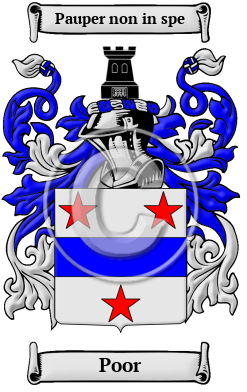
Motto: Pauper non in spe
Motto Translation: Not poor in hope.
- Smith, George (ed), Dictionary of National Biography. London: Smith, Elder & Co., 1885-1900. Print
- Lewis, Samuel, A Topographical Dictionary of England. Institute of Historical Research, 1848, Print.
- Reaney, P.H and R.M. Wilson, A Dictionary of English Surnames. London: Routledge, 1991. Print. (ISBN 0-415-05737-X)
- "What are the 5,000 Most Common Last Names in the U.S.?". NameCensus.com, https://namecensus.com/last-names/
- Convict Records of Australia. Retrieved 4th February 2021 from https://convictrecords.com.au/ships
- Filby, P. William, Meyer, Mary K., Passenger and immigration lists index : a guide to published arrival records of about 500,000 passengers who came to the United States and Canada in the seventeenth, eighteenth, and nineteenth centuries. 1982-1985 Cumulated Supplements in Four Volumes Detroit, Mich. : Gale Research Co., 1985, Print (ISBN 0-8103-1795-8)
- Convict Records Voyages to Australia (Retrieved 25th October 2020). Retrieved from https://convictrecords.com.au/ships/boddingtons
- Convict Records Voyages to Australia (Retrieved 24th October 2022). https://convictrecords.com.au
- State Records of South Australia. (Retrieved 2010, November 5) MOFFATT 1839. Retrieved from http://www.slsa.sa.gov.au/BSA/1839Moffatt.htm
- https://en.wikipedia.org/wiki/British_West_Indies
- Final Crew List, retrieved 2021, October 30th Retrieved from https://www.ussindianapolis.com/final-crew
 |