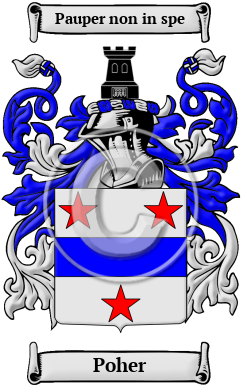
| ![Show Contents]() Poher History, Family Crest & Coats of Arms Poher History, Family Crest & Coats of Arms
Etymology of PoherWhat does the name Poher mean? The history of the Poher family name begins after the Norman Conquest of 1066. They lived in Devon. Their name, however, is a reference to one of two places, Picardy, France, or Puers, Belgium, either of which could have been the family's place of residence prior to the Norman Conquest of England in 1066. At this time those who hailed from Picardy were referred to as Pohiers, and it was in this form that the name was probably first brought to England. Another source notes "Poore was the equivalent not of 'pauper,' but of 'puer' or the Norman 'poer,' a knight or cadet of good family." 1 Early Origins of the Poher familyThe surname Poher was first found in Devon. However, some of the family held a family seat at Durrington in Wiltshire since early times. "The church [of Durrington] is an ancient edifice with a pulpit of richly carved oak, and several of the pews are also embellished with carving, particularly the family pew of the Poores, which has a ceiling of oak, with an escutcheon of armorial bearings." 2 Roger le Poer (died 1186), was "one of the conquerors of Ireland, belonged to a family which is said to have derived its name from Poher, one of the ancient divisions of Brittany. In the reign of Henry II, William le Poer held lands in Oxfordshire, Herefordshire, and Gloucestershire, and Robert le Poer in Oxfordshire. Roger, Robert, William, and Simon le Poer are all said to have taken part in the conquest of Ireland." 1 His son Robert le Poer (fl. 1190), was one of the marshals in the court of Henry II. About the same time, Herbert Poor or Pauper (died 1217), was Bishop of Salisbury, son of Richard of Ilchester and a few years later, his younger brother, Richard Poor, Poore, Poure or Le Poor (died 1237) was Bishop of Chichester, Salisbury, and Durham. Walter le Poher was found in Lincolnshire in 1162 and later, Hugo le Puhier was listed in the Pipe Rills for Shropshire (Salop) in 1166. Hugo Puher was found in the puipe Rolls for Worcestershire in 1170 and in Northumberland, John le Poer was listed in the Feet of Fines for 1199. In Derbyshire, Roger le Puiher was listed in the Curia Regis Rolls for 1204. 3 "Geoffrey and William Pouere, customary tenants of the Bishop of Ely at Wetheringsett (Suffolk) in 1221 (ElyA) were not likely to be Picards. In London, Henry Puer or Poer (1300 LoCt) was probably of this nationality, but whether Geoffrey le Power (1299 ib.) and John le Poer (1300 ib.) came from Picardy or were nicknamed 'the poor' cannot be determined." 3 Early History of the Poher familyThis web page shows only a small excerpt of our Poher research. Another 221 words (16 lines of text) covering the years 1100, 1172, 1217, 1237, 1580, 1640, 1702 and 1797 are included under the topic Early Poher History in all our PDF Extended History products and printed products wherever possible. Poher Spelling VariationsAnglo-Norman names are characterized by a multitude of spelling variations. When the Normans became the ruling people of England in the 11th century, they introduced a new language into a society where the main languages of Old and later Middle English had no definite spelling rules. These languages were more often spoken than written, so they blended freely with one another. Contributing to this mixing of tongues was the fact that medieval scribes spelled words according to sound, ensuring that a person's name would appear differently in nearly every document in which it was recorded. The name has been spelled Poor, Poher, Poer, Poore and others. Early Notables of the Poher familyRichard Poore or Poor (died 1237), a medieval English clergyman best known for founding of Salisbury Cathedral. He was probably the son of Richard of Ilchester, also known as Richard Toclive, who served as Bishop of Winchester. His brother was Herbert Poore...
Another 42 words (3 lines of text) are included under the topic Early Poher Notables in all our PDF Extended History products and printed products wherever possible. Migration of the Poher family to IrelandSome of the Poher family moved to Ireland, but this topic is not covered in this excerpt. More information about their life in Ireland is included in all our PDF Extended History products and printed products wherever possible. Migration of the Poher familyFor many English families, the political and religious disarray that plagued their homeland made the frontiers of the New World an attractive prospect. Thousands migrated, aboard cramped disease-ridden ships. They arrived sick, poor, and hungry, but were welcomed in many cases with far greater opportunity than at home in England. Many of these hardy settlers went on to make important contributions to the emerging nations in which they landed. Among early immigrants bearing the name Poher or a variant listed above were: David Poor settled in Barbados in 1678 with his wife and daughter; Samuel Poor settled in Boston in 1638; John Poor settled with his wife in Boston in 1716.
The motto was originally a war cry or slogan. Mottoes first began to be shown with arms in the 14th and 15th centuries, but were not in general use until the 17th century. Thus the oldest coats of arms generally do not include a motto. Mottoes seldom form part of the grant of arms: Under most heraldic authorities, a motto is an optional component of the coat of arms, and can be added to or changed at will; many families have chosen not to display a motto.
Motto: Pauper non in spe
Motto Translation: Not poor in hope.
- Smith, George (ed), Dictionary of National Biography. London: Smith, Elder & Co., 1885-1900. Print
- Lewis, Samuel, A Topographical Dictionary of England. Institute of Historical Research, 1848, Print.
- Reaney, P.H and R.M. Wilson, A Dictionary of English Surnames. London: Routledge, 1991. Print. (ISBN 0-415-05737-X)
 |