
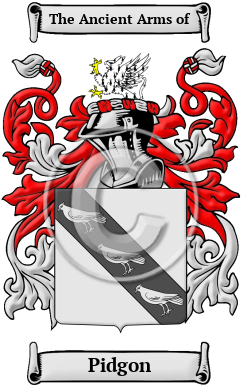
Show ContentsPidgon History, Family Crest & Coats of Arms

Etymology of Pidgon

What does the name Pidgon mean?

Pidgon is a name of ancient Norman origin. It arrived in England with the Norman Conquest of 1066. Pidgon is a name that comes from the ancient and forgotten given name Prujean. Alternatively, the name could have been a nickname derived from the Middle English word "pygeon" as "bird-names are among the most common of the nickname class of surnames. 1

Interestingly, the Magni Rotuli Scaccarii Normanniae of 1180-1195 lists John Pichon, Normandy 1180-1195. This could point to either another origin or that the name was in fact originally a Norman name. 2

Early Origins of the Pidgon family

The surname Pidgon was first found in various counties and shires throughout ancient Britain. Alan Pigun was the first record of the family and he was listed in the Curia Regis Rolls of Norfolk in 1200 and the Assize Rolls of Lancashire in 1202. Ralf Pyjun was listed in the Assise Rolls of Somerset in 1268. 3

The Hundredorum Rolls of 1273 list William Pigun in Norfolk and Richard Pigun in Cambridgeshire. 4

The Subsidy Rolls for Sussex list a wide range of phonetic variants: "Relicta Pygon, 1296; Relicta Pijohan, John Petijohan, John Pyion, John Pyion, Jopn Petiion and Thomas Pyion 1327. " 3

Early History of the Pidgon family

This web page shows only a small excerpt of our Pidgon research. Another 83 words (6 lines of text) covering the years 1593 and 1666 are included under the topic Early Pidgon History in all our PDF Extended History products and printed products wherever possible.

Pidgon Spelling Variations

Anglo-Norman names are characterized by a multitude of spelling variations. When the Normans became the ruling people of England in the 11th century, they introduced a new language into a society where the main languages of Old and later Middle English had no definite spelling rules. These languages were more often spoken than written, so they blended freely with one another. Contributing to this mixing of tongues was the fact that medieval scribes spelled words according to sound, ensuring that a person's name would appear differently in nearly every document in which it was recorded. The name has been spelled Pigeon, Pidgeon and others.

Early Notables of the Pidgon family

Another 33 words (2 lines of text) are included under the topic Early Pidgon Notables in all our PDF Extended History products and printed products wherever possible.

Migration of the Pidgon family to Ireland

Some of the Pidgon family moved to Ireland, but this topic is not covered in this excerpt. More information about their life in Ireland is included in all our PDF Extended History products and printed products wherever possible.

Migration of the Pidgon family

For many English families, the political and religious disarray that plagued their homeland made the frontiers of the New World an attractive prospect. Thousands migrated, aboard cramped disease-ridden ships. They arrived sick, poor, and hungry, but were welcomed in many cases with far greater opportunity than at home in England. Many of these hardy settlers went on to make important contributions to the emerging nations in which they landed. Among early immigrants bearing the name Pidgon or a variant listed above were: John and Mary Pidgeon settled in Virginia in 1728; Peter and John Pidgeon settled in Philadelphia in 1806; Joe Pigeon settled in Virginia in 1635.


  1. Harrison, Henry, Surnames of the United Kingdom: A Concise Etymological Dictionary Baltimore: Geneological Publishing Company, 2013. Print
  2. The Norman People and Their Existing Descendants in the British Dominions and the United States Of America. Baltimore: Genealogical Publishing, 1975. Print. (ISBN 0-8063-0636-X)
  3. Reaney, P.H and R.M. Wilson, A Dictionary of English Surnames. London: Routledge, 1991. Print. (ISBN 0-415-05737-X)
  4. Bardsley, C.W, A Dictionary of English and Welsh Surnames: With Special American Instances. Wiltshire: Heraldry Today, 1901. Print. (ISBN 0-900455-44-6)


Houseofnames.com on Facebook