
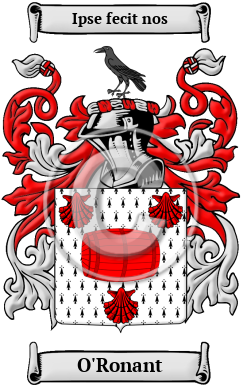
Show ContentsO'Ronant History, Family Crest & Coats of Arms

Etymology of O'Ronant

What does the name O'Ronant mean?

Hundreds of years ago, the Gaelic name used by the O'Ronant family in Ireland was Ó Ronain, which means descendant of Ronan. The popular personal name Ronan may derive from the word ron, which means a seal.

Early Origins of the O'Ronant family

The surname O'Ronant was first found in County Cork (Irish: Corcaigh) the ancient Kingdom of Deis Muin (Desmond), located on the southwest coast of Ireland in the province of Munster, where they held a family seat from very ancient times. John Ronayne is recorded in the County of Cork in the year 1139. The name is from the old Gaelic O'Roynian and they were apparently an old Munster family until the Anglo/Norman invasion of 1172, when their lands were forfeited and the family dispersed.

Early History of the O'Ronant family

This web page shows only a small excerpt of our O'Ronant research. Another 79 words (6 lines of text) covering the years 1139 and 1684 are included under the topic Early O'Ronant History in all our PDF Extended History products and printed products wherever possible.

O'Ronant Spelling Variations

The Middle Ages saw a great number of spelling variations for surnames common to the Irish landscape. One reason for these variations is the fact that surnames were not rigidly fixed by this period. The following variations for the name O'Ronant were encountered in the archives: Ronane, Ronayne, O'Ronayne, O'Ronan, Roonane, O'Roonane, Roonan, O'Roonan and many more.

Early Notables of the O'Ronant family

More information is included under the topic Early O'Ronant Notables in all our PDF Extended History products and printed products wherever possible.

Migration of the O'Ronant family

In the 19th century, thousands of Irish left their English-occupied homeland for North America. Like most new world settlers, the Irish initially settled on the eastern shores of the continent but began to move westward with the promise of owning land. The height of this Irish migration came during the Great Potato Famine of the late 1840s. With apparently nothing to lose, Irish people left on ships bound for North America and Australia. Unfortunately a great many of these passengers lost their lives - the only thing many had left - to disease, starvation, and accidents during the long and dangerous journey. Those who did safely arrive in "the land of opportunities" were often used for the hard labor of building railroads, coal mines, bridges, and canals. The Irish were critical to the quick development of the infrastructure of the United States and Canada. Passenger and immigration lists indicate that members of the O'Ronant family came to North America quite early: George Ronan who settled in Philadelphia, Pennsylvania in 1872; James Ronan settled in Philadelphia in 1836; John Ronan settled in Canada in 1840; Patrick Ronan settled in Boston Massachusetts in 1849.


The O'Ronant Motto +

The motto was originally a war cry or slogan. Mottoes first began to be shown with arms in the 14th and 15th centuries, but were not in general use until the 17th century. Thus the oldest coats of arms generally do not include a motto. Mottoes seldom form part of the grant of arms: Under most heraldic authorities, a motto is an optional component of the coat of arms, and can be added to or changed at will; many families have chosen not to display a motto.

Motto: Ipse fecit nos
Motto Translation: For he is our maker.


Houseofnames.com on Facebook