| ![Show Contents]() Molley History, Family Crest & Coats of Arms Molley History, Family Crest & Coats of Arms
- Origins Available:
Scotland
Ireland
Early Origins of the Molley familyThe surname Molley was first found in Roxburghshire, where they held a family seat as a Clan and conjecturally descended from Eustace the Sheriff of Huntingdon who held his lands of Molesworth in Huntingdon from Countess Judith a relative of Duke William of Normandy at the taking of the Domesday Book survey in 1086 A.D. A branch of this distinguished family moved north in 1124 in the train of King David of Scotland (Earl David of Huntingdon) and were granted lands in the upper half of Morebattle in Roxburghshire. Early History of the Molley familyThis web page shows only a small excerpt of our Molley research. Another 184 words (13 lines of text) covering the years 1152, 1490, 1566, 1575, 1590, 1596, 1603 and 1624 are included under the topic Early Molley History in all our PDF Extended History products and printed products wherever possible. Molley Spelling VariationsSpelling variations of this family name include: Molle, Moll, Mow, Mowe and others. Early Notables of the Molley familyMore information is included under the topic Early Molley Notables in all our PDF Extended History products and printed products wherever possible. Migration of the Molley family to IrelandSome of the Molley family moved to Ireland, but this topic is not covered in this excerpt.
Another 31 words (2 lines of text) about their life in Ireland is included in all our PDF Extended History products and printed products wherever possible.
| Molley migration to Australia | + |
Molley Settlers in Australia in the 19th Century- Sarah Molley, aged 21, a housemaid, who arrived in South Australia in 1853 aboard the ship "Epaminondas" 1
- Catherine Molley, aged 32, a domestic servant, who arrived in South Australia in 1855 aboard the ship "Aliquis"
- Mary Molley, aged 19, a domestic servant, who arrived in South Australia in 1855 aboard the ship "Aliquis"
| Molley migration to New Zealand | + |
Emigration to New Zealand followed in the footsteps of the European explorers, such as Captain Cook (1769-70): first came sealers, whalers, missionaries, and traders. By 1838, the British New Zealand Company had begun buying land from the Maori tribes, and selling it to settlers, and, after the Treaty of Waitangi in 1840, many British families set out on the arduous six month journey from Britain to Aotearoa to start a new life. Early immigrants include: Molley Settlers in New Zealand in the 19th Century- Patrick Molley, aged 26, a labourer, who arrived in Lyttelton, New Zealand aboard the ship "Siberia" in 1870
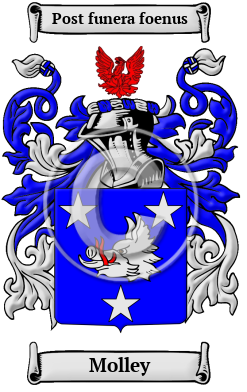
The motto was originally a war cry or slogan. Mottoes first began to be shown with arms in the 14th and 15th centuries, but were not in general use until the 17th century. Thus the oldest coats of arms generally do not include a motto. Mottoes seldom form part of the grant of arms: Under most heraldic authorities, a motto is an optional component of the coat of arms, and can be added to or changed at will; many families have chosen not to display a motto.
Motto: Post funera foenus
Motto Translation: An interest after death.
- South Australian Register Monday 26th December 1853. (Retrieved 2010, November 5) Epaminondas 1853. Retrieved http://www.theshipslist.com/ships/australia/epaminondas1853.shtml
 |