
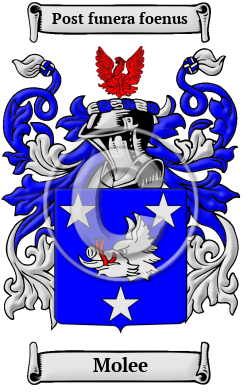
Show ContentsMolee History, Family Crest & Coats of Arms

Early Origins of the Molee family

The surname Molee was first found in Roxburghshire, where they held a family seat as a Clan and conjecturally descended from Eustace the Sheriff of Huntingdon who held his lands of Molesworth in Huntingdon from Countess Judith a relative of Duke William of Normandy at the taking of the Domesday Book survey in 1086 A.D. A branch of this distinguished family moved north in 1124 in the train of King David of Scotland (Earl David of Huntingdon) and were granted lands in the upper half of Morebattle in Roxburghshire.

Early History of the Molee family

This web page shows only a small excerpt of our Molee research. Another 184 words (13 lines of text) covering the years 1152, 1490, 1566, 1575, 1590, 1596, 1603 and 1624 are included under the topic Early Molee History in all our PDF Extended History products and printed products wherever possible.

Molee Spelling Variations

Spelling variations of this family name include: Molle, Moll, Mow, Mowe and others.

Early Notables of the Molee family

More information is included under the topic Early Molee Notables in all our PDF Extended History products and printed products wherever possible.

Migration of the Molee family to Ireland

Some of the Molee family moved to Ireland, but this topic is not covered in this excerpt.
Another 31 words (2 lines of text) about their life in Ireland is included in all our PDF Extended History products and printed products wherever possible.


Molee migration to Australia +

Emigration to Australia included the Second Fleet of convicts, tradespeople and early settlers. Early immigrants include:

Second Fleet
  • Mr. James Molee, British settler convicted in London, England in 1787, sentenced to 7 years for stealing, transported aboard the ship "Albermarle" leaving in 1790 arriving in New South Wales, Australia in 1791 1


The Molee Motto +

The motto was originally a war cry or slogan. Mottoes first began to be shown with arms in the 14th and 15th centuries, but were not in general use until the 17th century. Thus the oldest coats of arms generally do not include a motto. Mottoes seldom form part of the grant of arms: Under most heraldic authorities, a motto is an optional component of the coat of arms, and can be added to or changed at will; many families have chosen not to display a motto.

Motto: Post funera foenus
Motto Translation: An interest after death.


  1. Convict Records of Australia. Retrieved 4th February 2021 from https://convictrecords.com.au/ships


Houseofnames.com on Facebook