| ![Show Contents]() Moireach History, Family Crest & Coats of Arms Moireach History, Family Crest & Coats of Arms
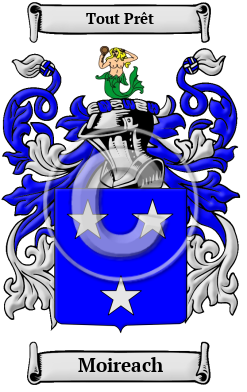
Etymology of MoireachWhat does the name Moireach mean? Moireach was first used as a surname by descendants of the Pictish people of ancient Scotland. The ancestors of the Moireach family lived in the county of Moray in the northeast of Scotland, but some historians describe the Clan's forbears as originally Flemish, some as Lowland Scots. More enlightened research places them as descendents of MacAngus de Moravia, who was descended from King Duncan of Scotland and who was the first Earl of Murray. Moireach Coat of Arms Creation In the course of time there was no heir male to succeed to the earldom; only a daughter -who married a Murray, William, the second Earl of Tullibardine. This Tullibardine was appointed Hereditary Sheriff of Perthshire in 1600 for rescuing the King at Perth from the attempt of the Earl of Gowrie; and Charles I. revived the Earldom of Atholl in the issue of this Countess of Tullibardine. Thus the original Stewart crest became the crest of the Murrays. In 1893 the name was changed from Athole to the original Atholl. There are no fewer than 63 branches of the Murrays showing their own crests and mottoes. A mermaid with a comb in her right hand and in the left a mirror is the crest of several branches, and the motto, " Tout pret" (Quite ready) Early Origins of the Moireach familyThe surname Moireach was first found in Moray, where the Clan founder, Freskin, received a grant of the lands of Strathbrock in 1100 AD. He was descended from the first Earl, and his grandson, William, married the heiress of the Bothwell Clan in Lanarkshire. His sons founded many other houses, including the Murrays of Tullibardine, who later became the Dukes of Atholl, and Chiefs of the Clan. At the same time, an early branch in the north had given origin to the Earls of Sutherland. Andrew Moray (died 1297) also known as Andrew de Moray, Andrew of Moray, or Andrew Murray, was prominent in the Scottish Wars of Independence. He led the rising in north Scotland in the summer of 1297 against the occupation by King Edward I of England. He was mortally wounded in the fighting at the Battle of Stirling Bridge. Early History of the Moireach familyThis web page shows only a small excerpt of our Moireach research. Another 596 words (43 lines of text) covering the years 1100, 1170, 1203, 1255, 1297, 1320, 1333, 1360, 1446, 1586, 1598, 1600, 1608, 1629, 1631, 1640, 1650, 1655, 1660, 1663, 1673, 1691, 1701, 1703, 1710, 1715, 1716, 1719, 1724, 1734, 1745, 1765 and 1890 are included under the topic Early Moireach History in all our PDF Extended History products and printed products wherever possible. Moireach Spelling VariationsRepeated and inaccurate translation of Scottish names from Gaelic to English and back resulted in a wide variety of spelling variations with single names. Moireach has appeared Murray, Murrey, Moray, Morey, Morrey, Morry, Murry, MacMhuirich (Gaelic) and many more. Early Notables of the Moireach familySir Robert Moray (Murrey, Murray) (1608-1673), a Scottish soldier, statesman, diplomat, judge, spy, freemason and natural philosopher; John Murray, 1st Duke of Atholl, KT, PC (1660-1724) was a Scottish nobleman, Knight of the Thistle, politician, and soldier; William Murray, 1st Earl of Dysart (c. 1600-1655), the childhood whipping boy of Charles I of England and later an adviser to the king; John Murray, 1st Marquess...
Another 65 words (5 lines of text) are included under the topic Early Moireach Notables in all our PDF Extended History products and printed products wherever possible. Migration of the Moireach family to IrelandSome of the Moireach family moved to Ireland, but this topic is not covered in this excerpt.
Another 59 words (4 lines of text) about their life in Ireland is included in all our PDF Extended History products and printed products wherever possible. Migration of the Moireach familyMany Scottish families suffered enormous hardships and were compelled to leave their country of birth. They traveled to Ireland and Australia, but mostly to the colonies of North America, where many found the freedom and opportunity they sought. It was not without a fight, though, as many were forced to stand up and defend their freedom in the American War of Independence. The ancestors of these Scots abroad have rediscovered their heritage in the last century through the Clan societies and other organizations that have sprung up across North America. Immigration and passenger ship lists show some important early immigrants bearing the name Moireach: Andrew, Anne, Archibald, Bernard, Catherine, Charles, Daniel, Denis, Edward, George, Henry, Hugh, James, John, Martin, Michael, Patrick, Peter, Robert, Thomas and William Murray who all arrived in Philadelphia between 1800 and 1870. In Newfoundland, James Murray was in possession of property and was a fisherman of St. John'.
| Contemporary Notables of the name Moireach (post 1700) | + |
- Derek Moireach, (English: Derek "Pluto" Murray), Scottish radio and television presenter
- Iain Moireach (1938-2018), (English: John Murray), a Scottish Gaelic writer from Barvas, Isle of Lewis who wrote poetry, screenplays, and short stories
The motto was originally a war cry or slogan. Mottoes first began to be shown with arms in the 14th and 15th centuries, but were not in general use until the 17th century. Thus the oldest coats of arms generally do not include a motto. Mottoes seldom form part of the grant of arms: Under most heraldic authorities, a motto is an optional component of the coat of arms, and can be added to or changed at will; many families have chosen not to display a motto.
Motto: Tout Prêt
Motto Translation: Quite ready.
 |