| ![Show Contents]() McRath History, Family Crest & Coats of Arms McRath History, Family Crest & Coats of Arms
- Origins Available:
Ireland
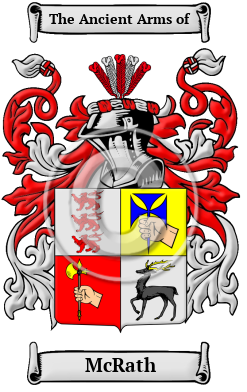
Etymology of McRathWhat does the name McRath mean? All Irish surnames have underlying meanings that can be traced back to their fullest points when the names first appeared in a Gaelic form. The name McRath originally appeared in Gaelic as Mac Graith or Mag Raith; these are both derived from the personal name Craith which literally means "to weave" and in this case is an occupational name too. The Mac or Mc prefix would denote "son of the weaver." (O'Hart) Anciently the family claim descent through O'Sullivan Mor which explains the stag (or antelope) in the fourth quarter of the shield. In turn, the O'Sullivans descend from the Heber line of Irish kings. (O'Hart) Early Origins of the McRath familyThe surname McRath was first found in County Clare (Irish: An Clár) located on the west coast of Ireland in the province of Munster, where they held a family seat from ancient times. They were the hereditary poets to the O'Briens of Thomond. The family is still found here, but present day descendants usually hail from Tipperary and Waterford. Another branch was located at Termon MacGrath on the borders of Donegal and Fermanagh. 1 The MacGraths were Chiefs in the County of Waterford since very early times. A sub-branch was located at Ballynagilty in Waterford where Philip MacGrath was the progenitor. (O'Hart) This latter branch of the family produced Thomas McGrath of Ardagh, near Youhal, co. Cork who had four sons and twelve daughters. Thomas was descended from the Ulster M'Graths of Clanaboy, who were of the race of Clan Colla and were men of influence in County Waterford. Two of the sons emigrated to the Americas: Alderman Thomas McGrath of Montreal (died 1864); and Denis MacGrath of New York (died in 1846.) (O'Hart) Early History of the McRath familyThis web page shows only a small excerpt of our McRath research. Another 87 words (6 lines of text) covering the years 1067, 1097, 1172, 1240, 1389, 1395, 1400, 1415, 1421, 1423, 1433, 1450, 1460, 1463, 1523, 1580, 1600, 1622 and 1650 are included under the topic Early McRath History in all our PDF Extended History products and printed products wherever possible. McRath Spelling VariationsThe recording of names in Ireland in the Middle Ages was an inconsistent endeavor at best. The standardized literary languages of today were not yet reached. Research into the name McRath revealed spelling variations, including MacGrath, MacGraw, MacGrauth, Magrath, Magraw and many more. Early Notables of the McRath familyMiler MacGrath (1523-1622), Archbishop of Cashel. Seán mac Ruaidhri Mac Craith (fl. 14th-century), later known as John Macrory Magrath, was an Irish historian known as the author of Caithréim Thoirdhealbhaigh.
Mathghamhain Mág Raith, was Bishop of Killaloe, (1389-1400) and Donatus Mág Raith, O.S.A., was Bishop of Killaloe (1400-1421.) Continuing this line was Thaddaeus Mág Raith I, Bishop of Killaloe (1423-1433) and Thaddaeus Mág Raith II, Bishop of Killaloe, (1460-1463.) Miler Magrath (1523?-1622), was Archbishop of Cashel.
Maolmhuire Mag Raith (Miler Magrath...
Another 80 words (6 lines of text) are included under the topic Early McRath Notables in all our PDF Extended History products and printed products wherever possible. Migration of the McRath familyIrish families began leaving their homeland for North America in the late 18th century. These families were usually modestly well off, but they were looking forward to owning and working on a sizable tract of land of their own. This pattern of emigration continued until the 1840s when the Great Potato Famine sparked a major exodus of destitute and desperate Irish people. These people were not leaving for a grant of land in North America because by this time the East Coast had reached its saturation point and free land was scarce. They were merely looking to escape the disease, starvation, and hopelessness that Ireland had fallen into. Although these unfortunate immigrants did not receive a warm welcome by the established populations in the United States and what would become Canada, they were absolutely critical to the rapid development that these two nations enjoyed. They would help populate the western lands and provide the cheap labor required for a rapid industrialization. An examination of passenger and immigration lists has revealed many early bearers of the name McRath or one of its variants: Bernard, Bridget, Charles, Denis, Edward, Henry, Hugh, James, John, Mark, Michael, Owen, Patrick, Robert, Thomas McGrath all arrived in Philadelphia between 1840 and 1860.
- MacLysaght, Edward, Irish Families Their Names, Arms and Origins 4th Edition. Dublin: Irish Academic, 1982. Print. (ISBN 0-7165-2364-7)
 |