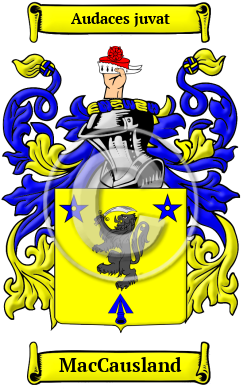
| ![Show Contents]() MacCausland History, Family Crest & Coats of Arms MacCausland History, Family Crest & Coats of Arms
Etymology of MacCauslandWhat does the name MacCausland mean? The ancient Dalriadan clans of Scotland spawned the name MacCausland. It is derived from the Gaelic form of Absolom, which means peace. Historically this name can be found in The Bible, as the name of the third son of King David, who was killed for rebellion against his father. Early Origins of the MacCausland familyThe surname MacCausland was first found in Argyllshire (Gaelic erra Ghaidheal), the region of western Scotland corresponding roughly with the ancient Kingdom of Dál Riata, in the Strathclyde region of Scotland, now part of the Council Area of Argyll and Bute, where they held a family seat from early times and their first records appeared on the early census rolls taken by the early Kings of Britain to determine the rate of taxation of their subjects. Early History of the MacCausland familyThis web page shows only a small excerpt of our MacCausland research. Another 103 words (7 lines of text) covering the years 1421, 1692, 1716, 1766 and 1890 are included under the topic Early MacCausland History in all our PDF Extended History products and printed products wherever possible. MacCausland Spelling VariationsIn the Middle Ages, the translation between Gaelic and English was not a highly developed process. Spelling was not yet standardized, and so, an enormous number of spelling variations appear in records of early Scottish names. MacCausland has appeared as MacAuslan, MacAslan, MacAsland, MacAusland, MacAuslane, Mac Auslin, MacCauslan, MacCausland, MacCauseland and many more. Early Notables of the MacCausland familyBaron Alexander MacAuslan who reputedly killed the Duke of Clarence, brother of King Henry V of England at the Battle of Beauge in Normandy in 1421.
Further to the south in Wales, William Caslon the Elder (1692-1766), the famous type-founder, was born in 1692 at Cradley, Worcestershire, near Halesowen, Shropshire. He served his apprenticeship to an ornamental engraver of gun locks and barrels...
Another 61 words (4 lines of text) are included under the topic Early MacCausland Notables in all our PDF Extended History products and printed products wherever possible. Migration of the MacCausland family to IrelandSome of the MacCausland family moved to Ireland, but this topic is not covered in this excerpt.
Another 74 words (5 lines of text) about their life in Ireland is included in all our PDF Extended History products and printed products wherever possible.
| MacCausland migration to the United States | + |
Many settled along the east coast of what would become the United States and Canada. As the American War of Independence broke out, those who remained loyal to the crown went north to Canada as United Empire Loyalists. The ancestors of all of these hardy Dalriadan-Scottish settlers began to recover their collective history in the 20th century with the advent of the vibrant culture fostered by highland games and Clan societies in North America. Highland games, Clan societies, and other organizations generated much renewed interest in Scottish heritage in the 20th century. The MacCausland were among the earliest of the Scottish settlers as immigration passenger lists have shown:
MacCausland Settlers in United States in the 18th Century- Andrew MacCausland, who settled in Philadelphia in 1773
MacCausland Settlers in United States in the 19th Century- Andrew MacCausland, who landed in New York, NY in 1816 1
- James MacCausland, who settled in Philadelphia in 1820
- Conolly, James, John, Oliver, Susannah, and William MacCausland all, who arrived in Philadelphia, Pennsylvania between 1840 and 1860
The motto was originally a war cry or slogan. Mottoes first began to be shown with arms in the 14th and 15th centuries, but were not in general use until the 17th century. Thus the oldest coats of arms generally do not include a motto. Mottoes seldom form part of the grant of arms: Under most heraldic authorities, a motto is an optional component of the coat of arms, and can be added to or changed at will; many families have chosen not to display a motto.
Motto: Audaces juvat
Motto Translation: Fortune favours the bold.
- Filby, P. William, Meyer, Mary K., Passenger and immigration lists index : a guide to published arrival records of about 500,000 passengers who came to the United States and Canada in the seventeenth, eighteenth, and nineteenth centuries. 1982-1985 Cumulated Supplements in Four Volumes Detroit, Mich. : Gale Research Co., 1985, Print (ISBN 0-8103-1795-8)
 |