
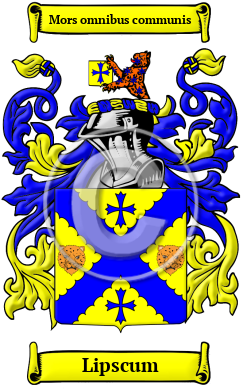
Show ContentsLipscum History, Family Crest & Coats of Arms

Etymology of Lipscum

What does the name Lipscum mean?

The ancient roots of the Lipscum family name are in the Anglo-Saxon culture. The name Lipscum comes from when the family lived in the region of Luscombe in the counties of Devon, Dorset, and Cornwall. Lipscum is a topographic surname, which was given to a person who resided near a physical feature such as a hill, stream, church, or type of tree. Habitation names form the other broad category of surnames that were derived from place-names. They were derived from pre-existing names for towns, villages, parishes, or farmsteads. Other local names are derived from the names of houses, manors, estates, regions, and entire counties.

Early Origins of the Lipscum family

The surname Lipscum was first found in Devon where they held a family seat from early times and their first records appeared on the early census rolls taken by the early Kings of Britain to determine the rate of taxation of their subjects.

Early History of the Lipscum family

This web page shows only a small excerpt of our Lipscum research. Another 81 words (6 lines of text) are included under the topic Early Lipscum History in all our PDF Extended History products and printed products wherever possible.

Lipscum Spelling Variations

One relatively recent invention that did much to standardize English spelling was the printing press. However, before its invention even the most literate people recorded their names according to sound rather than spelling. The spelling variations under which the name Lipscum has appeared include Luscombe, Luscomb, Lustcomb, Liscomb, Listcomb and others.

Early Notables of the Lipscum family

More information is included under the topic Early Lipscum Notables in all our PDF Extended History products and printed products wherever possible.

Migration of the Lipscum family to Ireland

Some of the Lipscum family moved to Ireland, but this topic is not covered in this excerpt. More information about their life in Ireland is included in all our PDF Extended History products and printed products wherever possible.

Migration of the Lipscum family

At this time, the shores of the New World beckoned many English families that felt that the social climate in England was oppressive and lacked opportunity for change. Thousands left England at great expense in ships that were overcrowded and full of disease. A great portion of these settlers never survived the journey and even a greater number arrived sick, starving, and without a penny. The survivors, however, were often greeted with greater opportunity than they could have experienced back home. These English settlers made significant contributions to those colonies that would eventually become the United States and Canada. An examination of early immigration records and passenger ship lists revealed that people bearing the name Lipscum arrived in North America very early: John Luscombe settled in Barbados in 1654; William Luscombe settled in Maryland in 1774; the family also settled in Newfoundland between 1701 and 1881..


The Lipscum Motto +

The motto was originally a war cry or slogan. Mottoes first began to be shown with arms in the 14th and 15th centuries, but were not in general use until the 17th century. Thus the oldest coats of arms generally do not include a motto. Mottoes seldom form part of the grant of arms: Under most heraldic authorities, a motto is an optional component of the coat of arms, and can be added to or changed at will; many families have chosen not to display a motto.

Motto: Mors omnibus communis
Motto Translation: Death is common to all men.


Houseofnames.com on Facebook