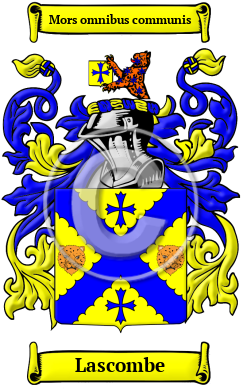
| ![Show Contents]() Lascombe History, Family Crest & Coats of Arms Lascombe History, Family Crest & Coats of Arms
Etymology of LascombeWhat does the name Lascombe mean? The ancient history of the Lascombe name begins with the ancient Anglo-Saxon tribes of Britain. The name is derived from when the family resided in the region of Luscombe in the counties of Devon, Dorset, and Cornwall. Lascombe is a topographic surname, which was given to a person who resided near a physical feature such as a hill, stream, church, or type of tree. Habitation names form the other broad category of surnames that were derived from place-names. They were derived from pre-existing names for towns, villages, parishes, or farmsteads. Other local names are derived from the names of houses, manors, estates, regions, and entire counties. Early Origins of the Lascombe familyThe surname Lascombe was first found in Devon where they held a family seat from early times and their first records appeared on the early census rolls taken by the early Kings of Britain to determine the rate of taxation of their subjects. Early History of the Lascombe familyThis web page shows only a small excerpt of our Lascombe research. Another 81 words (6 lines of text) are included under the topic Early Lascombe History in all our PDF Extended History products and printed products wherever possible. Lascombe Spelling VariationsUntil quite recently, the English language has lacked a definite system of spelling rules. Consequently, Anglo-Saxon surnames are characterized by a multitude of spelling variations. Changes in Anglo-Saxon names were influenced by the evolution of the English language, as it incorporated elements of French, Latin, and other languages. Although Medieval scribes and church officials recorded names as they sounded, so it is common to find one person referred to by several different spellings of his surname, even the most literate people varied the spelling of their own names. Variations of the name Lascombe include Luscombe, Luscomb, Lustcomb, Liscomb, Listcomb and others. Early Notables of the Lascombe familyMore information is included under the topic Early Lascombe Notables in all our PDF Extended History products and printed products wherever possible. Migration of the Lascombe family to IrelandSome of the Lascombe family moved to Ireland, but this topic is not covered in this excerpt. More information about their life in Ireland is included in all our PDF Extended History products and printed products wherever possible.
| Lascombe migration to New Zealand | + |
Emigration to New Zealand followed in the footsteps of the European explorers, such as Captain Cook (1769-70): first came sealers, whalers, missionaries, and traders. By 1838, the British New Zealand Company had begun buying land from the Maori tribes, and selling it to settlers, and, after the Treaty of Waitangi in 1840, many British families set out on the arduous six month journey from Britain to Aotearoa to start a new life. Early immigrants include: Lascombe Settlers in New Zealand in the 19th Century- Mr. William Lascombe, (b. 1844), aged 18, British farm labourer travelling from London aboard the ship "Echunga" arriving in Lyttelton, Canterbury, New Zealand on 24th December 1862 1
- Mr. William Lascombe, (b. 1853), aged 18, English farm labourer from Devon, England, travelling from Gravesend aboard the ship 'Merope' arriving in Lyttelton, Christchurch, South Island, New Zealand on 25th August 1871 1
The motto was originally a war cry or slogan. Mottoes first began to be shown with arms in the 14th and 15th centuries, but were not in general use until the 17th century. Thus the oldest coats of arms generally do not include a motto. Mottoes seldom form part of the grant of arms: Under most heraldic authorities, a motto is an optional component of the coat of arms, and can be added to or changed at will; many families have chosen not to display a motto.
Motto: Mors omnibus communis
Motto Translation: Death is common to all men.
- New Zealand Yesteryears Passenger Lists 1800 to 1900 (Retrieved 17th October 2018). Retrieved from http://www.yesteryears.co.nz/shipping/passlist.html
 |