| ![Show Contents]() Lambes History, Family Crest & Coats of Arms Lambes History, Family Crest & Coats of Arms
Etymology of LambesWhat does the name Lambes mean? The name Lambes is rooted in the ancient Anglo-Saxon culture. It was a name for someone who was a gentle-hearted person. The surname Lambes originally derived from a broad and miscellaneous class of surnames. As a nickname surname it could refer either directly or indirectly to a characteristic of the first person who used the name. They can describe the bearer's favored style of clothing, appearance, habits, or character. Another source claims that "the name was probably taken from the sign of a lamb at an inn, the young of the sheep kind." 1 And yet another source claims that the name was a baptismal name as in " 'the son of Lambert,' from Lamb the nickname." 2 3 Early Origins of the Lambes familyThe surname Lambes was first found in Northumberland where they were Lords of the manor of West Denton; although, the earliest recorded record of this surname found was of Edward, Wulmar Lamb, who was listed in the Pipe Rolls of Kent in 1195. 3 The name was "pretty well dispersed over England, except in the south coast counties from Devon to Kent. At present it is most numerous in the north of England, in the counties of Northumberland and Durham." 4 Other early records of the family include listings as they appeared in the Hundredorum Rolls of 1273: William le Lambe, Cambridgeshire; Richard le Lam, Northamptonshire; and Ingrida Lomb, Huntingdonshire. 2 Early History of the Lambes familyThis web page shows only a small excerpt of our Lambes research. Another 103 words (7 lines of text) covering the years 1296, 1450, 1504, 1545, 1628, 1715 and 1890 are included under the topic Early Lambes History in all our PDF Extended History products and printed products wherever possible. Lambes Spelling VariationsLambes has been spelled many different ways. Before English spelling became standardized over the last few hundred years, spelling variations in names were a common occurrence. As the English language changed in the Middle Ages, absorbing pieces of Latin and French, as well as other languages, the spelling of people's names also changed considerably, even over a single lifetime. Many variations of the name Lambes have been found, including Lamb, Lambe, Lam and others. Early Notables of the Lambes familyWalter Lambe (1450-1504), an English composer, many of his works appear in the Eton Chioirbook; Benjamin Lamb (fl. 1715), an English organist of Eton College and verger of St. George's Chapel, Windsor, c. 1715; and John Lambe (or Lamb) (c.1545-1628), English astrologer who served George Villiers, 1st Duke of Buckingham...
Another 49 words (4 lines of text) are included under the topic Early Lambes Notables in all our PDF Extended History products and printed products wherever possible. Migration of the Lambes family to IrelandSome of the Lambes family moved to Ireland, but this topic is not covered in this excerpt.
Another 61 words (4 lines of text) about their life in Ireland is included in all our PDF Extended History products and printed products wherever possible. Migration of the Lambes familyIn an attempt to escape the chaos experienced in England, many English families boarded overcrowded and diseased ships sailing for the shores of North America and other British colonies. Those families hardy enough, and lucky enough, to make the passage intact were rewarded with land and a social environment less prone to religious and political persecution. Many of these families became important contributors to the young colonies in which they settled. Early immigration and passenger lists have documented some of the first Lambess to arrive on North American shores: John, Edward, and Elizabeth Lamb settled in Salem, Massachusetts in 1630; Nancy and Nellie Lamb settled in Boston Massachusetts in 1736; John Lamb settled in Nova Scotia in 1774.
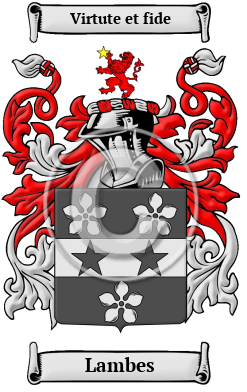
The motto was originally a war cry or slogan. Mottoes first began to be shown with arms in the 14th and 15th centuries, but were not in general use until the 17th century. Thus the oldest coats of arms generally do not include a motto. Mottoes seldom form part of the grant of arms: Under most heraldic authorities, a motto is an optional component of the coat of arms, and can be added to or changed at will; many families have chosen not to display a motto.
Motto: Virtute et fide
Motto Translation: By valour and faith.
- Arthur, William , An Etymological Dictionary of Family and Christian Names. London: 1857. Print
- Bardsley, C.W, A Dictionary of English and Welsh Surnames: With Special American Instances. Wiltshire: Heraldry Today, 1901. Print. (ISBN 0-900455-44-6)
- Reaney, P.H and R.M. Wilson, A Dictionary of English Surnames. London: Routledge, 1991. Print. (ISBN 0-415-05737-X)
- Guppy, Henry Brougham, Homes of Family Names in Great Britain. 1890. Print.
 |