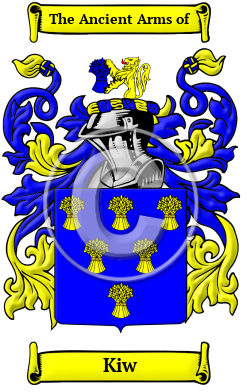
| ![Show Contents]() Kiw History, Family Crest & Coats of Arms Kiw History, Family Crest & Coats of Arms
Etymology of KiwWhat does the name Kiw mean? The name Kiw is part of the ancient legacy of the Anglo-Saxon tribes of Britain. The name was taken on by someone who worked as a person who worked as the cook. The surname was originally derived from the Old French terms queu, keu, kieu, cu, which denoted the cook or someone who operated an eating house. 1 The present-day French forms are Le Queu and Le Queux. 2 Early Origins of the Kiw familyThe surname Kiw was first found in Norfolk, England where Roger le Cu was recorded in the Feet of Fines for 1196. Later in Leicestershire, William Kue was found in the Pipe Rolls for 1203 and William le Keu was listed in the Feet of Fines for Cheshire in 1231. Over the Lancashire, we found Hugh le Kew listed in the Assize Rolls for 1246. 1 The Hundredorum Rolls of 1273 include the following entries: Nicholas le Keu, Nottinghamshire; and Walter le Keu, Oxfordshire, while the Writs of Parliament lists William le Keu, 1301; William Cocus, 1302; and William le Keu, or Cocus, 1306. 3 In Scotland, the name has similar origins, specifically from the occupation of "cook," from Latin coquus. "John le Keu, a Scots prisoner taken at the capture of Dunbar Castle, was sent to Montgomery Castle in 1296. William le Keu of Knolle in the county of Lanark and Richard le Keu of the county of Fife, rendered homage for their lands in the same year, and Cristin le Cu of Stratherne was a Scots prisoner in Carlisle Castle in 1305. The seal of William of Knolle bears a raven and S' Will' Cod de Knol. Hugh Kew de Den was a notary public in Aberdeen in 1451. 4 Early History of the Kiw familyThis web page shows only a small excerpt of our Kiw research. Another 147 words (10 lines of text) covering the years 1150, 1296, 1305, 1688 and 1809 are included under the topic Early Kiw History in all our PDF Extended History products and printed products wherever possible. Kiw Spelling VariationsBefore English spelling was standardized a few hundred years ago, spelling variations of names were a common occurrence. Elements of Latin, French and other languages became incorporated into English through the Middle Ages, and name spellings changed even among the literate. The variations of the surname Kiw include Kew, Kiew, Keu, le Keu, Cocus and others. Early Notables of the Kiw familyMore information is included under the topic Early Kiw Notables in all our PDF Extended History products and printed products wherever possible. Migration of the Kiw familyA great wave of immigration to the New World was the result of the enormous political and religious disarray that struck England at that time. Families left for the New World in extremely large numbers. The long journey was the end of many immigrants and many more arrived sick and starving. Still, those who made it were rewarded with an opportunity far greater than they had known at home in England. These emigrant families went on to make significant contributions to these emerging colonies in which they settled. Some of the first North American settlers carried this name or one of its variants: Anne Kew with her husband and servants settled in Barbados in 1680; Robert Kew settled in Virginia in 1663; Nicholas Kew settled in Antigua in 1679.
- Reaney, P.H and R.M. Wilson, A Dictionary of English Surnames. London: Routledge, 1991. Print. (ISBN 0-415-05737-X)
- Harrison, Henry, Surnames of the United Kingdom: A Concise Etymological Dictionary Baltimore: Geneological Publishing Company, 2013. Print
- Bardsley, C.W, A Dictionary of English and Welsh Surnames: With Special American Instances. Wiltshire: Heraldry Today, 1901. Print. (ISBN 0-900455-44-6)
- Black, George F., The Surnames of Scotland Their Origin, Meaning and History. New York: New York Public Library, 1946. Print. (ISBN 0-87104-172-3)
 |