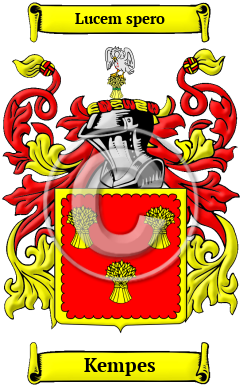
| ![Show Contents]() Kempes History, Family Crest & Coats of Arms Kempes History, Family Crest & Coats of Arms
Etymology of KempesWhat does the name Kempes mean? Kempes is a name of ancient Norman origin. It arrived in England with the Norman Conquest of 1066. It is a name for a champion at jousting or wrestling. In medieval England, the joust was used to train feudal knights for battle. Checking further we found the name was derived from the Middle English word kempe, which is a derivative of the Old English word cempa, which means warrior or champion. 1 Early Origins of the Kempes familyThe surname Kempes was first found in Wiltshire, where one of the first records of the name was Eadulf Cempa in 902. Years later, Edmund Kempe was listed in Norfolk c. 1100 and Ralph le Kemp was listed in the Subsidy Rolls of 1296 in Sussex. 1 The Hundredorum Rolls of 1273 list Alan Kempe in Suffolk and William Kempe in Oxfordshire. The Yorkshire Poll Tax Rolls of 1379 list Ricardus Kempe and Johannes Kempe. 2 The parish of Slindon in Sussex was of great significance to the family. "Slindon House, the seat of the Countess Dowager of Newburgh, was originally built by one of the archbishops of Canterbury, and was for some time the residence of the celebrated Archbishop Langton, who died here in the reign of Henry III.; the present mansion, erected by Sir George Kemp in the reign of Elizabeth, is a handsome structure, on a bold eminence." 3 The parish of Wye in Kent was another ancient family seat. "The church was rebuilt by John Kemp, a native of the parish, who was first preferred to the bishopric of Rochester, and, having successively presided over several other sees, was lastly translated to the archbishopric of Canterbury and made cardinal. In 1447, he founded a college here for a master, or provost, and Secular canons, dedicated to St. Gregory and St. Martin. Olantigh, in the parish, was formerly the seat of the family of Kemp, and is supposed to have been the birthplace of Archbishop Kemp, and also of his nephew, Thomas Kemp, Bishop of London." 3 In the far south in the parish of St. Ewe in Cornwall, another branch of the family was found. "What now remains of Trevithick is turned into a farm house, and is the property of Arthur Kempe, Esq. admiral of the blue." 4 Early History of the Kempes familyThis web page shows only a small excerpt of our Kempes research. Another 149 words (11 lines of text) covering the years 1373, 1380, 1438, 1450, 1454, 1594, 1599, 1780 and 1890 are included under the topic Early Kempes History in all our PDF Extended History products and printed products wherever possible. Kempes Spelling VariationsA multitude of spelling variations characterize Norman surnames. Many variations occurred because Old and Middle English lacked any definite spelling rules. The introduction of Norman French to England also had a pronounced effect, as did the court languages of Latin and French. Therefore, one person was often referred to by several different spellings in a single lifetime. The various spellings include Kemp, Kempe and others. Early Notables of the Kempes familyCardinal John Kemp (c.1380-1454), Archbishop of Canterbury, and Lord Chancellor of England; Will Kemp who was an actor with the Lord Chamberlain's Men from 1594 to 1599, and was listed as one of the principal actors in the First Folio (first...
Another 40 words (3 lines of text) are included under the topic Early Kempes Notables in all our PDF Extended History products and printed products wherever possible. Migration of the Kempes family to IrelandSome of the Kempes family moved to Ireland, but this topic is not covered in this excerpt.
Another 50 words (4 lines of text) about their life in Ireland is included in all our PDF Extended History products and printed products wherever possible. Migration of the Kempes familyMany English families left England, to avoid the chaos of their homeland and migrated to the many British colonies abroad. Although the conditions on the ships were extremely cramped, and some travelers arrived diseased, starving, and destitute, once in the colonies, many of the families prospered and made valuable contributions to the cultures of what would become the United States and Canada. Research into the origins of individual families in North America has revealed records of the immigration of a number of people bearing the name Kempes or a variant listed above: Edmund Kemp settled in Virginia in 1653; Evan Kemp settled in Virginia in 1637; Humfrey Kemp settled in Bermuda in 1635; Thomas Kemp settled in Virginia in 1636 along with William.
The motto was originally a war cry or slogan. Mottoes first began to be shown with arms in the 14th and 15th centuries, but were not in general use until the 17th century. Thus the oldest coats of arms generally do not include a motto. Mottoes seldom form part of the grant of arms: Under most heraldic authorities, a motto is an optional component of the coat of arms, and can be added to or changed at will; many families have chosen not to display a motto.
Motto: Lucem spero
Motto Translation: I hope for light.
- Reaney, P.H and R.M. Wilson, A Dictionary of English Surnames. London: Routledge, 1991. Print. (ISBN 0-415-05737-X)
- Bardsley, C.W, A Dictionary of English and Welsh Surnames: With Special American Instances. Wiltshire: Heraldry Today, 1901. Print. (ISBN 0-900455-44-6)
- Lewis, Samuel, A Topographical Dictionary of England. Institute of Historical Research, 1848, Print.
- Hutchins, Fortescue, The History of Cornwall, from the Earliest Records and Traditions to the Present Time. London: William Penaluna, 1824. Print
 |