| ![Show Contents]() Hunters History, Family Crest & Coats of Arms Hunters History, Family Crest & Coats of Arms
- Origins Available:
Scotland
Ireland
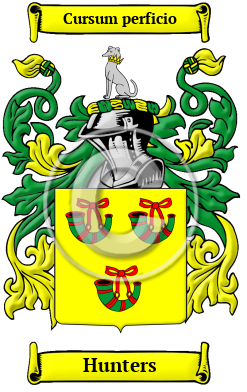
Etymology of HuntersWhat does the name Hunters mean? The name Hunters comes from the ancient Scottish kingdom of Dalriada, where it was used to indicate someone who worked as a hunter or someone involved in the chase.This name is derived the Latin word venator. 1 2 Early Origins of the Hunters familyThe surname Hunters was first found in Ayrshire (Gaelic: Siorrachd Inbhir Àir), formerly a county in the southwestern Strathclyde region of Scotland, that today makes up the Council Areas of South, East, and North Ayrshire. But while Scottish history places them in this area, we must remember that before the 5th century this Clan, held a family seat at Hy Seaain counties Derry and Tyrone, in Ireland, and were chiefs who calimes descent from King Colla da Crioch. Moving to Scotland about the 5th or 6th century they were granted lands by the Grahams at Polmood. "William venator, who was one of the witnesses to the Inquisition of Earl David, before 1124, is apparently the first of the name recorded in Scotland. Yone Venatore was one of the witnesses to a Beauly charter of 1231. Adam Hunter was granted the hereditary office of sergeantry in all causes touching life and limb throughout the abbey land of Crauford belonging to the Abbey of Newbattle before 1259. John the hunter (venator) was one of the jurors on an inquisition made on the lands of Hopkelchoc (now Kailzie) in 1259." 3 "The family have been seated at Hunterston in Ayrshire since the time of Alexander II. They bear three hunting horns vert in their arms, whence probably the name." 4 "The Normans were great preservers and mighty hunters of game, and though the name is Anglo-Saxon (hunta) it is generally considered that the families bearing it are chiefly of Norman origin. Under the Norman and early Scottish kings the office of king's hunter ( Venator Regis) was one of considerable dignity. "The hunters of Polmood in Tweedsmuir pretend to have had a charter of their lands from Graeme, who broke through the Wall of Antoninus in the V. century." 5 Early History of the Hunters familyThis web page shows only a small excerpt of our Hunters research. Another 285 words (20 lines of text) covering the years 1124, 1296, 1327, 1328, 1375, 1376, 1547, 1555, 1664, 1666, 1675, 1684, 1701, 1702, 1710, 1718, 1720, 1725, 1728, 1729, 1733, 1734, 1737, 1741, 1742, 1745, 1750, 1753, 1757, 1763, 1771, 1775, 1777, 1780, 1783, 1790, 1793, 1795, 1800, 1809, 1821, 1835, 1837, 1846, 1890 and 1905 are included under the topic Early Hunters History in all our PDF Extended History products and printed products wherever possible. Hunters Spelling VariationsSince medieval scribes still spelled according to sound, records from that era contain an enormous number of spelling variations. In various documents Hunters has been spelled Hunter, Hunters and others. Early Notables of the Hunters family- General Robert Hunter (1664-1734), the colonial Governor of New York and New Jersey from 1710 to 1720, he belonged to the family of Hunter of Hunterston, Ayrshire
Migration of the Hunters family to IrelandSome of the Hunters family moved to Ireland, but this topic is not covered in this excerpt.
Another 107 words (8 lines of text) about their life in Ireland is included in all our PDF Extended History products and printed products wherever possible. Migration of the Hunters familyDescendents of Dalriadan-Scottish families still populate many communities across North America. They are particularly common in Canada, since many went north as United Empire Loyalists at the time of the American War of Independence. Much later, in the late 19th and early 20th centuries, the highland games and Clan societies that now dot North America sprang up, allowing many Scots to recover their lost national heritage. Some of the first immigrants to cross the Atlantic and come to North America bore the name Hunters, or a variant listed above: Elizabeth and Francis Hunter arrived in Virginia in 1635; James Hunter settled in Virginia in 1653; Jonathon Hunter with his wife and servants settled in Barbados in 1680.
The motto was originally a war cry or slogan. Mottoes first began to be shown with arms in the 14th and 15th centuries, but were not in general use until the 17th century. Thus the oldest coats of arms generally do not include a motto. Mottoes seldom form part of the grant of arms: Under most heraldic authorities, a motto is an optional component of the coat of arms, and can be added to or changed at will; many families have chosen not to display a motto.
Motto: Cursum perficio
Motto Translation: I accomplish the race.
- Smith, Eldson Coles, New Dictionary of American Family Names New York: Harper & Row, 1956. Print
- Harrison, Henry, Surnames of the United Kingdom: A Concise Etymological Dictionary Baltimore: Geneological Publishing Company, 2013. Print
- Black, George F., The Surnames of Scotland Their Origin, Meaning and History. New York: New York Public Library, 1946. Print. (ISBN 0-87104-172-3)
- Sims, Clifford Stanley The Origin and Signification of Scottish Surnames. 1862. Print.
- Lower, Mark Anthony, Patronymica Britannica, A Dictionary of Family Names of the United Kingdom. London: John Russel Smith, 1860. Print.
 |