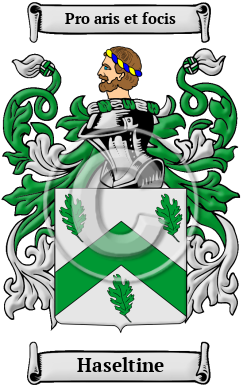
| ![Show Contents]() Haseltine History, Family Crest & Coats of Arms Haseltine History, Family Crest & Coats of Arms
Etymology of HaseltineWhat does the name Haseltine mean? The Anglo-Saxon name Haseltine comes from the family having resided in one of a variety of similarly-named places. The parishes of Cold Hesleton (Hesleden) and Monk Hesleton (Hesleden) are in Durham. Both date back to Saxon times when they were collectively known as Heseldene c. 1050 and literally meant "valley where hazels grow." 1 Haslingden in Lancashire dates back to 1241 when it was known as Heselingedon and meant "valley where hazels grow." 1 Hazeldon Farm is in Wiltshire, and Hazelton is in Gloucestershire. The surname Haseltine belongs to the large category of Anglo-Saxon habitation names, which are derived from pre-existing names for towns, villages, parishes, or farmsteads. Early Origins of the Haseltine familyThe surname Haseltine was first found in Sussex at ancient manor in or near Dallington. 2 The name is derived from the Old English words hoesel + denu, which mean "Hazel" + "valley." 3 Hazleton Abbey was an abbey in Gloucestershire. Early rolls revealed Robert de Heseldene in the Assize Rolls for Surham in 1243; Alexander de Haselinden in Kirkstal, Yorkshire in 1258; Reginald de Haselden in the Hundredorum Rolls for Warwickshire in 1275; and William de Heseldenn in the Subsidy Rolls for Sussexin in 1296. 4 In Somerset, early records there found: William de Haseldin; and Adam Haseldene, both listed 1, Edward III (during the first year of King Edward III's reign.) 5 The Yorkshire Poll Tax Rolls of 1379 included: Willelmus de Hesledyn; and Jeppe de Hesilden as both hold lands there at that time. 6 Early History of the Haseltine familyThis web page shows only a small excerpt of our Haseltine research. Another 66 words (5 lines of text) covering the years 1595, 1690, 1710, 1740 and 1763 are included under the topic Early Haseltine History in all our PDF Extended History products and printed products wherever possible. Haseltine Spelling VariationsHaseltine has been spelled many different ways. Before English spelling became standardized over the last few hundred years, spelling variations in names were a common occurrence. As the English language changed in the Middle Ages, absorbing pieces of Latin and French, as well as other languages, the spelling of people's names also changed considerably, even over a single lifetime. Spelling variants included: Hazeltine, Hazelton, Hazletine, Hasleden, Hazleton, Haseltine, Haselton, Hasletine, Haslett, Aseltine and many more. Early Notables of the Haseltine familyThomas Haselden (d. 1740), English mathematician who was for some time schoolmaster at Wapping Old Stairs, and afterwards 'head-master of the Royal Academy at Portsmouth.' 7 Richard Hasleton (fl. 1595), was an English traveller who has related his travels in the very scarce 'Strange and wonderful things happened to Rd. Hasleton, borne at Braintree in Essex, in his ten yeares travailes in...
Another 61 words (4 lines of text) are included under the topic Early Haseltine Notables in all our PDF Extended History products and printed products wherever possible. Migration of the Haseltine family to IrelandSome of the Haseltine family moved to Ireland, but this topic is not covered in this excerpt.
Another 41 words (3 lines of text) about their life in Ireland is included in all our PDF Extended History products and printed products wherever possible.
| Haseltine migration to the United States | + |
In an attempt to escape the chaos experienced in England, many English families boarded overcrowded and diseased ships sailing for the shores of North America and other British colonies. Those families hardy enough, and lucky enough, to make the passage intact were rewarded with land and a social environment less prone to religious and political persecution. Many of these families became important contributors to the young colonies in which they settled. Early immigration and passenger lists have documented some of the first Haseltines to arrive on North American shores:
Haseltine Settlers in United States in the 17th Century- Mr. John Haseltine, (b. 1612), aged 26, British settler traveling aboard the ship "John of London" arriving in Boston, Massachuetts in 1638 8
- Mr. Robert Haseltine, (b. 1600), aged 38, British settler traveling aboard the ship "John of London" arriving in Boston, Massachuetts in 1638 8
| Haseltine migration to Canada | + |
Haseltine Settlers in Canada in the 18th Century- Paul Haseltine, who landed in Anapolis (Annapolis), Nova Scotia in 1760
| Contemporary Notables of the name Haseltine (post 1700) | + |
- Mara G. Haseltine (b. 1971), American artist and environmental activist
- William Stanley Haseltine (1835-1900), American painter and draftsman
- William A. Haseltine (b. 1944), American biologist and entrepreneur
- Herbert Haseltine (1877-1962), Italian-born French/American animalier sculptor associated with the Düsseldorf school of painting
- Florence Pat Haseltine (b. 1942), American physician, biophysicist, reproductive endocrinologist, journal editor, novelist, inventor, and advocate for women's health
- Eric Haseltine (b. 1951), American technologist, Chairman of the Board of the US Technology Leadership Council (USTLC)
- Dan Haseltine (b. 1973), American singer, best known as lead vocalist for Christian alternative folk rock group Jars of Clay
- William A. Haseltine (b. 1944), American scientist, businessman, author, and philanthropist, best known for his work on HIV/AIDS and the human genome
- S. E. Haseltine, American politician, Mayor of Selma, California, 1953-54 9
The motto was originally a war cry or slogan. Mottoes first began to be shown with arms in the 14th and 15th centuries, but were not in general use until the 17th century. Thus the oldest coats of arms generally do not include a motto. Mottoes seldom form part of the grant of arms: Under most heraldic authorities, a motto is an optional component of the coat of arms, and can be added to or changed at will; many families have chosen not to display a motto.
Motto: Pro aris et focis
Motto Translation: For our altars and our homes
- Mills, A.D., Dictionary of English Place-Names. Oxford: Oxford University Press, 1991. Print. (ISBN 0-19-869156-4)
- Lower, Mark Anthony, Patronymica Britannica, A Dictionary of Family Names of the United Kingdom. London: John Russel Smith, 1860. Print.
- Hanks, Patricia and Flavia Hodges, A Dictionary of Surnames. Oxford: Oxford University Press, 1988. Print. (ISBN 0-19-211592-8)
- Reaney, P.H and R.M. Wilson, A Dictionary of English Surnames. London: Routledge, 1991. Print. (ISBN 0-415-05737-X)
- Dickinson, F.H., Kirby's Quest for Somerset of 16th of Edward the 3rd London: Harrison and Sons, Printers in Ordinary to Her Majesty, St, Martin's Lane, 1889. Print.
- Bardsley, C.W, A Dictionary of English and Welsh Surnames: With Special American Instances. Wiltshire: Heraldry Today, 1901. Print. (ISBN 0-900455-44-6)
- Smith, George (ed), Dictionary of National Biography. London: Smith, Elder & Co., 1885-1900. Print
- Pilgrim Ship's of 1600's. Retrieved October 6th 2021 from https://www.packrat-pro.com/ships/shiplist.htm
- The Political Graveyard: Alphabetical Name Index. (Retrieved 2015, November 3) . Retrieved from http://politicalgraveyard.com/alpha/index.html
 |