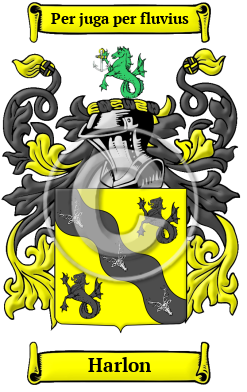
| ![Show Contents]() Harlon History, Family Crest & Coats of Arms Harlon History, Family Crest & Coats of Arms
Etymology of HarlonWhat does the name Harlon mean? Harlon is a name whose history is connected to the ancient Anglo-Saxon tribes of Britain. The name is derived from when the Harlon family once lived in the village of Horlands, that can be traced to numerous places round England, including Harland Edge in Derbyshire and Harland Wood in Sussex. This surname was originally derived from the Old English words har and land, which means that the original bearers of the surname lived in the land that was infested with hares. Early Origins of the Harlon familyThe surname Harlon was first found in Middlesex where they held a family seat from very ancient times, some say well before the Norman Conquest and the arrival of Duke William at Hastings in 1066 A.D. Early History of the Harlon familyThis web page shows only a small excerpt of our Harlon research. Another 89 words (6 lines of text) covering the years 1208, 1235, 1330, 1384, 1411, 1425, 1459, 1500 and 1664 are included under the topic Early Harlon History in all our PDF Extended History products and printed products wherever possible. Harlon Spelling VariationsSound was what guided spelling in the essentially pre-literate Middle Ages, so one person's name was often recorded under several variations during a single lifetime. Also, before the advent of the printing press and the first dictionaries, the English language was not standardized. Therefore, spelling variations were common, even among the names of the most literate people. Known variations of the Harlon family name include Harland, Hoarland, Hoareland, Hoorland, Hooreland, Horland, Horlands, Harlin, Harlind and many more. Early Notables of the Harlon familyHugh Herland (1330-1411), a 14th-century medieval English carpenter, the chief carpenter to King Richard II, best known pieces is the hammer-beam roof at Westminster Hall, regarded as one of the greatest carpentry achievements of the time, worked for William of Wykeham at New College, Oxford (c. 1384), commissioned by royalty to work on some of the major architecture of the time...
Another 61 words (4 lines of text) are included under the topic Early Harlon Notables in all our PDF Extended History products and printed products wherever possible. Migration of the Harlon family to IrelandSome of the Harlon family moved to Ireland, but this topic is not covered in this excerpt. More information about their life in Ireland is included in all our PDF Extended History products and printed products wherever possible.
| Harlon migration to Canada | + |
For political, religious, and economic reasons, thousands of English families boarded ships for Ireland, Canada, the America colonies, and many of smaller tropical colonies in the hope of finding better lives abroad. Although the passage on the cramped, dank ships caused many to arrive in the New World diseased and starving, those families that survived the trip often went on to make valuable contributions to those new societies to which they arrived. Early immigrants bearing the Harlon surname or a spelling variation of the name include: Harlon Settlers in Canada in the 19th Century- Patrick Harlon, aged 20, a labourer, who arrived in Saint John, New Brunswick aboard the ship "Neptune" in 1834
- Ellen Harlon, aged 19, who arrived in Saint John, New Brunswick aboard the ship "Neptune" in 1834
The motto was originally a war cry or slogan. Mottoes first began to be shown with arms in the 14th and 15th centuries, but were not in general use until the 17th century. Thus the oldest coats of arms generally do not include a motto. Mottoes seldom form part of the grant of arms: Under most heraldic authorities, a motto is an optional component of the coat of arms, and can be added to or changed at will; many families have chosen not to display a motto.
Motto: Per juga per fluvius
Motto Translation: Through precipices and torrents.
 |