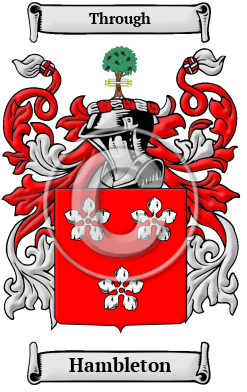
| ![Show Contents]() Hambleton History, Family Crest & Coats of Arms Hambleton History, Family Crest & Coats of Arms
Etymology of HambletonWhat does the name Hambleton mean? The Hambleton family name, was a Norman name that came to Scotland from England. It is thought to derive from the village of Hamilton or Hameldune near Barkby in the county of Leicestershire. The village name comes from the Old English elements "hamel," which means "blunt," "flat-topped," or "crooked," and "dun," which means hill. There is a town of Hamilton near Glasgow, which took its name from the family, but may in turn have spawned more instances of the surname. Hambleton Coat of Arms CreationIt will be noticed that many Hamiltons have as crests an oak tree rising penetrated transversely by a frame saw. The motto is " Through." The story is that the first Hamilton, a Sir Gilbert was obliged to fly from the Court of Edward II. in 1323 for slaying a John Despencer. He was closely pursued, and Hamilton and his servant changed clothes with two woodcutters, and, taking the saw of the workmen, were in the act of cutting an oak tree when their pursuers passed. The servant took notice of them, and Sir Gilbert called out " Through," and thus the Hamiltons got their crest and motto. 1 Early Origins of the Hambleton familyThe surname Hambleton was first found in Renfrewshire (Gaelic: Siorrachd Rinn Friù), a historic county of Scotland, today encompassing the Council Areas of Renfrew, East Renfrewshire, and Iverclyde, in the Strathclyde region of southwestern Scotland, where they were granted lands by King Robert the Bruce of Scotland. The Clan traces its origin to the Earls of Mellent in Normandy who arrived in Britain with William the Conqueror in 1066 AD. They were granted lands in Hambleton in Buckinghamshire. Soon after, Sir William de Hambleton accepted a challenge from John de Spence. Spence was killed, drawing the wrath of King Edward II of England. Sir William fled northwards with his entourage to Scotland, hotly pursued by the king's men. With their pursuers close behind them, Sir William and his servant exchanged clothes with two wood cutters and, using their saw, they cut down a large oak tree to bridge a river. Finally, when at last the tree fell, Sir William cried 'through' and they escaped across the river over the tree. The Clan Hamilton has retained this motto since that eventful day. Early History of the Hambleton familyThis web page shows only a small excerpt of our Hambleton research. Another 157 words (11 lines of text) covering the years 1280, 1282, 1296, 1307, 1333, 1392, 1495, 1504, 1520, 1528, 1563, 1575, 1580, 1600, 1604, 1607, 1610, 1623, 1626, 1633, 1636, 1637, 1640, 1646, 1650, 1655, 1658, 1659, 1663, 1666, 1668, 1669, 1670, 1674, 1679, 1685, 1701, 1706, 1707, 1715, 1719, 1720, 1721, 1734 and 1890 are included under the topic Early Hambleton History in all our PDF Extended History products and printed products wherever possible. Hambleton Spelling VariationsSpelling variations of this family name include: Hamilton, Hamelton, Hameldon, Hamildon, Hamylton, Hambleton and many more. Early Notables of the Hambleton familySir Patrick Hamilton (d. 1520), a Scottish nobleman, and younger brother of aforementioned James Hamilton, 1st Earl of Arran; his son, Patrick Hamilton (c.1504-1528), Scottish Protestant martyr, charged with heresy, sentenced by Archbishop Beaton, and burned at the stake in 1528; Thomas Hamilton, 1st Earl of Haddington (1563-1637), Scottish administrator, Lord Advocate, judge, and Lord Lieutenant of Haddingtonshire; Patrick Hamilton (c. 1575-1658), a minister of The Church of Scotland during a turbulent period in Scotland's history, also a poet; Archibald Hamilton (1580-1659), the fourth Anglican Archbishop of Cashel, nominated Bishop of Killala and Achonry in 1623 and consecrated that year; Thomas...
Another 161 words (12 lines of text) are included under the topic Early Hambleton Notables in all our PDF Extended History products and printed products wherever possible. Hambleton RankingIn the United States, the name Hambleton is the 18,674th most popular surname with an estimated 2,487 people with that name. 2 Migration of the Hambleton family to IrelandSome of the Hambleton family moved to Ireland, but this topic is not covered in this excerpt.
Another 160 words (11 lines of text) about their life in Ireland is included in all our PDF Extended History products and printed products wherever possible.
| Hambleton migration to the United States | + |
Hambleton Settlers in United States in the 17th Century- Amos Hambleton, who arrived in Maryland in 1651 3
- John Hambleton, who landed in Virginia in 1651 3
- Geo Hambleton, who arrived in Virginia in 1654 3
- Peter Hambleton, who landed in Maryland in 1656 3
- Francis Hambleton, who landed in Maryland in 1657 3
- ... (More are available in all our PDF Extended History products and printed products wherever possible.)
Hambleton Settlers in United States in the 18th Century- Kath Hambleton, who arrived in Virginia in 1701 3
- Sarah Hambleton, who landed in Virginia in 1701 3
- Margaret Hambleton, who landed in Virginia in 1702 3
- Jos Hambleton, who landed in Virginia in 1703 3
- Margaret Hambleton, who landed in Virginia in 1714 3
- ... (More are available in all our PDF Extended History products and printed products wherever possible.)
Hambleton Settlers in United States in the 19th Century- T E Hambleton, who arrived in San Frandsco, California in 1851 3
| Hambleton migration to Australia | + |
Hambleton Settlers in Australia in the 19th Century- Mr. James Hambleton, British Convict who was convicted in Hampshire, England for 7 years, transported aboard the "Coromandel" on 4th December 1803, arriving in New South Wales, Australia 4
- Mr. William Lowther Hambleton, (James, Hamilton), British settler who was convicted in Wiltshire, England for 7 years for vagabond, transported aboard the "Fortune And Alexander" on 31st December 1805, arriving in New South Wales, Australia 5
- Mr. Joseph Hambleton, English convict who was convicted in Middlesex, England for 7 years, transported aboard the "Baring" in December 1818, arriving in New South Wales, Australia 6
- Mr. John Hambleton, English convict who was convicted in Knutsford (Nether Knutsford), Cheshire, England for 7 years, transported aboard the ""Blenheim"" on 24th July 1850, arriving in Tasmania (Van Diemen's Land) and Norfolk Island, Australia 7
- Louisa Hambleton, aged 24, a housemaid, who arrived in South Australia in 1858 aboard the ship "Bee"
| Contemporary Notables of the name Hambleton (post 1700) | + |
- Albert F. N. Hambleton (1857-1922), American politician, Member of the Iowa House of Representatives (1903-1909)
- Samuel Hambleton (1777-1851), United States Navy officer who served with distinction during the War of 1812, eponym of the destroyer USS Hambleton (DD-455)
- Lieutenant Colonel Iceal E. "Gene" Hambleton (1918-2004), United States Air Force officer, famous for being the subject of a long and costly search and rescue mission during the Vietnam War
- Samuel Hambleton (1812-1886), American Democratic Party politician, Member of Maryland State House of Delegates, 1834-36, 1854; Member of Maryland State Senate, 1844-49; U.S. Representative from Maryland 1st District, 1869-73 8
- A. Kenneth Hambleton, American Republican politician, Member of New Hampshire State House of Representatives from Goffstown; Elected 1938, 1956; Delegate to New Hampshire State Constitutional Convention from Goffstown, 1956 9
- Peter Hambleton (b. 1960), New Zealand stage, film and television actor, and stage director
- Aman Hambleton (b. 1992), Canadian chess grandmaster from Halifax, Nova Scotia
- Richard Hambleton (1952-2017), Canadian street artist, known for his Shadowman paintings
- Oliver Hambleton Postle (1851-1900), American architect from Chicago, father of Joy Postle
The motto was originally a war cry or slogan. Mottoes first began to be shown with arms in the 14th and 15th centuries, but were not in general use until the 17th century. Thus the oldest coats of arms generally do not include a motto. Mottoes seldom form part of the grant of arms: Under most heraldic authorities, a motto is an optional component of the coat of arms, and can be added to or changed at will; many families have chosen not to display a motto.
Motto: Through
- Polson, Alexander, The Romance of Scottish Crests and Mottoes. Inverness: Walter Alexander, Inglis Street 1929. Print
- "What are the 5,000 Most Common Last Names in the U.S.?". NameCensus.com, https://namecensus.com/last-names/
- Filby, P. William, Meyer, Mary K., Passenger and immigration lists index : a guide to published arrival records of about 500,000 passengers who came to the United States and Canada in the seventeenth, eighteenth, and nineteenth centuries. 1982-1985 Cumulated Supplements in Four Volumes Detroit, Mich. : Gale Research Co., 1985, Print (ISBN 0-8103-1795-8)
- Convict Records Voyages to Australia (Retrieved 22nd March 2021). Retrieved from https://convictrecords.com.au/ships/coromandel-and-experiment
- Convict Records Voyages to Australia (Retrieved 24th October 2022). https://convictrecords.com.au
- Convict Records Voyages to Australia (Retrieved 16th September 2020). Retrieved from https://convictrecords.com.au/ships/baring
- Convict Records Voyages to Australia (Retrieved 25th October 2020). Retrieved from https://convictrecords.com.au/ships/blenheim
- The Political Graveyard: Alphabetical Name Index. (Retrieved 2015, November 6) . Retrieved from http://politicalgraveyard.com/alpha/index.html
 |