| ![Show Contents]() Gunnink History, Family Crest & Coats of Arms Gunnink History, Family Crest & Coats of Arms
Etymology of GunninkWhat does the name Gunnink mean? The Gunnink name is an important part of the history of the ancient Anglo-Saxon tribes of Britain. Gunnink is derived from Gunwyn deriving its origin from the Old English gundwein, which meant "battle friend" or in some cases, as a baptismal name as in "the son of Gunwyn." 1 Early Origins of the Gunnink familyThe surname Gunnink was first found in Suffolk where "in Corton (Suffolk) in the reign of John, Gundewyn' de Nethergate held land which was held in 1275 by Gerald Gunwine or Gundwyne by heredity." 2 Gundewinus cortinarius was listed in the Pipe Rolls of Surrey in 1130. From this early Latin entry, Thomas Gundewin was found in the Close Rolls of 1228 and William Gundewyne was later listed in the Subsidy Rolls of Sussex in 1296. 2 The Yorkshire Poll Tax Rolls of 1379 had only one listing, Willelmus Gunwyn as holding lands there at that time. 1 Early History of the Gunnink familyThis web page shows only a small excerpt of our Gunnink research. Another 60 words (4 lines of text) covering the years 1614, 1615, 1661, 1670, 1674, 1675, 1684, 1731, 1734, 1765, 1771, 1772, 1774, 1776, 1798, 1816 and 1890 are included under the topic Early Gunnink History in all our PDF Extended History products and printed products wherever possible. Gunnink Spelling VariationsBefore the last few hundred years, the English language had no fast system of spelling rules. For that reason, spelling variations are commonly found in early Anglo-Saxon surnames. Over the years, many variations of the name Gunnink were recorded, including Gunning, Guning and others. Early Notables of the Gunnink familyPeter Gunning (1614-1684), an English Royalist church leader, Bishop of Chichester (1670-1675) and Ely (1675-1684), Master of Corpus Christi College, Cambridge (1661.) He was son of Peter Gunning (d. 1615), vicar of Hoo, Kent, whose brother Richard settled in Ireland and was ancestor of Sir Robert Gunning (1731-1816), the Irish...
Another 49 words (4 lines of text) are included under the topic Early Gunnink Notables in all our PDF Extended History products and printed products wherever possible. Migration of the Gunnink family to IrelandSome of the Gunnink family moved to Ireland, but this topic is not covered in this excerpt.
Another 95 words (7 lines of text) about their life in Ireland is included in all our PDF Extended History products and printed products wherever possible. Migration of the Gunnink familyTo escape oppression and starvation at that time, many English families left for the "open frontiers" of the New World with all its perceived opportunities. In droves people migrated to the many British colonies, those in North America in particular, paying high rates for passages in cramped, unsafe ships. Although many of the settlers did not make the long passage alive, those who did see the shores of North America perceived great opportunities before them. Many of the families that came from England went on to make essential contributions to the emerging nations of Canada and the United States. Research into various historical records revealed some of first members of the Gunnink family emigrate to North America: John Gunning, who settled in Barbados in 1680 with his servants; John Gunning settled in Philadelphia in 1836; and another John Gunning settled in Salem Massachusetts in 1799.
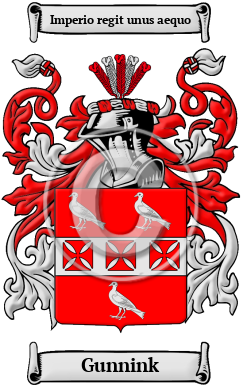
The motto was originally a war cry or slogan. Mottoes first began to be shown with arms in the 14th and 15th centuries, but were not in general use until the 17th century. Thus the oldest coats of arms generally do not include a motto. Mottoes seldom form part of the grant of arms: Under most heraldic authorities, a motto is an optional component of the coat of arms, and can be added to or changed at will; many families have chosen not to display a motto.
Motto: Imperio regit unus aequo
Motto Translation: One governs with just sway.
- Bardsley, C.W, A Dictionary of English and Welsh Surnames: With Special American Instances. Wiltshire: Heraldry Today, 1901. Print. (ISBN 0-900455-44-6)
- Reaney, P.H and R.M. Wilson, A Dictionary of English Surnames. London: Routledge, 1991. Print. (ISBN 0-415-05737-X)
 |