| ![Show Contents]() Grys History, Family Crest & Coats of Arms Grys History, Family Crest & Coats of Arms
- Origins Available:
Scotland
Ireland
Etymology of GrysWhat does the name Grys mean? An ancient Scottish tribe called the Boernicians were the ancestors of the first people to use the surname Grys. It is a name for a person who had gray hair. In Scotland, the surname Grys actually came from two different derivations. As a nickname, it came from the Gaelic word riabhach, which means gray. As a habitational name, it derived from the place named Graye, in Calvados. This place-name came from the Gallo-Roman personal name, Gratus, which means welcome or pleasing. Grys is therefore a nickname and a habitation name, which belongs to the category of hereditary surnames. Early Origins of the Grys familyThe surname Grys was first found in Northumberland, with Anschatel Groy of Haute Saone, Normandy, who fought with William the Conqueror in 1066 AD. After the conquest, Anschatel Groy settled in Chillingham, Northumberland. He was from the department of Haute Saone called Gray, sometimes Groy, or Croy, in Normandy. From this house sprang the Grays of Suffolk, Kent, Tankerville, and Stamford. Some of the earliest records of the name include: Richard de Grey (born c. 1140); and his son, Sir Henry de Grey of Grays Thurrock, Essex (1155-1219), a favourite courtier of King John of England; and his son, Richard de Grey (died 1271) of Codnor, Derbyshire, Lord Warden of the Cinque Ports in 1258; and his brother Sir John de Grey (died 1266), an English soldier and High Sheriff of Bedfordshire and Buckinghamshire (1238-1239) and of High Sheriff of Herefordshire (1252-1253). John de Gray (died 1214) was Bishop of Norwich in Norfolk, and later became Archbishop of Canterbury, but was never confirmed. Backworth in Northumberland was home to one branch of the family. "This place formerly belonged to Tynemouth priory, and afterwards to the Grey family, by whom it was sold to the late Duke of Northumberland, for £95,000." 1 Barcombe in Sussex was another ancient family seat. "It comprises 3106 acres, whereof 305 are common or waste; and is bounded on the east by the river Ouse, on which is a flour-mill that has existed since the Conquest, and has been for more than a century in the possession of the family of Mr. Russell Gray, who has also established an extensive oilmill at an expense of £10,000." 1 Early History of the Grys familyThis web page shows only a small excerpt of our Grys research. Another 119 words (8 lines of text) covering the years 1248, 1250, 1255, 1266, 1268, 1282, 1296, 1305, 1323, 1353, 1362, 1377, 1380, 1387, 1390, 1392, 1416, 1424, 1427, 1437, 1439, 1440, 1445, 1449, 1451, 1454, 1469, 1490, 1501, 1505, 1582, 1590, 1599, 1611, 1612, 1614, 1621, 1622, 1623, 1624, 1628, 1630, 1639, 1657, 1660, 1663, 1673, 1674, 1676 and 1890 are included under the topic Early Grys History in all our PDF Extended History products and printed products wherever possible. Grys Spelling VariationsSpelling rules only evolved in the last few centuries with the invention of the printing press and the first dictionaries. Spelling variations are extremely common in names from before that period. Grys has been spelled Gray, Grey, Groy, Croy, Graye and others. Early Notables of the Grys familyAndrew Gray, 1st Lord Gray (c.1390-1469), a Scottish nobleman, politician and diplomat; Sir Andrew Gray (d. 1445) of Fowlis, Perthshire; Sir John Grey KG (c.1387-1439), English nobleman and soldier; Edmund Grey (1416-1490), English nobleman; Thomas Grey KG (1451-1501), 7th Baron Ferrers of Groby, 1st Earl of Huntingdon, and 1st Marquess of Dorset, an English nobleman and courtier; George Grey, 2nd Earl of Kent (1454-1505), the son of Edmund Grey, 1st Earl of Kent and Lady Katherine Percy, was the Second Earl of Kent from 1490 to 1505; Nicholas Grey (c.1590-1660), English headmaster of Eton College, born in London; Henry Grey, 1st...
Another 106 words (8 lines of text) are included under the topic Early Grys Notables in all our PDF Extended History products and printed products wherever possible. Migration of the Grys family to IrelandSome of the Grys family moved to Ireland, but this topic is not covered in this excerpt.
Another 61 words (4 lines of text) about their life in Ireland is included in all our PDF Extended History products and printed products wherever possible.
| Grys migration to the United States | + |
After making their great crossing, many Boernician-Scottish families settled along the east coast of North America. When the War of Independence broke out, United Empire Loyalists moved north to Canada while the rest stayed to fight. The ancestors of many of these Scots still populate the continent. This century, through Clan societies and other Scottish organizations, they began to rediscover their collective national heritage. Analysis of immigration records indicates that some of the first North American immigrants bore the name Grys or a variant listed above:
Grys Settlers in United States in the 18th Century- Johannes Grys, who arrived in Pennsylvania in 1752-1753 2
- Martin Grys, who landed in Pennsylvania in 1752-1753 2
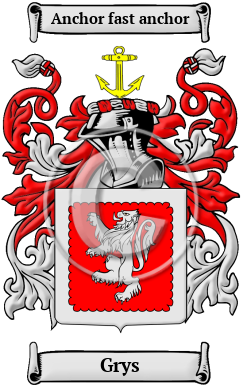
The motto was originally a war cry or slogan. Mottoes first began to be shown with arms in the 14th and 15th centuries, but were not in general use until the 17th century. Thus the oldest coats of arms generally do not include a motto. Mottoes seldom form part of the grant of arms: Under most heraldic authorities, a motto is an optional component of the coat of arms, and can be added to or changed at will; many families have chosen not to display a motto.
Motto: Anchor fast anchor
- Lewis, Samuel, A Topographical Dictionary of England. Institute of Historical Research, 1848, Print.
- Filby, P. William, Meyer, Mary K., Passenger and immigration lists index : a guide to published arrival records of about 500,000 passengers who came to the United States and Canada in the seventeenth, eighteenth, and nineteenth centuries. 1982-1985 Cumulated Supplements in Four Volumes Detroit, Mich. : Gale Research Co., 1985, Print (ISBN 0-8103-1795-8)
 |