
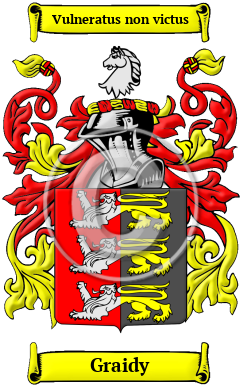
Show ContentsGraidy History, Family Crest & Coats of Arms

Early Origins of the Graidy family

The surname Graidy was first found in Galway (Irish: Gaillimh) part of the province of Connacht, located on the west coast of the Island, and County Clare where they held a family seat from ancient times. They were descended from Olioll Olum, King of Munster who reigned about 130 A.D. and descended through a line of Chiefs and Kings to John O'Grady, alias O'Brady, who died in 1332 in the Clann territories of Fassaghmore in the county of Clare. His son, Sir Denis O'Grady alias O'Brady of Fassaghmore was knighted by King Henry VI of England. This great confusion of names continued into the 14th and 15th century and to make matters even more confusing the line frequently reverted from one spelling to the other. The Clann seat became established at Kilballyowen in County Limerick, and the present Chief of the Gradys (or Bradys) is one of the few Chiefs recognized in Ireland. He is Lieutenant Colonel Gerald Vogors de Courcy O'Grady. They were settled in Glenstal Abbey. Many of the name were also found in Cavan.

Early History of the Graidy family

This web page shows only a small excerpt of our Graidy research. Another 53 words (4 lines of text) are included under the topic Early Graidy History in all our PDF Extended History products and printed products wherever possible.

Graidy Spelling Variations

Spelling variations of this family name include: Grady, Brady, O'Grady, O'Brady, Braidy, Graidy, Bradie, Braidie, Braydy, Braydie, Gradie, Graidie, Graydy, Graydie, Gradaigh, Grada, Bradigan, O'Bradigan and many more.

Early Notables of the Graidy family

More information is included under the topic Early Graidy Notables in all our PDF Extended History products and printed products wherever possible.


Graidy migration to Australia +

Graidy Settlers in Australia in the 19th Century
  • Lawrence Graidy, who arrived in Adelaide, Australia aboard the ship "Britannia" in 1846 1


The Graidy Motto +

The motto was originally a war cry or slogan. Mottoes first began to be shown with arms in the 14th and 15th centuries, but were not in general use until the 17th century. Thus the oldest coats of arms generally do not include a motto. Mottoes seldom form part of the grant of arms: Under most heraldic authorities, a motto is an optional component of the coat of arms, and can be added to or changed at will; many families have chosen not to display a motto.

Motto: Vulneratus non victus
Motto Translation: Wounded not conquered.


  1. State Records of South Australia. (Retrieved 2010, November 5) BRITANNIA 1846. Retrieved from http://www.slsa.sa.gov.au/BSA/1846Britannia.htm


Houseofnames.com on Facebook