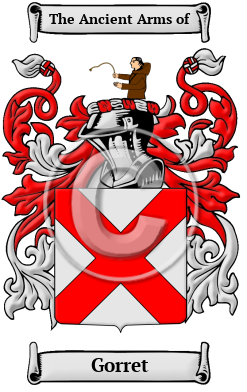
| ![Show Contents]() Gorret History, Family Crest & Coats of Arms Gorret History, Family Crest & Coats of Arms
Etymology of GorretWhat does the name Gorret mean? Although the Gorret surname came to Britain with the Normans, it derives from the Germanic personal names Gerard, or Gerald, composed of the elements "gar," or "ger," meaning "spear," "hard," meaning "brave," or "strong," and "wald," meaning "rule." 1 Not all of the family made the crossing with the Conqueror as Roger and William Garet were both listed in Normandy in 1180. A few years later, Arnulph and William Garet were also listed there in 1198. 2 Early Origins of the Gorret familyThe surname Gorret was first found in Lincolnshire, where a Geraddus filius Simonis is on record in 1242 in Liber Feodorum. The same source also included Peter Geraud son of Robert Gerold 1250-1251 in Northumberland. 3 Later the Yorkshire Poll Tax Rolls of 1379 included the family as a forename and surname: Johannes Gerard; Thomas Gerard; and Gyrerd Tolus. 1 In Cumberland, Thomas Gerad was listed there in the Subsidy Rolls of 1332. 4 In Somerset, Adam Garet was registered there 1 Edward III (during the first year of King Edward III's reign) 5 and John Gerad was listed in the Pipe Rolls of 1230. 4 Early History of the Gorret familyThis web page shows only a small excerpt of our Gorret research. Another 91 words (6 lines of text) covering the years 1086, 1379, 1511, 1551, 1560, 1579, 1594, 1597, 1603, 1621, 1640, 1641, 1642, 1648, 1650 and 1890 are included under the topic Early Gorret History in all our PDF Extended History products and printed products wherever possible. Gorret Spelling VariationsEndless spelling variations are a prevailing characteristic of Norman surnames. Old and Middle English lacked any definite spelling rules, and the introduction of Norman French added an unfamiliar ingredient to the English linguistic stew. French and Latin, the languages of the court, also influenced spellings. Finally, Medieval scribes generally spelled words according to how they sounded, so one person was often referred to by different spellings in different documents. The name has been spelled Garrett, Garratt, Garret, Garrat, Garet, Garitt, Garatt and many more. Early Notables of the Gorret familySir Thomas Gerard, 1st Baronet (1560-1621), an English politician who sat in the House of Commons at various times between 1597 and 1621. He was the son of Sir Thomas Gerard, of Bryn and his wife Elizabeth Port, daughter of Sir John Port, of Etwall, Derbyshire.
George Garrett or Garrard (1579- after 1650), was an English Member of Parliament. He was a younger son of Sir William Garrard of Dorney Court, Buckinghamshire. He was educated at Merton College, Oxford from 1594, graduating BA in 1597...
Another 84 words (6 lines of text) are included under the topic Early Gorret Notables in all our PDF Extended History products and printed products wherever possible. Migration of the Gorret family to IrelandSome of the Gorret family moved to Ireland, but this topic is not covered in this excerpt.
Another 59 words (4 lines of text) about their life in Ireland is included in all our PDF Extended History products and printed products wherever possible. Migration of the Gorret familyTo escape the political and religious persecution within England at the time, many English families left for the various British colonies abroad. The voyage was extremely difficult, though, and the cramped, dank ships caused many to arrive in the New World diseased and starving. But for those who made it, the trip was most often worth it. Many of the families who arrived went on to make valuable contributions to the emerging nations of Canada and the United States. An inquiry into the early roots of North American families reveals a number of immigrants bearing the name Gorret or a variant listed above: Hannah and Richard Garrett, who came to Salem, Massachusetts in 1630; Eliz. Garrett, who came to Virginia in 1632; Richard West Garrett, who arrived in St. Christopher in 1635.
- Bardsley, C.W, A Dictionary of English and Welsh Surnames: With Special American Instances. Wiltshire: Heraldry Today, 1901. Print. (ISBN 0-900455-44-6)
- The Norman People and Their Existing Descendants in the British Dominions and the United States Of America. Baltimore: Genealogical Publishing, 1975. Print. (ISBN 0-8063-0636-X)
- Testa de Nevill or "Liber Feodorum" or "Book of Fees," thought to have been written by Ralph de Nevill, for King John (1199–1216)
- Reaney, P.H and R.M. Wilson, A Dictionary of English Surnames. London: Routledge, 1991. Print. (ISBN 0-415-05737-X)
- Dickinson, F.H., Kirby's Quest for Somerset of 16th of Edward the 3rd London: Harrison and Sons, Printers in Ordinary to Her Majesty, St, Martin's Lane, 1889. Print.
 |