| ![Show Contents]() Gibord History, Family Crest & Coats of Arms Gibord History, Family Crest & Coats of Arms
- Origins Available:
England
Etymology of GibordWhat does the name Gibord mean? The name Gibord originated with the Anglo-Saxon tribes that once ruled Britain. It is derived from the baptismal name as in "son of Gilbert, popularly Gibbert, Gibberd, or Gibbard." 1 Early Origins of the Gibord familyThe surname Gibord was first found in Lincolnshire, where Robert filius Giberti was recorded. Later in Winton, Hampshire, Gislebert Gibart was recorded c. 1110 and in Lincolnshire, Richard Gybard was listed in the Assize Rolls for 1298. Over in Leicestershire, Alice Giberd was recorded in the Subsidy Rolls for 1327. 2 The Hundredorum Rolls of 1273 included entries for Henry Gilbard, Norfolk; John Gilbard, Norfolk; and John Gilberd, Cambridgeshire. The Placita de Quo Warranto, temp. Edward I-III included an entry for William Gilberd, Gloucestershire, 20 Edward I (during the 20th year of the reign of King Edward I.) 1 Early History of the Gibord familyThis web page shows only a small excerpt of our Gibord research. Another 134 words (10 lines of text) covering the years 1239, 1273, 1307, 1533, 1603, 1730 and 1778 are included under the topic Early Gibord History in all our PDF Extended History products and printed products wherever possible. Gibord Spelling VariationsOne relatively recent invention that did much to standardize English spelling was the printing press. However, before its invention even the most literate people recorded their names according to sound rather than spelling. The spelling variations under which the name Gibord has appeared include Gibbard, Gibbert, Gibert, Gybbard, Gybbert and many more. Early Notables of the Gibord familyMore information is included under the topic Early Gibord Notables in all our PDF Extended History products and printed products wherever possible. Migration of the Gibord familyAt this time, the shores of the New World beckoned many English families that felt that the social climate in England was oppressive and lacked opportunity for change. Thousands left England at great expense in ships that were overcrowded and full of disease. A great portion of these settlers never survived the journey and even a greater number arrived sick, starving, and without a penny. The survivors, however, were often greeted with greater opportunity than they could have experienced back home. These English settlers made significant contributions to those colonies that would eventually become the United States and Canada. An examination of early immigration records and passenger ship lists revealed that people bearing the name Gibord arrived in North America very early: Thomas and Henry Gibbard landed in Virginia in 1774; William Gibbard settled in New Haven, Conn. in 1640; Ann, Edward and Jane Gibberd landed in New York in 1830.
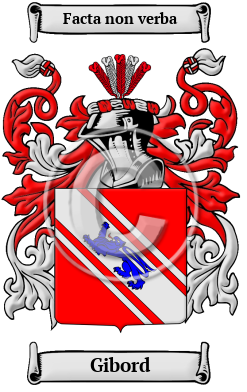
The motto was originally a war cry or slogan. Mottoes first began to be shown with arms in the 14th and 15th centuries, but were not in general use until the 17th century. Thus the oldest coats of arms generally do not include a motto. Mottoes seldom form part of the grant of arms: Under most heraldic authorities, a motto is an optional component of the coat of arms, and can be added to or changed at will; many families have chosen not to display a motto.
Motto: Facta non verba
Motto Translation: Deeds not words
- Bardsley, C.W, A Dictionary of English and Welsh Surnames: With Special American Instances. Wiltshire: Heraldry Today, 1901. Print. (ISBN 0-900455-44-6)
- Reaney, P.H and R.M. Wilson, A Dictionary of English Surnames. London: Routledge, 1991. Print. (ISBN 0-415-05737-X)
 |