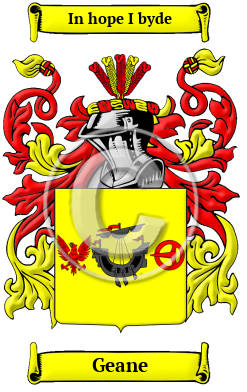
| ![Show Contents]() Geane History, Family Crest & Coats of Arms Geane History, Family Crest & Coats of Arms
- Origins Available:
Ireland
Scotland
Etymology of GeaneWhat does the name Geane mean? Geane comes from the ancient Dalriadan clans of Scotland's west coast and Hebrides islands. The name comes from the given name Ian or John. John is the most common personal name in the Highlands. The Gaelic form of the name is Mac Iain. Early Origins of the Geane familyThe surname Geane was first found in Argyllshire (Gaelic erra Ghaidheal), the region of western Scotland corresponding roughly with the ancient Kingdom of Dál Riata, in the Strathclyde region of Scotland, now part of the Council Area of Argyll and Bute, where they held a family seat from early times and their first records appeared on the early census rolls taken by the early Kings of Britain to determine the rate of taxation of their subjects. Early History of the Geane familyThis web page shows only a small excerpt of our Geane research. Another 166 words (12 lines of text) covering the years 1292, 1340, 1618, 1667, 1717, 1777, 1808, 1875 and 1890 are included under the topic Early Geane History in all our PDF Extended History products and printed products wherever possible. Geane Spelling VariationsThe translation of Gaelic names in the Middle Ages was not a task undertaken with great care. Records from that era show an enormous number of spelling variations, even in names referring to the same person. Over the years Geane has appeared as MacIan, MacAne, MacKane, MacKean, MacKain and others. Early Notables of the Geane familyArchibald McKain (1717-1777), Scottish Shoemaker and Burgess of Elgin, Morayshire, who became the 15th Chief of MacIain of Ardnamurchan. Also of note was Thomas M'kean of Delaware, one of the signers of the American Declaration of Independence.
John Canne (d. 1667?), was an English divine and printer and "may...
Another 48 words (3 lines of text) are included under the topic Early Geane Notables in all our PDF Extended History products and printed products wherever possible. Migration of the Geane family to IrelandSome of the Geane family moved to Ireland, but this topic is not covered in this excerpt.
Another 80 words (6 lines of text) about their life in Ireland is included in all our PDF Extended History products and printed products wherever possible.
| Geane migration to Australia | + |
Geane Settlers in Australia in the 19th Century- Mr. Thomas Geane, (b. 1815), aged 43, Cornish wheelwright departing from Plymouth aboard the ship "Fitzjames" arriving in Sydney, New South Wales, Australia on 28th July 1858 1
- Mrs. Elizabeth Geane, (b. 1818), aged 40, Cornish settler departing from Plymouth aboard the ship "Fitzjames" arriving in Sydney, New South Wales, Australia on 28th July 1858 1
- Miss Mary Geane, (b. 1838), aged 20, Cornish settler departing from Plymouth aboard the ship "Fitzjames" arriving in Sydney, New South Wales, Australia on 28th July 1858 1
- Miss Jane Geane, (b. 1840), aged 18, Cornish settler departing from Plymouth aboard the ship "Fitzjames" arriving in Sydney, New South Wales, Australia on 28th July 1858 1
- Miss Elizabeth Geane, (b. 1846), aged 12, Cornish settler, from Isle of Wight, England, UK departing from Plymouth aboard the ship "Fitzjames" arriving in Sydney, New South Wales, Australia on 28th July 1858 1
- ... (More are available in all our PDF Extended History products and printed products wherever possible.)
| Contemporary Notables of the name Geane (post 1700) | + |
- Geane Carlos Herrera (1990-2024), American mixed martial artist who competed in the Flyweight division
The motto was originally a war cry or slogan. Mottoes first began to be shown with arms in the 14th and 15th centuries, but were not in general use until the 17th century. Thus the oldest coats of arms generally do not include a motto. Mottoes seldom form part of the grant of arms: Under most heraldic authorities, a motto is an optional component of the coat of arms, and can be added to or changed at will; many families have chosen not to display a motto.
Motto: In hope I byde
- Cornwall Online Parish Clerks. (Retrieved 3rd May 2018). Retrieved from http://www.opc-cornwall.org/Resc/pdfs/emigration_nsw_1850_59.pdf
 |