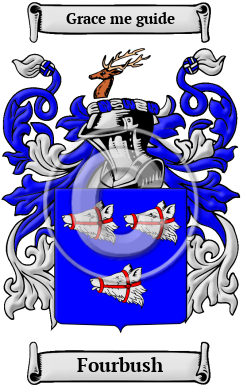
| ![Show Contents]() Fourbush History, Family Crest & Coats of Arms Fourbush History, Family Crest & Coats of Arms
Etymology of FourbushWhat does the name Fourbush mean? The Fourbush family name was first used by descendants of the Pictish people of ancient Scotland. It is a name for someone who lived in the lands of Forbes on Aberdeenshire where the family's history dates back before 1000 AD Fourbush Coat of Arms CreationThere are various guesses as to the origin of this name. One writer says that a gentleman who, wishing to secure the hand of a lady named "Bess," showed his courage by slaying a ferocious bear, and on being asked why he did it, replied, "For Bess." Another version is that the founder of the family of Forbes was a man named Bois, who received lands from an early king of Scotland, who, in making the gift, said they were "for Bois." Others say the word is derived from the Gaelic word Ferbasach-a bold man. In any case, the progenitor of the family must have had something to do with bears, as the various branches carry bear's heads in their shields. The bear is a cruel and fierce animal, and in armorial bearings represents a man that had over-come a cruel and vicious enemy. Dr William Mackay, in his "History of Urquhart and Glenmoriston,"says that Conacher of Ulster was the progenitor of the families of Forbes, Mackay, and Urquhart; and in allusion to his wonderful feat of killing a wild boar of extraordinary ferocity and strength the three families in after years adopted the boar's head as their arms. Clans did sometimes change their crest, but though the Urquharts still have the boar's head and the motto, "Mean, speak, and doe well," the Forbes and the Mackays have certainly changed theirs. 1 Early Origins of the Fourbush familyThe surname Fourbush was first found in Aberdeenshire (Gaelic: Siorrachd Obar Dheathain), a historic county, and present day Council Area of Aberdeen, located in the Grampian region of northeastern Scotland, at Pitscottie from 1168, which was later named "the Braes of Forbes." Legend has it that the founder of the Clan, Oconochar, slew a bear in order to take up residence there. One of the first records of the name from this region was Duncan de Forbeys who received a grant of lands c. 1272 from King Alexander III. Later, John de Fernboys was listed as rendering allegiance to King Edward I of England in 1296 and later still, William of Forbace was canon of Aberdeen in 1464. 2 Early History of the Fourbush familyThis web page shows only a small excerpt of our Fourbush research. Another 159 words (11 lines of text) covering the years 1165, 1214, 1380, 1448, 1581, 1590, 1611, 1623, 1626, 1629, 1632, 1644, 1671, 1680, 1684, 1685, 1696, 1704, 1712, 1747 and 1890 are included under the topic Early Fourbush History in all our PDF Extended History products and printed products wherever possible. Fourbush Spelling VariationsScribes in the Middle Ages did not have access to a set of spelling rules. They spelled according to sound, the result was a great number of spelling variations. In various documents, Fourbush has been spelled Forbes, Forbose, Forbess, Forbeis (Gaelic) and others. Early Notables of the Fourbush familyAlexander de Forbes, (c. 1380-1448) 1st Lord Forbes, progenitor of the lordship. He was "the eldest son of Sir John de Forbes of that ilk. The lands of Forbes in Aberdeenshire gave name to the family, who trace back their ancestors in it to the time of King William the Lion (1165-1214). Sir John de Forbes was justiciar and coroner for Aberdeenshire...
Another 62 words (4 lines of text) are included under the topic Early Fourbush Notables in all our PDF Extended History products and printed products wherever possible. Migration of the Fourbush family to IrelandSome of the Fourbush family moved to Ireland, but this topic is not covered in this excerpt.
Another 134 words (10 lines of text) about their life in Ireland is included in all our PDF Extended History products and printed products wherever possible.
| Fourbush migration to the United States | + |
The cruelties suffered under the new government forced many to leave their ancient homeland for the freedom of the North American colonies. Those who arrived safely found land, freedom, and opportunity for the taking. These hardy settlers gave their strength and perseverance to the young nations that would become the United States and Canada. Immigration and passenger lists have shown many early immigrants bearing the name Fourbush:
Fourbush Settlers in United States in the 17th Century- John Fourbush, who arrived in Maryland in 1662 3
| Fourbush Motto and War Cry | + |
The motto was originally a war cry or slogan. Mottoes first began to be shown with arms in the 14th and 15th centuries, but were not in general use until the 17th century. Thus the oldest coats of arms generally do not include a motto. Mottoes seldom form part of the grant of arms: Under most heraldic authorities, a motto is an optional component of the coat of arms, and can be added to or changed at will; many families have chosen not to display a motto.
Motto: Grace me guide
War Cry: "Leonach"
War Cry Description: Significance - a hill in Strathdon
- Polson, Alexander, The Romance of Scottish Crests and Mottoes. Inverness: Walter Alexander, Inglis Street 1929. Print
- Black, George F., The Surnames of Scotland Their Origin, Meaning and History. New York: New York Public Library, 1946. Print. (ISBN 0-87104-172-3)
- Filby, P. William, Meyer, Mary K., Passenger and immigration lists index : a guide to published arrival records of about 500,000 passengers who came to the United States and Canada in the seventeenth, eighteenth, and nineteenth centuries. 1982-1985 Cumulated Supplements in Four Volumes Detroit, Mich. : Gale Research Co., 1985, Print (ISBN 0-8103-1795-8)
 |