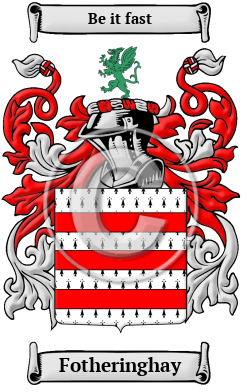
| ![Show Contents]() Fotheringhay History, Family Crest & Coats of Arms Fotheringhay History, Family Crest & Coats of Arms
Etymology of FotheringhayWhat does the name Fotheringhay mean? The name Fotheringhay has a history dating as far back as the Anglo-Saxon tribes of Britain. It is derived from when the Fotheringhay family lived in Fotheringhay, in Northamptonshire having derived from the Old English word "fodring," which meant "grazing." The other portion is the Old English word "eg," which meant "island." The name as a whole meant "island with good grazing land." The suffix was later replaced by “-ham”, meaning “homestead”. That a family assumes the name of the place where they lived is often indicative the degree of power and influence they held in that area. Early Origins of the Fotheringhay familyThe surname Fotheringhay was first found in Angus (Gaelic: Aonghas), part of the Tayside region of northeastern Scotland, and present day Council Area of Angus, formerly known as Forfar or Forfarshire, seated there since about 1130 A.D. Because of their geographical location, it is highly probable that they are also of Pictish ancestry. The earliest explicit record of the Fotheringham family was in Angus in 1261, when Dominus Robert de Ffodryngay (an ancient form of Fotheringhay) was witness to the Maule Charter signed in that year. Other ancestors who held titles were Master Henry of Fottyngham, rector of the church of Taruedal in Ross in 1274, Roger de Foderinggeye, vicar of the church of Kilmor in the county of Ross and Henry de Foddrynghame, sheriff of Perth and Banff in 1358. Other recorded occurrences of the name include Walter de Fodringgeye, who was one of the executors of the will of Dervorgilla, wife of John de Baliol, in 1291, Huwe (or Hugh) de Foderingeye of the county of Perth, who rendered homage to King Edward I of England on his brief conquest of Scotland in 1296, Henry de Foddrynghame who was deputy of the sheriff of Perth in 1358 and is probably the same Henry de Fodrynghay who witnessed a Brechin document in 1364, Robyn of Fodryngame, who was one of the assize on the marches of Woodwrae in 1388, Alexander Forigham, who appears as a witness in Brechin in 1464 and finally Thomas Foddringhame of Poury (a variation on Pourie), who was witness to a charter by John Jardin of Appilgarth in 1476. Early History of the Fotheringhay familyThis web page shows only a small excerpt of our Fotheringhay research. Another 104 words (7 lines of text) covering the years 1358 and 1377 are included under the topic Early Fotheringhay History in all our PDF Extended History products and printed products wherever possible. Fotheringhay Spelling VariationsSpelling variations of this family name include: Fotheringham, Fothringham, Fothrynghame, Fotringham, Foderingham, Fotheringay and many more. Early Notables of the Fotheringhay familyMore information is included under the topic Early Fotheringhay Notables in all our PDF Extended History products and printed products wherever possible. Migration of the Fotheringhay familySome of the first settlers of this family name or some of its variants were: John Fotheringham who settled in South Carolina in 1716.
The motto was originally a war cry or slogan. Mottoes first began to be shown with arms in the 14th and 15th centuries, but were not in general use until the 17th century. Thus the oldest coats of arms generally do not include a motto. Mottoes seldom form part of the grant of arms: Under most heraldic authorities, a motto is an optional component of the coat of arms, and can be added to or changed at will; many families have chosen not to display a motto.
Motto: Be it fast
 |