


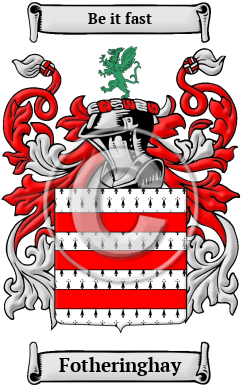
Show ContentsFotheringhay History, Family Crest & Coats of Arms

Etymology of Fotheringhay

What does the name Fotheringhay mean?

The Anglo-Saxon name Fotheringhay comes from the family having resided in Fotheringhay, in Northamptonshire having derived from the Old English word fodring, which meant grazing. The other portion is the Old English word eg, which meant island. The name as a whole meant "island with good grazing land."

Early Origins of the Fotheringhay family

The surname Fotheringhay was first found in Angus where they held a family seat from very ancient times, some say well before the Norman Conquest and the arrival of Duke William at Hastings in 1066 A.D.

Early History of the Fotheringhay family

This web page shows only a small excerpt of our Fotheringhay research. Another 112 words (8 lines of text) covering the years 1130, 1296 and 1358 are included under the topic Early Fotheringhay History in all our PDF Extended History products and printed products wherever possible.

Fotheringhay Spelling Variations

Fotheringhay has been spelled many different ways. Before English spelling became standardized over the last few hundred years, spelling variations in names were a common occurrence. As the English language changed in the Middle Ages, absorbing pieces of Latin and French, as well as other languages, the spelling of people's names also changed considerably, even over a single lifetime. Spelling variants included: Fotheringham, Fothringham, Fothrynghame, Fotringham, Foderingham, Fotheringay and many more.

Early Notables of the Fotheringhay family

More information is included under the topic Early Fotheringhay Notables in all our PDF Extended History products and printed products wherever possible.

Migration of the Fotheringhay family

In an attempt to escape the chaos experienced in England, many English families boarded overcrowded and diseased ships sailing for the shores of North America and other British colonies. Those families hardy enough, and lucky enough, to make the passage intact were rewarded with land and a social environment less prone to religious and political persecution. Many of these families became important contributors to the young colonies in which they settled. Early immigration and passenger lists have documented some of the first Fotheringhays to arrive on North American shores: John Fotheringham who settled in South Carolina in 1716.


The Fotheringhay Motto +

The motto was originally a war cry or slogan. Mottoes first began to be shown with arms in the 14th and 15th centuries, but were not in general use until the 17th century. Thus the oldest coats of arms generally do not include a motto. Mottoes seldom form part of the grant of arms: Under most heraldic authorities, a motto is an optional component of the coat of arms, and can be added to or changed at will; many families have chosen not to display a motto.

Motto: Be it fast


Houseofnames.com on Facebook
