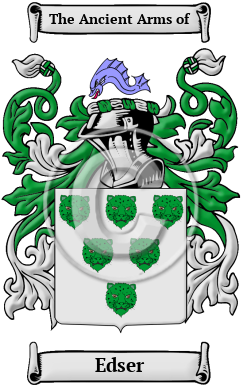
| ![Show Contents]() Edser History, Family Crest & Coats of Arms Edser History, Family Crest & Coats of Arms
Etymology of EdserWhat does the name Edser mean? The history of the name Edser began when it was derived from The surname Edser is a patronymic surname, that is, derived from an ancestor's given name. Patronymic surnames belong to the category of hereditary surnames, and they arose out of the vernacular and religious given name traditions. The vernacular or regional naming tradition is the oldest and most pervasive type of patronymic surname. According to this custom, names were originally composed of vocabulary elements from the local language. Vernacular names that were derived from ancient Germanic personal names have cognates in most European languages. For example, the court of Charlemagne (742-814) was Christian and Latin-speaking, but the Frankish dialect of Old German was commonly used for personal names. Vernacular names were widespread throughout Normandy. Accordingly, many typical English and French names are in fact, originally of Germanic origin and often have cognates in other European countries. In this case, family tradition has it that the name is derived from the name Isolde, the wife of Tristram, nephew of the King of Cornwall, of the great Arthurian legends. According to the family tradition, Tristram escaped to Brittany, where he married Isolde, daughter of the Duke of Brittany. Their tragic love affair became the subject of the opera Tristan and Isolde by Wagner. On the other hand, it seems more likely that the name is derived from the Old German word ishild, which meant ice battle. Early Origins of the Edser familyThe surname Edser was first found in Gloucestershire where they held a family seat from ancient times, being granted lands in that shire soon after the Norman Conquest in 1066. Traditionally, the family was descended from Isolde, daughter of the Duke of Brittany in the fifth century who later became the wife of Tristram, of the great Arthurian legends, nephew of the King of Cornwall. Tristram escaped to Brittany and their tragic love affair became the subject of an opera by Wagner. Early History of the Edser familyThis web page shows only a small excerpt of our Edser research. Another 172 words (12 lines of text) covering the years 1400, 1569, 1577, 1599, 1645, 1695 and 1785 are included under the topic Early Edser History in all our PDF Extended History products and printed products wherever possible. Edser Spelling VariationsThe Old and Middle English languages lacked definite spelling rules, and therefore, Breton surnames have many spelling variations. Latin and French, which were the official court languages, were also influential on the spelling of surnames. The spelling of surnames was rarely consistent in medieval times, and scribes and church officials recorded names as they sounded rather than adhering to any specific spelling rules. Therefore, it was common to find the same individual referred to with different spellings of their surname in the ancient chronicles. Moreover, a large number of foreign names were brought into England after the Norman Conquest, which accelerated and accentuated the alterations to the spelling of various surnames. The name has been spelled Izzat, Izat, Izatt, Issard, Isoed, Izzatt, Izzard, Izod, Essarts, Isett and many more. Early Notables of the Edser familyMore information is included under the topic Early Edser Notables in all our PDF Extended History products and printed products wherever possible. Migration of the Edser family to IrelandSome of the Edser family moved to Ireland, but this topic is not covered in this excerpt. More information about their life in Ireland is included in all our PDF Extended History products and printed products wherever possible.
| Edser migration to New Zealand | + |
Emigration to New Zealand followed in the footsteps of the European explorers, such as Captain Cook (1769-70): first came sealers, whalers, missionaries, and traders. By 1838, the British New Zealand Company had begun buying land from the Maori tribes, and selling it to settlers, and, after the Treaty of Waitangi in 1840, many British families set out on the arduous six month journey from Britain to Aotearoa to start a new life. Early immigrants include: Edser Settlers in New Zealand in the 19th Century- John Edser, who arrived in Auckland, New Zealand aboard the ship "Waterlily" in 1861
 |