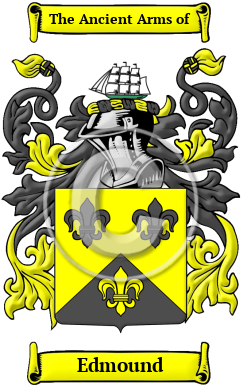
| ![Show Contents]() Edmound History, Family Crest & Coats of Arms Edmound History, Family Crest & Coats of Arms
- Origins Available:
England
Etymology of EdmoundWhat does the name Edmound mean? The name Edmound is from the ancient Anglo-Saxon culture of the Britain and comes from the given name Edmond. 1 2 Saint Edmund or Eadmund (841-870), was King of the East Angles, martyr, and saint and was born in Saxony in the city of Nüremberg in 841, being the son of King Alkmund and Queen Scivare. "Eadmund began his reign on 25 Dec. 855, and was crowned and anointed king of East Anglia by Humbert, bishop of Hulme, the following Christmas day, being then fifteen years old." 3 Edmund or Eadmund (922?-946), king of the English, was son of Eadward the Elder and Edmund called Ironside (981?-1016), was king, the third son, probably, of Æthelred the Unready. Saint Edmund (1170?-1240), was Archbishop of Canterbury, born on St. Edmund's day (20 Nov.), probably between 1170 and 1175. 3 Early Origins of the Edmound familyThe surname Edmound was first found in Oxfordshire, where the first on record of the family was Edmund of Woodstock, Earl of Kent (1301-1330), youngest son of Edward I, by his second wife, Margaret of France. Born at Woodstock, he received from his father a revenue of seven thousand marks a year. It is thought that Edward I was to confer the rich earldom of Cornwall either on Edmund or on his elder brother Thomas of Brotherton; but the accession of Edward II negated that possibility. Edward II made Edmund Lord of the Castle and Honour of Knaresborough in 1319 and the next year granted him lands of the value of two thousand marks a year. 3 Many of the early records were in Latin as per the following: Simon dl. Edmundi, Norfolk; and Thomas filius Edmundi, Kent, both listed in the Hundredorum Rolls of 1273. 4 The Testa de Nevill, sive Liber Feodorum, temp. Henry III-Edward I. included the forename Edmund filius Osmund, Berkshire, Henry III-Edward I 5 and later, the Yorkshire Poll Tax Rolls of 1379 included Johannes Edmund; and Edmundua del Grange. 4 Early History of the Edmound familyThis web page shows only a small excerpt of our Edmound research. Another 147 words (10 lines of text) covering the years 1544, 1563, 1564, 1582, 1622 and 1639 are included under the topic Early Edmound History in all our PDF Extended History products and printed products wherever possible. Edmound Spelling VariationsThe first dictionaries that appeared in the last few hundred years did much to standardize the English language. Before that time, spelling variations in names were a common occurrence. The language was changing, incorporating pieces of other languages, and the spelling of names changed with it. Edmound has been spelled many different ways, including Edmond, Edmonde, Edmon, Edmonds, Edmun, Edmund, Edmunds and many more. Early Notables of the Edmound familyJohn Edmunds (died 1544), English Master of Peterhouse. 3
Sir Clement Edmondes (1564?-1622), was Clerk to the Council, born at Shrawardine in Shropshire. His parentage is not known, but he is described in the Oxford matriculation register as a yeoman's son. 3
Thomas Edmondes (1563?-1639), was an English...
Another 46 words (3 lines of text) are included under the topic Early Edmound Notables in all our PDF Extended History products and printed products wherever possible. Migration of the Edmound familyThousands of English families in this era began to emigrate the New World in search of land and freedom from religious and political persecution. Although the passage was expensive and the ships were dark, crowded, and unsafe, those who made the voyage safely were rewarded with opportunities unavailable to them in their homeland. Research into passenger and immigration lists has revealed some of the very first Edmounds to arrive in North America: Thomas Edmond who settled in Virginia in 1654. There was a John Edmonds living in Salem, Massachusetts in 1630. Phillip Edmund brought his family to Barbados in 1663.
- Harrison, Henry, Surnames of the United Kingdom: A Concise Etymological Dictionary Baltimore: Geneological Publishing Company, 2013. Print
- Lower, Mark Anthony, Patronymica Britannica, A Dictionary of Family Names of the United Kingdom. London: John Russel Smith, 1860. Print.
- Smith, George (ed), Dictionary of National Biography. London: Smith, Elder & Co., 1885-1900. Print
- Bardsley, C.W, A Dictionary of English and Welsh Surnames: With Special American Instances. Wiltshire: Heraldry Today, 1901. Print. (ISBN 0-900455-44-6)
- Testa de Nevill or "Liber Feodorum" or "Book of Fees," thought to have been written by Ralph de Nevill, for King John (1199–1216)
 |