| ![Show Contents]() Daviss History, Family Crest & Coats of Arms Daviss History, Family Crest & Coats of Arms
Etymology of DavissWhat does the name Daviss mean? The Welsh Daviss surname is a patronymic, meaning "son of David." Ultimately derived from the Hebrew name "David," meaning "beloved," the name became a popular given name throughout Medieval Europe due to the biblical King David of Israel. The popularity of the name was further increased in Britain due to it being the name of the Patron Saint of Wales. Little is known about Saint David, but he is thought to have been a 6th century monk and bishop. The name came to be used as a patronymic name by the Brythonic people of Wales. One of the most famous bearers of this personal name in Wales was David ap Gruffydd, the last Prince of North Wales, who was executed in 1276 by King Edward I of England. Early Origins of the Daviss familyThe surname Daviss was first found in Flintshire (Welsh: Sir y Fflint), a historic county, created after the defeat of the Welsh Kingdom of Gwynedd in 1284, and located in north-east Wales, where the distinguished Daviss family held a family seat from very ancient times. They were descended from Cynrig Efell, Lord of Eglwysegle, the twin son of Madog ab Maredadd, the great grandson of Bleddyn ap Cynvin, Prince of Powys, head of the honorable and worthy third Royal Tribe of Wales, who was traitorously murdered in 1073 by the men of Ystrad Tywi, after he had governed all of Wales for 13 years. Directly descended from this line was John ap Davydd (John Davies of Gwasanau in the county of Flint). Early History of the Daviss familyThis web page shows only a small excerpt of our Daviss research. Another 65 words (5 lines of text) covering the years 1550, 1575, 1600, 1605, 1623, 1625, 1633, 1646, 1648, 1667, 1670, 1672, 1675, 1680, 1687, 1688, 1689, 1690, 1692, 1693, 1715, 1716, 1718, 1719, 1722, 1739, 1760 and 1890 are included under the topic Early Daviss History in all our PDF Extended History products and printed products wherever possible. Daviss Spelling VariationsThe Welsh have an extremely large amount of spelling variations of their native surnames to their credit. It was up to the priest or the scribe taking the official records to determine how the spoken name was to be made literal. As time progressed, the old Brythonic names of Wales were recorded in English, which was especially problematic since the English language had extreme difficulty recording the highly inflected sounds of Cymraeg. Spelling variations were, however, also carried out according to an individual's design: a branch loyalty within the family, a religious adherence, or even patriotic affiliations could be indicated by spelling variations of one's name. The spelling variations of the name Daviss have included Davies, Davis, Divis and others. Early Notables of the Daviss familyJohn Davis (1550-1605), an English navigator who discovered the Falkland Islands and what is now known as the Davis Strait; James Davis (c. 1575-c. 1623) an English ship captain and author who was part of the expedition of the Virginia Company of Plymouth which established Popham Colony, also called "Northern Virginia"; Francis Davies (1605-1675), a Welsh clergyman, Bishop of Llandaff (1667 to 1675); Edward Davis or Davies (fl. c. 1680-1688) was an English buccaneer active in the Caribbean during the 1680's; John Davies (1625-1693), a Welsh translator and writer; Joseph Davis, (fl. 1692-1715), a Welsh captain in the Hudson's...
Another 98 words (7 lines of text) are included under the topic Early Daviss Notables in all our PDF Extended History products and printed products wherever possible. Migration of the Daviss family to IrelandSome of the Daviss family moved to Ireland, but this topic is not covered in this excerpt.
Another 201 words (14 lines of text) about their life in Ireland is included in all our PDF Extended History products and printed products wherever possible.
| Daviss migration to the United States | + |
During the latter half of the 19th and the beginning of the 20th century, the people of Wales journeyed to North America to find a new life. They made major contributions to the arts, industry and commerce of both Canada and the United States, and added a rich cultural heritage to their newly adopted societies. A look at the immigration and passenger lists has shown a number of people bearing the name Daviss:
Daviss Settlers in United States in the 19th Century- John Daviss, aged 60, who arrived in Georgia in 1813 1
| Contemporary Notables of the name Daviss (post 1700) | + |
- Larkin Daviss, American Democratic Party politician, Postmaster at Bel Air, Maryland, 1841-42 2
The motto was originally a war cry or slogan. Mottoes first began to be shown with arms in the 14th and 15th centuries, but were not in general use until the 17th century. Thus the oldest coats of arms generally do not include a motto. Mottoes seldom form part of the grant of arms: Under most heraldic authorities, a motto is an optional component of the coat of arms, and can be added to or changed at will; many families have chosen not to display a motto.
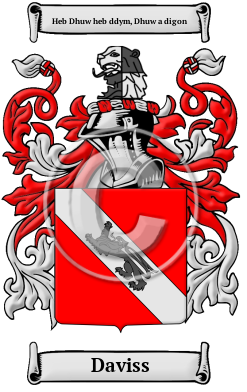
Motto: Heb Dhuw heb ddym, Dhuw a digon
Motto Translation: Without God without anything, God is enough.
- Filby, P. William, Meyer, Mary K., Passenger and immigration lists index : a guide to published arrival records of about 500,000 passengers who came to the United States and Canada in the seventeenth, eighteenth, and nineteenth centuries. 1982-1985 Cumulated Supplements in Four Volumes Detroit, Mich. : Gale Research Co., 1985, Print (ISBN 0-8103-1795-8)
- The Political Graveyard: Alphabetical Name Index. (Retrieved 2015, December 11) . Retrieved from http://politicalgraveyard.com/alpha/index.html
 |