| ![Show Contents]() Daffydd History, Family Crest & Coats of Arms Daffydd History, Family Crest & Coats of Arms
Etymology of DaffyddWhat does the name Daffydd mean? The Daffydd name, which is a very unique Celtic origin, came from the rugged landscape of Wales. This Brythonic Celtic name is from the personal name David, which means darling or friend. This name was common in England and Scotland from the 12th century onward, but was particularly popular in Wales even earlier. One of the most famous bearers of this personal name in Wales was David ap Gryffydd, the last Prince of North Wales, who was executed c. 1276 by King Edward I of England. Early Origins of the Daffydd familyThe surname Daffydd was first found in Cheshire, where they held a family seat from very ancient times. The name is conjecturally descended from David ap Gryffydd, the last Prince of North Wales who was executed by King Edward I of England about 1276. "St. David, is said to have been a Welsh Briton, born about the year 480, and bred up in the Christian religion. Coming to years of maturity, he became learned in all the liberal arts and sciences, and was finally constituted bishop of Menevia near Anglesea. From this place he went on pilgrimage to Jerusalem, and after his return was the reputed metropolitan of all the British churches." 1 David ap Gwilym (14th cent.), the celebrated Welsh bard, was born, according to one tradition, at Bro Gynin in the parish of Llanbadarn Vawr, Cardiganshire, about 1340, and dying there about 1400, was buried in the abbey of Ystrad Flur in the same county. 2 Early History of the Daffydd familyThis web page shows only a small excerpt of our Daffydd research. Another 63 words (4 lines of text) covering the years 1647, 1680 and 1690 are included under the topic Early Daffydd History in all our PDF Extended History products and printed products wherever possible. Daffydd Spelling VariationsThe Welsh have an extremely large amount of spelling variations of their native surnames to their credit. It was up to the priest or the scribe taking the official records to determine how the spoken name was to be made literal. As time progressed, the old Brythonic names of Wales were recorded in English, which was especially problematic since the English language had extreme difficulty recording the highly inflected sounds of Cymraeg. Spelling variations were, however, also carried out according to an individual's design: a branch loyalty within the family, a religious adherence, or even patriotic affiliations could be indicated by spelling variations of one's name. The spelling variations of the name Daffydd have included David, Dafydd, Dewi, Davith and others. Early Notables of the Daffydd familyDavid ap Gryffydd, Prince of North Wales.
Thomas Daffy (d. 1680), was the inventor of Daffy's 'elixir salutis,' and a clergyman, who in 1647 was presented by the Earl of Rutland to the living...
Another 32 words (2 lines of text) are included under the topic Early Daffydd Notables in all our PDF Extended History products and printed products wherever possible. Migration of the Daffydd family to IrelandSome of the Daffydd family moved to Ireland, but this topic is not covered in this excerpt.
Another 31 words (2 lines of text) about their life in Ireland is included in all our PDF Extended History products and printed products wherever possible. Migration of the Daffydd familyDuring the latter half of the 19th and the beginning of the 20th century, the people of Wales journeyed to North America to find a new life. They made major contributions to the arts, industry and commerce of both Canada and the United States, and added a rich cultural heritage to their newly adopted societies. A look at the immigration and passenger lists has shown a number of people bearing the name Daffydd: John David who settled in Boston in 1649; John David settled in Virginia in 1635; another John settled in Virginia in 1663; along with Joseph, Lewis, Rendall, and William.
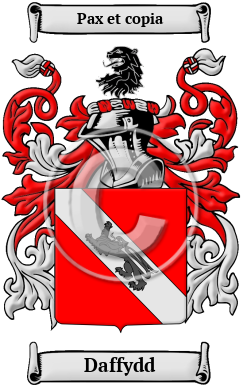
The motto was originally a war cry or slogan. Mottoes first began to be shown with arms in the 14th and 15th centuries, but were not in general use until the 17th century. Thus the oldest coats of arms generally do not include a motto. Mottoes seldom form part of the grant of arms: Under most heraldic authorities, a motto is an optional component of the coat of arms, and can be added to or changed at will; many families have chosen not to display a motto.
Motto: Pax et copia
Motto Translation: Peace and plenty.
- Hutchins, Fortescue, The History of Cornwall, from the Earliest Records and Traditions to the Present Time. London: William Penaluna, 1824. Print
- Smith, George (ed), Dictionary of National Biography. London: Smith, Elder & Co., 1885-1900. Print
 |