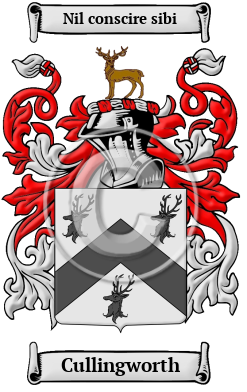
| ![Show Contents]() Cullingworth History, Family Crest & Coats of Arms Cullingworth History, Family Crest & Coats of Arms
Etymology of CullingworthWhat does the name Cullingworth mean? The name Cullingworth a local surname having originated in either Callingwood (Collingwood), Staffordshire or Collingwood, Northumberland. The Northumberland origin is perhaps more likely as the lion's share of the name is found there. The name itself is derived literally means "the wood of disputed ownership." 1 Early Origins of the Cullingworth familyThe surname Cullingworth was first found in Callingwood (Collingwood), Staffordshire 2 or perhaps Collingwood in Northumberland. 3 4 Bardsley continues with "this is a Northumberland surname, and it has flourished there for centuries." 5 In Staffordshire, we found Richard de Calangwode in the Assize Rolls of 1323 and Richard de Chalaungwode in the Subsidy Rolls for 1327. Later in Cheshire, we found John atte Calengwode in 1349 and later again, Ralph Colyngwood in 1516. 1 "The Collingwoods belong to an ancient Northumberland family that flourished at Eslington for centuries. During the last 300 years, however, the Collingwoods have formed an important family in the county of Durham, which may now be considered the home of the name." 3 The township of Little Rye in Northumberland was an early home of this distinguished family. "This was the seat of the fourth son of Sir Daniel Collingwood, of Brandon, the descendant of Sir Cuthbert Collingwood, of Eslington, whose family were celebrated for their feats of border chivalry, and held considerable possessions in these parts. Alexander Collingwood, who resided at Little Ryle, was High Sheriff of the county in 1725. The old Hall, which stood in a fine sheltered situation, has long been in ruins." 6 A branch of the family was established in North Dissington, Northumberland in early times. "This place was formerly the property and residence of a junior branch of the Delaval family, of whom Admiral Sir Ralph Delaval, a native of the township, sold the estate to Mr. Collingwood, of Byker, from whom it descended to its present possessor. The Hall, the seat of Mr. Collingwood, is a substantial stone mansion, erected in 1797, and contains a small collection of pictures. " 6 Early History of the Cullingworth familyThis web page shows only a small excerpt of our Cullingworth research. Another 155 words (11 lines of text) covering the years 1497, 1504, 1507, 1513, 1575, 1597, 1634, 1679, 1681, 1715, 1716 and 1726 are included under the topic Early Cullingworth History in all our PDF Extended History products and printed products wherever possible. Cullingworth Spelling VariationsSpelling variations of this family name include: Collingwood, Colingwood, Callingwood, Gollingwood and many more. Early Notables of the Cullingworth familyRoger Collingwood (fl. 1513), English mathematician, elected a fellow of Queens' College, Cambridge, in 1497. He was dean of his college in 1504, and obtained a license on 16 Sept. 1507 to travel on the continent during four years for the purpose of studying canon law. 7
Cuthbert Collingwood (d. 1597) an English landowner who was captured at the Raid of the Redeswire in 1575 and taken to Scotland, where he was known as "that courteous knight."
Daniel Collingwood (c.1634-1681), was an English politician, Member of Parliament for Morpeth (1679-1681).
George...
Another 87 words (6 lines of text) are included under the topic Early Cullingworth Notables in all our PDF Extended History products and printed products wherever possible.
| Cullingworth migration to Australia | + |
Cullingworth Settlers in Australia in the 19th Century- Mr. George Cullingworth, (b. 1805), aged 25, English labourer who was convicted in Yorkshire, England for 7 years for poaching, transported aboard the "Florentia" on 11th August 1830, arriving in New South Wales, Australia 8
| Cullingworth migration to New Zealand | + |
Emigration to New Zealand followed in the footsteps of the European explorers, such as Captain Cook (1769-70): first came sealers, whalers, missionaries, and traders. By 1838, the British New Zealand Company had begun buying land from the Maori tribes, and selling it to settlers, and, after the Treaty of Waitangi in 1840, many British families set out on the arduous six month journey from Britain to Aotearoa to start a new life. Early immigrants include: Cullingworth Settlers in New Zealand in the 19th Century- J Cullingworth, who landed in Nelson, New Zealand in 1842
The motto was originally a war cry or slogan. Mottoes first began to be shown with arms in the 14th and 15th centuries, but were not in general use until the 17th century. Thus the oldest coats of arms generally do not include a motto. Mottoes seldom form part of the grant of arms: Under most heraldic authorities, a motto is an optional component of the coat of arms, and can be added to or changed at will; many families have chosen not to display a motto.
Motto: Nil conscire sibi
Motto Translation: To have a conscience free from guilt.
- Reaney, P.H and R.M. Wilson, A Dictionary of English Surnames. London: Routledge, 1991. Print. (ISBN 0-415-05737-X)
- Hanks, Patricia and Flavia Hodges, A Dictionary of Surnames. Oxford: Oxford University Press, 1988. Print. (ISBN 0-19-211592-8)
- Guppy, Henry Brougham, Homes of Family Names in Great Britain. 1890. Print.
- Bardsley, C.W, A Dictionary of English and Welsh Surnames: With Special American Instances. Wiltshire: Heraldry Today, 1901. Print. (ISBN 0-900455-44-6)
- Lower, Mark Anthony, Patronymica Britannica, A Dictionary of Family Names of the United Kingdom. London: John Russel Smith, 1860. Print.
- Lewis, Samuel, A Topographical Dictionary of England. Institute of Historical Research, 1848, Print.
- Smith, George (ed), Dictionary of National Biography. London: Smith, Elder & Co., 1885-1900. Print
- Convict Records Voyages to Australia (Retrieved 11th October 2022). https://convictrecords.com.au/ships/florentia
 |