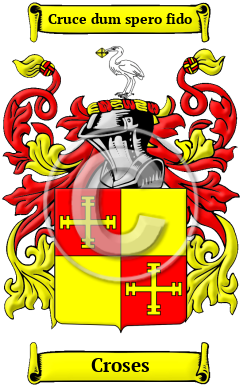
| ![Show Contents]() Croses History, Family Crest & Coats of Arms Croses History, Family Crest & Coats of Arms
Etymology of CrosesWhat does the name Croses mean? The Croses name has descended through the generations from the ancient Anglo-Saxon culture. Their name comes from having lived as dwellers at a cross or crucifix. The surname Croses originally derived from the Old English word crosse, which means cross. 1 2 3 Early Origins of the Croses familyThe surname Croses was first found in Lincolnshire. The name was first found to be in the southern English counties of Lincolnshire, Buckingham, and Oxfordshire, about the year 1250. By the year 1340 the most important branch of the name had moved northward to Lancashire, and established manors and estates at Crosse Hall, just outside Liverpool. This branch also moved into the Cross of Ledsham to the south in the county of Cheshire. The Yorkshire Poll Tax of 1379 included: Johannes del Crosse; Johanna del Crosse; and Andreas de la Croys while the Hundredorum Rolls of 1273 still had a few Latin entries for the family: Jordan ad Crucem, Buckinghamshire; Humfrey de Cruce, Oxfordshire; and Conan ad Crucem, Lincolnshire. 3 The name is "rare or absent in the northern counties, and in the south coast counties. Mostly confined to the east centre of England and to the adjacent coast counties between the Wash and the Thames." 4 In Norfolk, Thomas atte-cross, was Rector of Bexwell, Norfolk (no date given) 5 In Lancashire, Richard del Crosse was found there in the Assize Rolls of 1285 and later William atte Cros was listed in the Subsidy Rolls for Suffolk in 1327. 6 Early History of the Croses familyThis web page shows only a small excerpt of our Croses research. Another 74 words (5 lines of text) covering the years 1590, 1606, 1609, 1610, 1613, 1616, 1621, 1627, 1630, 1632, 1633, 1641, 1646, 1650, 1655, 1660, 1662, 1664, 1671, 1672, 1674, 1680, 1682, 1683, 1686, 1689, 1691, 1698, 1700, 1718, 1724, 1738, 1762 and 1890 are included under the topic Early Croses History in all our PDF Extended History products and printed products wherever possible. Croses Spelling VariationsOnly recently has spelling become standardized in the English language. As the English language evolved in the Middle Ages, the spelling of names changed also. The name Croses has undergone many spelling variations, including Cross, Crosse, Croce, Crosce, Croise, Croice and others. Early Notables of the Croses familyJohn Cross (1630-1689), Franciscan friar, a native of Norfolk, and his real name appears to have been More. He took the habit of St. Francis in or about 1646, and was declared D.D. on 12 Oct. 1672. On 10 May 1674 he was elected provincial of his order in England for three years, and being re-elected on 25 April 1686. 7
Michael Cross (fl. 1630-1660), the painter, obtained great renown as a copyist in the reign of Charles I. He is doubtless identical with Miguel de la Cruz, a painter at Madrid, who in 1633 executed copies for Charles I of the...
Another 331 words (24 lines of text) are included under the topic Early Croses Notables in all our PDF Extended History products and printed products wherever possible. Migration of the Croses family to IrelandSome of the Croses family moved to Ireland, but this topic is not covered in this excerpt.
Another 57 words (4 lines of text) about their life in Ireland is included in all our PDF Extended History products and printed products wherever possible. Migration of the Croses familyTo escape the unstable social climate in England of this time, many families boarded ships for the New World with the hope of finding land, opportunity, and greater religious and political freedom. Although the voyages were expensive, crowded, and difficult, those families that arrived often found greater opportunities and freedoms than they could have experienced at home. Many of those families went on to make significant contributions to the rapidly developing colonies in which they settled. Early North American records indicate many people bearing the name Croses were among those contributors: John Cross, who came from Ipswich, England, on the sailing ship the "Elizabeth" in 1634. Another John Cross settled a year later, also from Ipswich, and he became a freeman in Hampton in 1635. John Cross was constable of Wells, Massachusetts Bay Colony, in 1647. John Croos (same family) settled in Boston in 1633.
The motto was originally a war cry or slogan. Mottoes first began to be shown with arms in the 14th and 15th centuries, but were not in general use until the 17th century. Thus the oldest coats of arms generally do not include a motto. Mottoes seldom form part of the grant of arms: Under most heraldic authorities, a motto is an optional component of the coat of arms, and can be added to or changed at will; many families have chosen not to display a motto.
Motto: Cruce dum spero fido
Motto Translation: Whilst I have breath I confide in the cross.
- Smith, Eldson Coles, New Dictionary of American Family Names New York: Harper & Row, 1956. Print
- Black, George F., The Surnames of Scotland Their Origin, Meaning and History. New York: New York Public Library, 1946. Print. (ISBN 0-87104-172-3)
- Bardsley, C.W, A Dictionary of English and Welsh Surnames: With Special American Instances. Wiltshire: Heraldry Today, 1901. Print. (ISBN 0-900455-44-6)
- Guppy, Henry Brougham, Homes of Family Names in Great Britain. 1890. Print.
- Rye, Walter, A History of Norfolk. London: Elliot Stock, 62, Paternoster Row, 1885. Print
- Reaney, P.H and R.M. Wilson, A Dictionary of English Surnames. London: Routledge, 1991. Print. (ISBN 0-415-05737-X)
- Smith, George (ed), Dictionary of National Biography. London: Smith, Elder & Co., 1885-1900. Print
 |