| ![Show Contents]() Crichtant History, Family Crest & Coats of Arms Crichtant History, Family Crest & Coats of Arms
Etymology of CrichtantWhat does the name Crichtant mean? The ancestors of the first family to use the name Crichtant lived among the Boernician tribe of ancient Scotland. They lived near a border. This surname came from the Gaelic word crioch and the Old English word tune, which mean border and farm or settlement, respectively. Thus, the surname indicates that the original bearer lived near a border. The name may also have derived from a place name, such as Crichton, near Edinburgh, or the territories of Kreiton in Lothian. Further to the south in West Northamptonshire, England, Creaton, a village and civil parish which dates back to the Domesday Book of 1086 where it was known as Creaton Magna (Large Creaton) and Creaton Parva (now Little Creaton). 1 Early Origins of the Crichtant familyThe surname Crichtant was first found in Midlothian, where they held a family seat from very ancient times, some say well before the Norman Conquest and the arrival of Duke William at Hastings in 1066 A.D. The first on record was Turstan Crectune, who was granted lands by King David of Scotland in 1128. Alexander and Thomas Creighton both having territories in Berwickshire rendered homage to King Edward I of England on his brief conquest of Scotland, in 1296. 2 Early History of the Crichtant familyThis web page shows only a small excerpt of our Crichtant research. Another 177 words (13 lines of text) covering the years 1450, 1514, 1543, 1560, 1582, 1585, 1593, 1598, 1612, 1613, 1639, 1662, 1670, 1672, 1674, 1691, 1734, 1797, 1890 and 1902 are included under the topic Early Crichtant History in all our PDF Extended History products and printed products wherever possible. Crichtant Spelling VariationsBoernician names that evolved in the largely preliterate Middle Ages are often marked by considerable spelling variations. Crichtant has been spelled Crichton, Creighton, Creaton, Craighton, Creton, Creeton, Crichten, Crighton, Chreichton, Creichtone, Creychton, Creychtoun and many more. Early Notables of the Crichtant familyLord Crichton, Viscount Frendraught; William Crichton, 1st Lord Crichton of Sanquhar (died 1450s) ; Robert Crichton (died 1585), Catholic cleric, nephew of George Crichton, (d. 1543), Bishop of Dunkeld; and Robert Crichton, 6th Lord Sanquhar (died 1612); William Crichton (1598-1691), 2nd Earl of Dumfries; and James Crichton of Clunie (1560-1582), better known as the Admirable Crichton, a Scottish polymath noted for his extraordinary...
Another 62 words (4 lines of text) are included under the topic Early Crichtant Notables in all our PDF Extended History products and printed products wherever possible. Migration of the Crichtant family to IrelandSome of the Crichtant family moved to Ireland, but this topic is not covered in this excerpt.
Another 81 words (6 lines of text) about their life in Ireland is included in all our PDF Extended History products and printed products wherever possible. Migration of the Crichtant familySome of the Boernician-Scottish Clan families who came to North America were Loyalists who went north to Canada after the American War of Independence. Families on both sides of the border went on to found two of the world's great nations. This century, families with Scottish roots have rediscovered their heritage through highland games and Clan societies. An inquiry into the early roots of North American families reveals a number of immigrants bearing the name Crichtant or a variant listed above: John Crichton who settled in New Jersey in 1686; James Crichton settled in New York in 1820; James Critton settled in Potomac Maryland in 1747; Ann Crighton settled in Philadelphia, Pennsylvania in 1774.
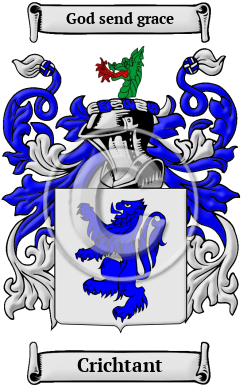
The motto was originally a war cry or slogan. Mottoes first began to be shown with arms in the 14th and 15th centuries, but were not in general use until the 17th century. Thus the oldest coats of arms generally do not include a motto. Mottoes seldom form part of the grant of arms: Under most heraldic authorities, a motto is an optional component of the coat of arms, and can be added to or changed at will; many families have chosen not to display a motto.
Motto: God send grace
- Williams, Dr Ann. And G.H. Martin, Eds., Domesday Book A Complete Translation. London: Penguin, 1992. Print. (ISBN 0-141-00523-8)
- Black, George F., The Surnames of Scotland Their Origin, Meaning and History. New York: New York Public Library, 1946. Print. (ISBN 0-87104-172-3)
 |