| ![Show Contents]() Crafford History, Family Crest & Coats of Arms Crafford History, Family Crest & Coats of Arms
- Origins Available:
Scotland
Ireland
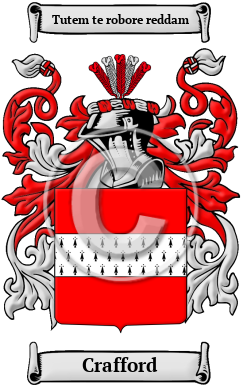
Etymology of CraffordWhat does the name Crafford mean? The surname Crafford is a topographic surname, which was given to a person who resided near a physical feature such as a hill, stream, church, or type of tree. Habitation names form the other broad category of surnames that were derived from place-names. They were derived from pre-existing names for towns, villages, parishes, or farmsteads. Other local names are derived from the names of houses, manors, estates, regions, and entire counties. As a general rule, the greater the distance between an individual and their homeland, the larger the territory they were named after. For example, a person who only moved to another parish would be known by the name of their original village, while people who migrated to a different country were often known by the name of a region or country from which they came. The name Crafford is derived from the Old English words "crawa," which means "crow," and "ford," which means "a river crossing," and indicates that the original bearer lived near a ford where crows nested. Crafford Coat of Arms CreationAccording to ancient records, King David I., commonly called ' The sair saint,' was hunting on Holy-rood-day near Edinburgh, when there appeared a hart or a stag, with a cross betwixt his horns, which ran at the king so furiously and dismounted him from his horse, that he was in hazard to be killed, if one of his attendants, Sir Gregan Crawford, had not inter-posed. The pious king, taking this as a reproof for hunting on such a holy day, erected a church on the place called Holy-rood-house, and the head of a stag with a cross between his horns became the badge of that Abbacy, and also the armorial figures of Sir Gregan Crawford. 1 Early Origins of the Crafford familyThe surname Crafford was first found in Lanarkshire (Gaelic: Siorrachd Lannraig) a former county in the central Strathclyde region of Scotland, now divided into the Council Areas of North Lanarkshire, South Lanarkshire, and the City of Glasgow, where the family resided in this area as early as the 11th century when Alan, the youngest son of the 4th Earl of Richmond, received a large grant of lands from King William the Conqueror. When King David of Scotland moved north to assume the throne in 1130, some Crawfords accompanied him on his journey. Galfredus Crawford would gain lands in Clydesdale and his son, Sir Reginald, acquired the barony of Loudoun, from which a significant branch of the Campbells would develop. Later, Reginald de Crauford, John de Crauford and William de Crauford are all recorded as paying homage to Edward I in 1296. 2 Early History of the Crafford familyThis web page shows only a small excerpt of our Crafford research. Another 107 words (8 lines of text) covering the years 1240, 1297, 1530, 1603, 1625, 1643, 1710 and 1890 are included under the topic Early Crafford History in all our PDF Extended History products and printed products wherever possible. Crafford Spelling VariationsSpelling variations of this family name include: Crawford, Crawfurd, Craufurd, Crawferd, Crawfford, Crafford, Craford, Crafort, Crayford and many more. Early Notables of the Crafford familySir Ronald Crawford (c. 1240-1297), 4th Sheriff of Ayrshire, Chief of Clan Crawford, and Lord of Loudon Castle; Captain Thomas Crawford (1530-1603) of Jordanhill, trusted confidant of Henry Stuart, Lord Darnley, husband of Queen Mary; and Colonel David Crawford (c. 1625-1710)...
Another 41 words (3 lines of text) are included under the topic Early Crafford Notables in all our PDF Extended History products and printed products wherever possible. Migration of the Crafford family to IrelandSome of the Crafford family moved to Ireland, but this topic is not covered in this excerpt.
Another 56 words (4 lines of text) about their life in Ireland is included in all our PDF Extended History products and printed products wherever possible.
| Crafford migration to the United States | + |
Crafford Settlers in United States in the 17th Century- Dorothy Crafford, who landed in Virginia in 1642 3
- Martin Crafford, who landed in Virginia in 1647 3
- Phill Crafford, who arrived in Virginia in 1652 3
- Elizab Crafford, who arrived in Virginia in 1652 3
- George Crafford, who landed in Maryland in 1658 3
- ... (More are available in all our PDF Extended History products and printed products wherever possible.)
| Crafford migration to Canada | + |
Crafford Settlers in Canada in the 18th Century- Mr. James Crafford U.E. who settled in Canada c. 1783 4
- Mr. John Crafford, "Crofford" U.E. who settled in St. Andrews, Charlotte County, New Brunswick c. 1783; member of the Penobscot Association 4
| Crafford migration to West Indies | + |
The British first settled the British West Indies around 1604. They made many attempts but failed in some to establish settlements on the Islands including Saint Lucia and Grenada. By 1627 they had managed to establish settlements on St. Kitts (St. Christopher) and Barbados, but by 1641 the Spanish had moved in and destroyed some of these including those at Providence Island. The British continued to expand the settlements including setting the First Federation in the British West Indies by 1674; some of the islands include Barbados, Bermuda, Cayman Island, Turks and Caicos, Jamaica and Belize then known as British Honduras. By the 1960's many of the islands became independent after the West Indies Federation which existed from 1958 to 1962 failed due to internal political conflicts. After this a number of Eastern Caribbean islands formed a free association. 5Crafford Settlers in West Indies in the 18th Century- Alex Crafford, who landed in Antigua (Antego) in 1730 3
| Historic Events for the Crafford family | + |
- Sarah Crafford, who was traveling aboard the ship "SS Atlantic" when it struck rocks off Nova Scotia in 1873, died in the sinking
The motto was originally a war cry or slogan. Mottoes first began to be shown with arms in the 14th and 15th centuries, but were not in general use until the 17th century. Thus the oldest coats of arms generally do not include a motto. Mottoes seldom form part of the grant of arms: Under most heraldic authorities, a motto is an optional component of the coat of arms, and can be added to or changed at will; many families have chosen not to display a motto.
Motto: Tutem te robore reddam
Motto Translation: I will make thee safe by my strength
- Polson, Alexander, The Romance of Scottish Crests and Mottoes. Inverness: Walter Alexander, Inglis Street 1929. Print
- Black, George F., The Surnames of Scotland Their Origin, Meaning and History. New York: New York Public Library, 1946. Print. (ISBN 0-87104-172-3)
- Filby, P. William, Meyer, Mary K., Passenger and immigration lists index : a guide to published arrival records of about 500,000 passengers who came to the United States and Canada in the seventeenth, eighteenth, and nineteenth centuries. 1982-1985 Cumulated Supplements in Four Volumes Detroit, Mich. : Gale Research Co., 1985, Print (ISBN 0-8103-1795-8)
- Rubincam, Milton. The Old United Empire Loyalists List. Genealogical Publishing Co., Inc, 1976. (Originally published as; United Empire Loyalists. The Centennial of the Settlement of Upper Canada. Rose Publishing Company, 1885.) ISBN 0-8063-0331-X
- https://en.wikipedia.org/wiki/British_West_Indies
 |