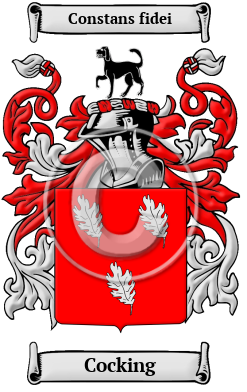
| ![Show Contents]() Cocking History, Family Crest & Coats of Arms Cocking History, Family Crest & Coats of Arms
Etymology of CockingWhat does the name Cocking mean? Celtic in origin, the name Cocking came from the rugged landscape of Wales. The name's origins go back to a time when the Cocking family lived in the parish of Cogan, which is in the diocese of Llandaff in the county of Glamorgan. The name literally means "a cup or bowl" 1 and probably meant "dweller in a bowl-shaped valley." 2 Early Origins of the Cocking familyThe surname Cocking was first found in Glamorganshire (Welsh: Sir Forgannwg), a region of South Wales, anciently part of the Welsh kingdom of Glywysing at Cogan, a parish, in the union of Cardiff, hundred of Dinas-Powys, county of Glamorgan, South Wales. 3 "Cogan or Coggan is an ancient west of England name. There was a John de Cogan, of Hunispull, Somerset, in the reign of Edward I.; and in the reign of Richard II., William Cogan was sheriff of the county. De Cogan was a name found also in different parts of Devonshire in the time of Edward I., and it has long been an old Tiverton name." 4 Exploring Somerset in more detail, Richard Cogan was registered there 1 Edward III (during the first year of the reign of King Edward III) 5 and the Hundredorum Rolls of 1273 included: John de Cogan, Somerset; and John de Cogan, Devon 6 "From this it is clear that the south-west forms of the surname are derived from the Llandaff parish. To Somerset and Devon was not a long journey." 6 In Devon, Bampton was the passed from the Paganell "heiress to Sir Milo Cogan, 'the great soldier and undertaker of the Irish Conquest.' Her descendant, Richard Cogan, had licence in 1336 to castellate his mansion house at Bampton, and to empark his wood and other lands at Uffculme. Every vestige of the castle has long disappeared." 7 Scotland was home to the family about this time. "Peter Cogan witnessed the gift of an acre of land in Coldingham to the monks of St. Cuthbert, and Robert Cogan witnessed a charter of lands in Raynigton to the Priory of Coldingham, 1275. Robert Cogan del counte de Berewyk rendered homage, 1296. [(to King Edward I during his invasion of Scotland)]" 8 The name "is uncommon in the Isle of Man." 9 Early History of the Cocking familyThis web page shows only a small excerpt of our Cocking research. Another 183 words (13 lines of text) covering the years 1172, 1230, 1233, 1278, 1545, 1591, 1593, 1605, 1607, 1684, 1686, 1716, 1723, 1731, 1780 and 1809 are included under the topic Early Cocking History in all our PDF Extended History products and printed products wherever possible. Cocking Spelling VariationsThere are relatively few surnames native to Wales, but they have an inordinately large number of spelling variations. Early variations of Welsh surnames can be explained by the fact that very few people in the early Middle Ages were literate. Priests and the few other literate people were responsible for recording names in official documents. And because most people could not specific how to properly record their names it was up to the individual recorder of that time to determine how a spoken name should be recorded. Variations due to the imprecise or improper recording of a name continued later in history when names originally composed in the Brythonic Celtic, language of Wales, known by natives as Cymraeg, were transliterated into English. Welsh names that were documented in English often changed dramatically since the native language of Wales, which was highly inflected, did not copy well. Occasionally, however, spelling variations were carried out according to an individual's specific design: a branch loyalty within the family, a religious adherence, or even patriotic affiliations could be indicated by minor variations. The spelling variations of the name Cocking have included Cogan, Cogen, Coogan, Coogen, Coogin, Coggan, Coggen, Coggin, Coggins, Gogan, Goggin and many more. Early Notables of the Cocking familyThomas Cogan (1545?-1607), English physician, born about 1545 at Chard, Somersetshire. He was educated at Oxford. He practised as a physician at Manchester. Before 1686 he married Ellen, daughter of Sir Edmund Trafford, and widow of Thomas Willott, who had property in...
Another 42 words (3 lines of text) are included under the topic Early Cocking Notables in all our PDF Extended History products and printed products wherever possible. Migration of the Cocking family to IrelandSome of the Cocking family moved to Ireland, but this topic is not covered in this excerpt.
Another 93 words (7 lines of text) about their life in Ireland is included in all our PDF Extended History products and printed products wherever possible.
| Cocking migration to the United States | + |
North America in the 1800s and 1900s saw the arrival of many Welsh people hoping to share in the wealth of land, work, and freedom that they felt North America held. Those who made the journey often attained those expectations, but only through an enormous amount of hard work, perseverance, and often a bout of good luck. These immigrants helped contribute to the growth of industry, commerce, and culture of both Canada and the United States. Discovered in the immigration and passenger lists were a number of people bearing the name Cocking:
Cocking Settlers in United States in the 19th Century- Luke Cocking, aged 25, who arrived in New York in 1862 10
- Margaret Cocking, aged 21, who landed in New York in 1862 10
- Mary Cocking, who arrived in New York in 1862 10
Cocking Settlers in United States in the 20th Century- Mr. Frederick Cocking, (b. 1885), aged 18, Cornish groom travelling aboard the ship "New York" arriving at Ellis Island, New York on 3rd May 1903 en route to Chicago, Illinois, USA 11
- Mr. Thomas T. Cocking, (b. 1886), aged 18, Cornish miner travelling aboard the ship "New York" arriving at Ellis Island, New York in 1904 en route to Calumet, Michigan, USA 11
- Miss Grace Cocking, (b. 1867), aged 38, Cornish settler travelling aboard the ship "Philadelphia" arriving at Ellis Island, New York on 24th June 1905 en route to New Boston, Michigan, USA 11
- Mrs. Lillie Cocking, (b. 1883), aged 22, Cornish settler travelling aboard the ship "Campania" arriving at Ellis Island, New York in 1905 en route to Globe, Arizona, USA 11
- Mr. Ralph Cocking, (b. 1868), aged 37, Cornish carpenter travelling aboard the ship "Lucania" arriving at Ellis Island, New York on 15th April 1905 en route to Oglesby, Illinois, USA 11
- ... (More are available in all our PDF Extended History products and printed products wherever possible.)
| Cocking migration to Australia | + |
Cocking Settlers in Australia in the 19th Century- William Cocking, who arrived in Adelaide, Australia aboard the ship "Britannia" in 1846 12
- Thomas Cocking, who arrived in Adelaide, Australia aboard the ship "Theresa" in 1847 13
- Catherine Cocking, who arrived in Adelaide, Australia aboard the ship "Constance" in 1848 14
- John Cocking, who arrived in Adelaide, Australia aboard the ship "Constance" in 1848 14
- Joseph Cocking, who arrived in Adelaide, Australia aboard the ship "Constance" in 1848 14
- ... (More are available in all our PDF Extended History products and printed products wherever possible.)
| Cocking migration to New Zealand | + |
Emigration to New Zealand followed in the footsteps of the European explorers, such as Captain Cook (1769-70): first came sealers, whalers, missionaries, and traders. By 1838, the British New Zealand Company had begun buying land from the Maori tribes, and selling it to settlers, and, after the Treaty of Waitangi in 1840, many British families set out on the arduous six month journey from Britain to Aotearoa to start a new life. Early immigrants include: Cocking Settlers in New Zealand in the 19th Century- William Cocking, who landed in Wellington, New Zealand in 1840
- Miss Elizabeth Cocking, (b. 1834), aged 28, British settler travelling from London aboard the ship 'Mermaid' arriving in Lyttelton, Christchurch, South Island, New Zealand on 26th December 1862 15
- Mr. Thomas Cocking, (b. 1839), aged 23, British farm labourer travelling from London aboard the ship 'Mermaid' arriving in Lyttelton, Christchurch, South Island, New Zealand on 26th December 1862 15
- Mrs. Elizabeth Cocking, (b. 1834), aged 28, Cornish settler departing on 29th September 1862 aboard the ship "Mermaid" arriving in Lyttelton, Canterbury, New Zealand on 26th December 1862 16
- Mr. Thomas Cocking, (b. 1839), aged 23, Cornish farm labourer departing on 29th September 1862 aboard the ship "Mermaid" arriving in Lyttelton, Canterbury, New Zealand on 26th December 1862 16
- ... (More are available in all our PDF Extended History products and printed products wherever possible.)
| Contemporary Notables of the name Cocking (post 1700) | + |
- Samuel Cocking (1845-1914), English merchant in Yokohama, founder of Cocking & Co which specialized in trading Japanese curios, art and antiques, founder of the Yokohama Cooperative Electric Light Company
- Robert Cocking (1776-1837), British watercolour artist who died in the first parachute accident
The motto was originally a war cry or slogan. Mottoes first began to be shown with arms in the 14th and 15th centuries, but were not in general use until the 17th century. Thus the oldest coats of arms generally do not include a motto. Mottoes seldom form part of the grant of arms: Under most heraldic authorities, a motto is an optional component of the coat of arms, and can be added to or changed at will; many families have chosen not to display a motto.
Motto: Constans fidei
Motto Translation: Constant to honor.
- Harrison, Henry, Surnames of the United Kingdom: A Concise Etymological Dictionary Baltimore: Geneological Publishing Company, 2013. Print
- Smith, Eldson Coles, New Dictionary of American Family Names New York: Harper & Row, 1956. Print
- Lewis, Samuel, A Topographical Dictionary of Wales. Institute of Historical Research, 1849, Print.
- Guppy, Henry Brougham, Homes of Family Names in Great Britain. 1890. Print.
- Dickinson, F.H., Kirby's Quest for Somerset of 16th of Edward the 3rd London: Harrison and Sons, Printers in Ordinary to Her Majesty, St, Martin's Lane, 1889. Print.
- Bardsley, C.W, A Dictionary of English and Welsh Surnames: With Special American Instances. Wiltshire: Heraldry Today, 1901. Print. (ISBN 0-900455-44-6)
- Worth, R.N., A History of Devonshire London: Elliot Stock, 62, Paternoster Row, E.G., 1895. Digital
- Black, George F., The Surnames of Scotland Their Origin, Meaning and History. New York: New York Public Library, 1946. Print. (ISBN 0-87104-172-3)
- Moore, A.W., Manx Names. London: Elliot Stock, 62 Paternoster Row, 1906. Print
- Filby, P. William, Meyer, Mary K., Passenger and immigration lists index : a guide to published arrival records of about 500,000 passengers who came to the United States and Canada in the seventeenth, eighteenth, and nineteenth centuries. 1982-1985 Cumulated Supplements in Four Volumes Detroit, Mich. : Gale Research Co., 1985, Print (ISBN 0-8103-1795-8)
- Cornwall Online Parish Clerks. (Retrieved 3rd May 2018). Retrieved from http://www.opc-cornwall.org/Resc/pdfs/emigration_ellis_island_1892_on.pdf
- State Records of South Australia. (Retrieved 2010, November 5) BRITANNIA 1846. Retrieved from http://www.slsa.sa.gov.au/BSA/1846Britannia.htm
- State Records of South Australia. (Retrieved 2010, November 5) THERESA 1847. Retrieved from http://www.slsa.sa.gov.au/BSA/1847Theresa.htm
- State Records of South Australia. (Retrieved 2010, November 5) CONSTANCE - 1848. Retrieved from http://www.slsa.sa.gov.au/BSA/1848Constance.htm
- New Zealand Yesteryears Passenger Lists 1800 to 1900 (Retrieved 17th October 2018). Retrieved from http://www.yesteryears.co.nz/shipping/passlist.html
- Cornwall Online Parish Clerks. (Retrieved 2018, April 30). Emigrants to Lyttelton 1858-84 [PDF]. Retrieved from http://www.opc-cornwall.org/Resc/pdfs/new_zealand_assisted.pdf
 |