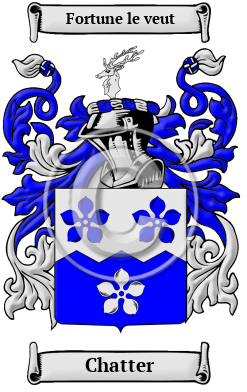
| ![Show Contents]() Chatter History, Family Crest & Coats of Arms Chatter History, Family Crest & Coats of Arms
- Origins Available:
England
Etymology of ChatterWhat does the name Chatter mean? The name Chatter was brought to England in the wave of migration that followed the Norman Conquest of 1066. The Chatter family lived in Bedfordshire. They were originally from Carteret Manche, Normandy, 1 having derived their name from the Ancient French word acatour, or acateor,which both mean "buyer" as in "buyer of provisions for a large household." 2 Other sources claim the name was "derived from the office of king's escheator-the person appointed to inquire into escheats, or property lapsing to the crown through want of heirs and other causes." 3 4 Early Origins of the Chatter familyThe surname Chatter was first found in Bedfordshire where William le CHatur was listed in the Curia Regis Rolls for 1220. A few years later in Cambridgeshire, Robert le Achatour was recorded in 1229 and later Amicia Lakature and Elias le Katur was listed there in 1271. Early Oxfordshire records show William le Catour, le Chatur, le Katour was listed at Balliol in 1310. 2 The Hundredorum Rolls of 1273 include an entry for Henry Escactor, Oxfordshire; Walter le Chatur, Cambridgeshire; and Agnes le Chatur, Cambridgeshire. 4 The source Testa de Nevill, sive Liber Feodorum, temp. Henry III-Edward I includes two entries: Ralph le Chatere, Warwickshire; and Stephen le Chatere, Warwickshire. 5. Early History of the Chatter familyThis web page shows only a small excerpt of our Chatter research. Another 128 words (9 lines of text) covering the years 1090, 1178, 1494, 1639, 1671, 1721, 1737 and 1801 are included under the topic Early Chatter History in all our PDF Extended History products and printed products wherever possible. Chatter Spelling VariationsSpelling variations in names were a common occurrence in the eras before English spelling was standardized a few hundred years ago. In the Middle Ages, even the literate regularly changed the spellings of their names as the English language incorporated elements of French, Latin, and other European languages. Many variations of the name Chatter have been found, including Chaytor, Chater, Chaters, Chator, Chators and others. Early Notables of the Chatter familyAnother 40 words (3 lines of text) are included under the topic Early Chatter Notables in all our PDF Extended History products and printed products wherever possible. Migration of the Chatter familyFor many English families, the social climate in England was oppressive and lacked opportunity for change. For such families, the shores of Ireland, Australia, and the New World beckoned. They left their homeland at great expense in ships that were overcrowded and full of disease. Many arrived after the long voyage sick, starving, and without a penny. But even those were greeted with greater opportunity than they could have experienced back home. Numerous English settlers who arrived in the United States and Canada at this time went on to make important contributions to the developing cultures of those countries. Many of those families went on to make significant contributions to the rapidly developing colonies in which they settled. Early North American records indicate many people bearing the name Chatter were among those contributors: J. Chayter who settled in Baltimore in 1823. James Chaytor settled in Baltimore in 1823; Mary and William Chaytor arrived in New York City in 1823; John Chaytor settled in Newbury in 1635..
The motto was originally a war cry or slogan. Mottoes first began to be shown with arms in the 14th and 15th centuries, but were not in general use until the 17th century. Thus the oldest coats of arms generally do not include a motto. Mottoes seldom form part of the grant of arms: Under most heraldic authorities, a motto is an optional component of the coat of arms, and can be added to or changed at will; many families have chosen not to display a motto.
Motto: Fortune le veut
Motto Translation: Fortune so wills it.
- The Norman People and Their Existing Descendants in the British Dominions and the United States Of America. Baltimore: Genealogical Publishing, 1975. Print. (ISBN 0-8063-0636-X)
- Reaney, P.H and R.M. Wilson, A Dictionary of English Surnames. London: Routledge, 1991. Print. (ISBN 0-415-05737-X)
- Lower, Mark Anthony, Patronymica Britannica, A Dictionary of Family Names of the United Kingdom. London: John Russel Smith, 1860. Print.
- Bardsley, C.W, A Dictionary of English and Welsh Surnames: With Special American Instances. Wiltshire: Heraldry Today, 1901. Print. (ISBN 0-900455-44-6)
- Testa de Nevill or "Liber Feodorum" or "Book of Fees," thought to have been written by Ralph de Nevill, for King John (1199–1216)
 |