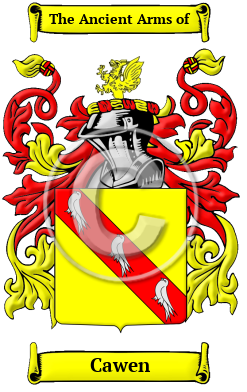
| ![Show Contents]() Cawen History, Family Crest & Coats of Arms Cawen History, Family Crest & Coats of Arms
- Origins Available:
Ireland
Etymology of CawenWhat does the name Cawen mean? The name Cawen comes from the Irish Gaelic name Ó Cathalain. The Gaelic versions of today's Irish names demonstrate a link to a proud, ancient past. The name is possibly derived from Cathalan, King of Farney slain in 1028, whose name means Little Charles. Cathalan was in turn descended from Coleman Mor, King of Meath and (the 133rd Monarch of Ireland). (O'Hart) Early Origins of the Cawen familyThe surname Cawen was first found in County Roscommon (Irish: Ros Comáin) located in central Ireland in the province of Connacht, where they held a family seat from very ancient times. Caillin (fl. 560), was an Irish saint, "son of Niata, descended from Rudraighe, whose grandson, Fergus Mac Roigh, flourished at the beginning of the Christian era. His mother was Deighe, granddaughter of Dubhthach, chief poet of King Laogaire in the time of St. Patrick. The authority for the history of St. Caillin is the ancient ‘Book of Fenagh,’ a series of poetical rhapsodies, written about 1400, a copy of which with a connecting narrative in prose was made in 1516. we may gather the following facts of St. Caillin's history from this curious repertory of ancient traditions: ‘The descendants of Medbh and Fergus, viz. the children of Conmac, Ciar, and Corc, grew and multiplied throughout Ireland. The children of Conmac especially were in Connaught.’ Those were the Conmaicne of Dunmor, kinsmen of Caillin's. Resolved to remedy the congestion of the population by killing each other, the Conmaicne would no doubt have carried out their plan but for the interference of St. Caillin. By the advice of an angel they sent messengers to him at Rome, whither he had gone for his education." 1 Early History of the Cawen familyThis web page shows only a small excerpt of our Cawen research. Another 149 words (11 lines of text) covering the years 1027 and 1280 are included under the topic Early Cawen History in all our PDF Extended History products and printed products wherever possible. Cawen Spelling VariationsIrish names were rarely spelled consistently in the Middle Ages. Spelling variations of the name Cawen dating from that time include Callan, Callanan, Caillan, Calan, Calanan, Callen, Callin, Callon, Callinan, Callinon and many more. Early Notables of the Cawen familyMore information is included under the topic Early Cawen Notables in all our PDF Extended History products and printed products wherever possible.
| Cawen migration to the United States | + |
Thousands of Irish families left for North American shores in the 19th century. These people were searching for a life unencumbered with poverty, hunger, and racial discrimination. Many arrived to eventually find such conditions, but many others simply did not arrive: victims of the diseased, overcrowded ships in which they traveled to the New World. Those who lived to see North American shores were instrumental in the development of the growing nations of Canada and the United States. A thorough examination of passenger and immigration lists has disclosed evidence of many early immigrants of the name Cawen:
Cawen Settlers in United States in the 19th Century- Thomas Cawen, aged 34, who arrived in New York in 1812 2
- Smith, George (ed), Dictionary of National Biography. London: Smith, Elder & Co., 1885-1900. Print
- Filby, P. William, Meyer, Mary K., Passenger and immigration lists index : a guide to published arrival records of about 500,000 passengers who came to the United States and Canada in the seventeenth, eighteenth, and nineteenth centuries. 1982-1985 Cumulated Supplements in Four Volumes Detroit, Mich. : Gale Research Co., 1985, Print (ISBN 0-8103-1795-8)
 |