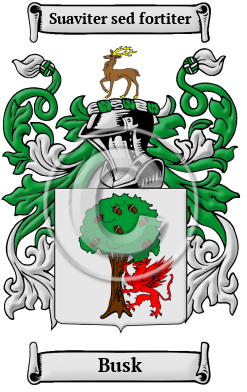
| ![Show Contents]() Busk History, Family Crest & Coats of Arms Busk History, Family Crest & Coats of Arms
- Origins Available:
England
Etymology of BuskWhat does the name Busk mean? The ancient roots of the Busk family name are in the Anglo-Saxon culture. The name Busk comes from when the family lived near a bush. The name Busk is derived from the Old Norman buskr, which means bush. The Magni Rotuli Scaccarii Normanniae listed Gilbert and William le Busc in Normandy 1180-95. 1 Early Origins of the Busk familyThe surname Busk was first found in Yorkshire. It is likely that the name was first assumed by someone living in this county near a prominent bush. The first known bearer of the name was Richard de la Busce, who was recorded in the Pipe Rolls of Yorkshire in 1181. 2 The Yorkshire Poll Tax Rolls of 1379 included: Thomas atte Busk; Agnes at Busk; and Thomas Bosc. 3 Earlier the Hundredorum Rolls of 1273 had included Hamo le Bosco and Henry del Busk, but no county was listed. Early History of the Busk familyThis web page shows only a small excerpt of our Busk research. Another 188 words (13 lines of text) covering the years 1181, 1275, 1305, 1379, 1668, 1772, 1780, 1796, 1800 and 1862 are included under the topic Early Busk History in all our PDF Extended History products and printed products wherever possible. Busk Spelling VariationsOne relatively recent invention that did much to standardize English spelling was the printing press. However, before its invention even the most literate people recorded their names according to sound rather than spelling. The spelling variations under which the name Busk has appeared include Busk, Buske, Busce, Bosc, Buscke, Bosk, Busker and many more. Early Notables of the Busk family- Sir Wadsworth Busk, attorney-general of the Isle of Man in the 1780s
- Hans Busk the Elder (1772-1862), was an English scholar and poet, descended from the family Du Busc of Normandy, one of whom was created Marquis de Fresney in 1668. 4
| Busk migration to the United States | + |
At this time, the shores of the New World beckoned many English families that felt that the social climate in England was oppressive and lacked opportunity for change. Thousands left England at great expense in ships that were overcrowded and full of disease. A great portion of these settlers never survived the journey and even a greater number arrived sick, starving, and without a penny. The survivors, however, were often greeted with greater opportunity than they could have experienced back home. These English settlers made significant contributions to those colonies that would eventually become the United States and Canada. An examination of early immigration records and passenger ship lists revealed that people bearing the name Busk arrived in North America very early:
Busk Settlers in United States in the 18th Century- John Busk, who emigrated from London to Maryland in 1736
Busk Settlers in United States in the 19th Century- T. Busk, who settled in San Francisco in 1852
- Ed L. P. Busk, aged 21, who immigrated to America from London, in 1893
- G.L. Busk, aged 24, who landed in America from London, in 1897
Busk Settlers in United States in the 20th Century- Eleanor Joy Busk, who immigrated to the United States, in 1905
- Frederick T. Busk, aged 45, who settled in America from Birkenhead, England, in 1910
- Gladys E. Busk, aged 23, who immigrated to the United States from Hindhead, England, in 1912
- Edmund Busk, aged 19, who landed in America from Woking, England, in 1912
- Charles W. Busk, aged 59, who settled in America from London, England, in 1912
- ... (More are available in all our PDF Extended History products and printed products wherever possible.)
| Busk migration to Canada | + |
Busk Settlers in Canada in the 20th Century- Chas. W. Busk, aged 63, who settled in Nelson, B. C., Canada, in 1916
| Busk migration to New Zealand | + |
Emigration to New Zealand followed in the footsteps of the European explorers, such as Captain Cook (1769-70): first came sealers, whalers, missionaries, and traders. By 1838, the British New Zealand Company had begun buying land from the Maori tribes, and selling it to settlers, and, after the Treaty of Waitangi in 1840, many British families set out on the arduous six month journey from Britain to Aotearoa to start a new life. Early immigrants include: Busk Settlers in New Zealand in the 19th Century- William Busk, who arrived in Auckland, New Zealand aboard the ship "Nimroud" in 1863
| Contemporary Notables of the name Busk (post 1700) | + |
- Hans Busk the Younger (1815-1882), one of the principal originators of the volunteer movement in England
- Sir Douglas Laird Busk, British diplomat, who served as ambassador to Ethiopia, Finland and Venezuela
- George Busk (1807-1886), British surgeon, zoologist and paleontologist
The motto was originally a war cry or slogan. Mottoes first began to be shown with arms in the 14th and 15th centuries, but were not in general use until the 17th century. Thus the oldest coats of arms generally do not include a motto. Mottoes seldom form part of the grant of arms: Under most heraldic authorities, a motto is an optional component of the coat of arms, and can be added to or changed at will; many families have chosen not to display a motto.
Motto: Suaviter sed fortiter
Motto Translation: Mildly, but firmly
- The Norman People and Their Existing Descendants in the British Dominions and the United States Of America. Baltimore: Genealogical Publishing, 1975. Print. (ISBN 0-8063-0636-X)
- Reaney, P.H and R.M. Wilson, A Dictionary of English Surnames. London: Routledge, 1991. Print. (ISBN 0-415-05737-X)
- Bardsley, C.W, A Dictionary of English and Welsh Surnames: With Special American Instances. Wiltshire: Heraldry Today, 1901. Print. (ISBN 0-900455-44-6)
- Smith, George (ed), Dictionary of National Biography. London: Smith, Elder & Co., 1885-1900. Print
 |