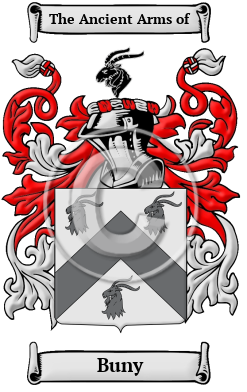
| ![Show Contents]() Buny History, Family Crest & Coats of Arms Buny History, Family Crest & Coats of Arms
Etymology of BunyWhat does the name Buny mean? The ancient Norman culture that was established in England after the Conquest of 1066 produced the name of Buny. It was given to a bunn, or literally from the Old French word bonne which means good. 1 Another source presumes the name could have been from place Bougnies, a Norman village in Belgium. 2 Early Origins of the Buny familyThe surname Buny was first found in Nottinghamshire at Bunny, a parish, in the union of Basford, N. division of the wapentake of Rushcliffe. "Bunny Park, the seat of Lord Rancliffe, to the east of the village, is an ancient mansion of brick ornamented with stone, with a massive gateway entrance. The church is a spacious and well-built edifice, partly in the decorated and partly in the later English style, with a tower surmounted by a crocketed spire." 3 The Bunnys of Ibdrope were said to have held that Hampshire estate from temp. King John. 4 Further to the north in Scotland, William Buny, was a Scottish merchant who had safe conduct into England, 1412; Patrick Buny held land in Linlithow, 1461; and Henry Buny held a tenement there in 1472. 5 Early History of the Buny familyThis web page shows only a small excerpt of our Buny research. Another 126 words (9 lines of text) covering the years 1540, 1543, 1558, 1559, 1562, 1567, 1574, 1584, 1588, 1601, 1612, 1617 and 1619 are included under the topic Early Buny History in all our PDF Extended History products and printed products wherever possible. Buny Spelling VariationsMultitudes of spelling variations are a hallmark of Anglo Norman names. Most of these names evolved in the 11th and 12th century, in the time after the Normans introduced their own Norman French language into a country where Old and Middle English had no spelling rules and the languages of the court were French and Latin. To make matters worse, medieval scribes spelled words according to sound, so names frequently appeared differently in the various documents in which they were recorded. The name was spelled Bunney, Bunny, Buny, Bunnie and others. Early Notables of the Buny familyEdmund Bunny (1540-1619), a noted theological writer who acquired the estates of the Hartops of Dalby. He was born in 1540 at the Vache, the seat of Edward Restwold, his mother's father, near Chalfont St. Giles, Buckinghamshire. He was the eldest son of Richard Bunny (d. 1584) of Newton or Bunny Hall in Wakefield parish, who was treasurer of Berwick, and otherwise employed in public services in...
Another 66 words (5 lines of text) are included under the topic Early Buny Notables in all our PDF Extended History products and printed products wherever possible. Migration of the Buny familyBecause of this political and religious unrest within English society, many people decided to immigrate to the colonies. Families left for Ireland, North America, and Australia in enormous numbers, traveling at high cost in extremely inhospitable conditions. The New World in particular was a desirable destination, but the long voyage caused many to arrive sick and starving. Those who made it, though, were welcomed by opportunities far greater than they had known at home in England. Many of these families went on to make important contributions to the emerging nations of Canada and the United States. Analysis of immigration records indicates that some of the first North American immigrants bore the name Buny or a variant listed above: Richard Bunny who settled in Barbados in 1679 with his wife and daughter; William Bunney his brother settled in Barbados in the same year; Thomas Bunney settled in Charlestown Massachusetts in 1630.
- Reaney, P.H and R.M. Wilson, A Dictionary of English Surnames. London: Routledge, 1991. Print. (ISBN 0-415-05737-X)
- The Norman People and Their Existing Descendants in the British Dominions and the United States Of America. Baltimore: Genealogical Publishing, 1975. Print. (ISBN 0-8063-0636-X)
- Lewis, Samuel, A Topographical Dictionary of England. Institute of Historical Research, 1848, Print.
- Lower, Mark Anthony, Patronymica Britannica, A Dictionary of Family Names of the United Kingdom. London: John Russel Smith, 1860. Print.
- Black, George F., The Surnames of Scotland Their Origin, Meaning and History. New York: New York Public Library, 1946. Print. (ISBN 0-87104-172-3)
 |