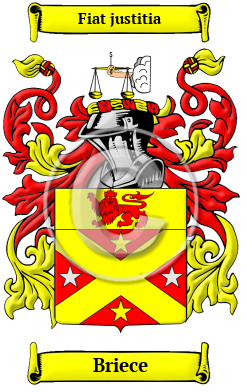
| ![Show Contents]() Briece History, Family Crest & Coats of Arms Briece History, Family Crest & Coats of Arms
Etymology of BrieceWhat does the name Briece mean? The chronicle of the name Briece begins with a family in the Pictish clans of ancient Scotland. The name is derived from the Gaulish saint Bricius, a nephew of St. Martin of Tours in the 5th century. From Gaelic, the name means quick or speedy. Early Origins of the Briece familyThe surname Briece was first found in Morayshire, where they held a family seat from very ancient times, around the 12th century. The name was originally Bricius, a Gaulish Saint of the fifth century, a nephew of St. Martin of Tours. Early History of the Briece familyThis web page shows only a small excerpt of our Briece research. Another 214 words (15 lines of text) covering the years 1189, 1203, 1296, 1370, 1532, 1569, 1570, 1636, 1648, 1690, 1696 and 1773 are included under the topic Early Briece History in all our PDF Extended History products and printed products wherever possible. Briece Spelling VariationsWhen the first dictionaries were invented in the last few hundred years, spelling gradually became standardized. Before that time, scribes spelled according to sound. Names were often recorded under different spelling variations every time they were written. Briece has been written Bryce, Brice, Bricius, Bryse, Breise, Bryces, Brices, Bryses, Breises, Bryse, Brise, Briece and many more. Early Notables of the Briece familyBishop Bricius of Moray; Edmund Brice (fl. 1648 - 1696), an English translator and schoolmaster; Edward Brice or Bryce (1569?-1636), Scottish Presbyterian minister; and Elizabeth Brice (Amadas) (died 1532), a lady at the royal court of King Henry VIII of England who was accused of treason and claimed to be a mistress of the king.
Thomas Brice (d. 1570), was an English martyrologist who was engaged early in Queen Mary's reign in bringing Protestant books 'from Wesel...
Another 76 words (5 lines of text) are included under the topic Early Briece Notables in all our PDF Extended History products and printed products wherever possible. Migration of the Briece family to IrelandSome of the Briece family moved to Ireland, but this topic is not covered in this excerpt.
Another 72 words (5 lines of text) about their life in Ireland is included in all our PDF Extended History products and printed products wherever possible. Migration of the Briece familyThe crossing to North America did not seem so great in comparison with the hardships many Scots endured at home. It was long, expensive, and cramped, but also rewarding. North America offered land and the chance for settlers to prove themselves in a new place. And many did prove themselves as they fought to forge a new nation in the American War of Independence. The ancestors of those Scots can now experience much of their once-lost heritage through the Clan societies and highland games that have sprung up across North America in the last century. A search of immigration and passenger lists revealed many important, early immigrants to North America bearing the name of Briece: William Bryce who settled in Virginia in 1654; followed by James in 1659; Alexander, Ann, Jane, Mary, and William Bryce, settled in New York, N.Y. in 1774.
The motto was originally a war cry or slogan. Mottoes first began to be shown with arms in the 14th and 15th centuries, but were not in general use until the 17th century. Thus the oldest coats of arms generally do not include a motto. Mottoes seldom form part of the grant of arms: Under most heraldic authorities, a motto is an optional component of the coat of arms, and can be added to or changed at will; many families have chosen not to display a motto.
Motto: Fiat justitia
Motto Translation: Let justice be done.
 |