| ![Show Contents]() Bowra History, Family Crest & Coats of Arms Bowra History, Family Crest & Coats of Arms
Etymology of BowraWhat does the name Bowra mean? The chronicles of Scottish history reveal that the first people to use the name Bowra were the Strathclyde-Britons. It was a name for a maker of bows. Further research revealed that the name is derived from the Old English word bower, which means bow maker. Early Origins of the Bowra familyThe surname Bowra was first found in Peeblesshire (Gaelic: Siorrachd nam Pùballan), former county in South-central Scotland, in the present day Scottish Borders Council Area, where they held a family seat in the old manor of Bower in the parish of Drummelzier. One of the first records of the family was "Lorence atte Bure of the county of Peebles, and William Oftherebure of the county of Roxburgh [who] rendered homage [to King Edward I of England] in 1296." 1 Early History of the Bowra familyThis web page shows only a small excerpt of our Bowra research. Another 166 words (12 lines of text) covering the years 1296, 1317, 1387, 1449, 1479, 1489, 1615, 1664, 1671, 1681, 1685, 1686, 1689, 1702, 1705, 1706, 1718 and 1766 are included under the topic Early Bowra History in all our PDF Extended History products and printed products wherever possible. Bowra Spelling VariationsPrior to the first dictionaries, scribes spelled words according to sound. This, and the fact that Scottish names were repeatedly translated from Gaelic to English and back, contributed to the enormous number of spelling variations in Scottish names. Bowra has been spelled Bower, Bowre, Bowyr, Bowers, Bowyer, Beauer and many more. Early Notables of the Bowra familyWalter Bower or Bowmaker (d. 1449), Abbot of Inchcolm, reputed continuator of Fordun's 'Chronica Gentis Scotorum,' as it appears in the volume generally known as the 'Scotichronicon.' Archibald Bower (1686-1766), was a Scottish author of the 'History of the Popes,' born on 17 Jan. 1685 at or near Dundee; according to his own account, he was descended from an ancient family which had been for several hundred years possessed of an estate in the county of Angus in Scotland. In 1702 he was sent to the Scotch college at Douay; afterwards proceeded to Rome, and was there admitted into the Society of...
Another 114 words (8 lines of text) are included under the topic Early Bowra Notables in all our PDF Extended History products and printed products wherever possible. Migration of the Bowra family to IrelandSome of the Bowra family moved to Ireland, but this topic is not covered in this excerpt. More information about their life in Ireland is included in all our PDF Extended History products and printed products wherever possible.
| Bowra migration to Australia | + |
Bowra Settlers in Australia in the 19th Century- Miss Eliza Bowra, (b. 1818), aged 18, Engish servant who was convicted in Kent, England for 14 years for stealing, transported aboard the "Elizabeth" on 20th June 1836, arriving in New South Wales, Australia, she died in 1887 2
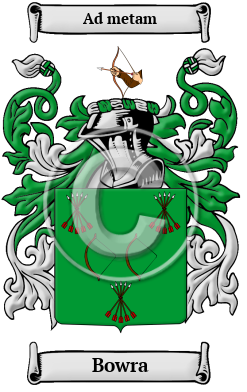
The motto was originally a war cry or slogan. Mottoes first began to be shown with arms in the 14th and 15th centuries, but were not in general use until the 17th century. Thus the oldest coats of arms generally do not include a motto. Mottoes seldom form part of the grant of arms: Under most heraldic authorities, a motto is an optional component of the coat of arms, and can be added to or changed at will; many families have chosen not to display a motto.
Motto: Ad metam
Motto Translation: To the mark.
- Black, George F., The Surnames of Scotland Their Origin, Meaning and History. New York: New York Public Library, 1946. Print. (ISBN 0-87104-172-3)
- Convict Records Voyages to Australia (Retrieved 11th March 2022). Retrieved from https://convictrecords.com.au/ships/elizabeth
 |