| ![Show Contents]() Bincine History, Family Crest & Coats of Arms Bincine History, Family Crest & Coats of Arms
- Origins Available:
Scotland
Etymology of BincineWhat does the name Bincine mean? The earliest roots of the name Bincine are with the Viking settlers of the early Middle Ages; the surname having come from a place named by the Vikings It is a name for someone who lived in the old barony of Binney, in the parish of Uphall, in the county of West Lothian. According to Scottish lore, there was once a man called Binnie, who at the time supplied hay to Linlithgow Castle which was at the time held by the English. He planned to have Scottish soldiers near the gate on a certain day. He placed several of his sons in a wagon, cover them with hay and drove up to the castle. The portcullis was raised and just as the wagon was underneath it, the ropes were cut so the portcullis could not fall. The Scottish soldiers rushed in and put the garrison to the sword. Binnie was thenceforth named Binning. 1 Early Origins of the Bincine familyThe surname Bincine was first found in the West Lothian, where they held a family seat from very ancient times. One of the first records of the family was William Bennings (fl. 1180), an English judge, "was, according to Giraldus Cambrensis, sent to Ireland by Henry II in 1176 as one of four envoys, of whom two were to remain with the viceroy, Richard FitzGilbert, earl of Striguil, and two were to return, bringing with them Reimund Fitzgerald, whose military exploits had aroused the king's jealousy. " 2 William Benyng or De Binn (fl. 1250), was an early Scottish "biographer, [who] may be presumed to have been a native of Binning in Linlithgowshire. He was proir of the Cistercian abbey of Newbattle until 1243, when he was elected abbot of Cupar. He resigned this office on 29 Sept. 1258, probably on account of old age. The date of his death is unknown. " 2 Early History of the Bincine familyThis web page shows only a small excerpt of our Bincine research. Another 147 words (10 lines of text) covering the years 1243, 1258, 1411, 1627, 1653 and 1666 are included under the topic Early Bincine History in all our PDF Extended History products and printed products wherever possible. Bincine Spelling VariationsStandards against which to judge the accuracy of spellings and translations did not yet exist in the Middle Ages. Spelling variations in names dating from that era, are thus, an extremely common occurrence. Bincine has been recorded as Binney, Binning, Binnie, Benning, Bennyng, Bynnie, Bynny, Bynnyng, Byning, Bynning and many more. Early Notables of the Bincine familyHugh Binning, (1627-1653), Scottish philosopher and regent of the University of Glasgow. He was the son of John Binning of Dalvenan, Ayrshire. His maternal uncle was "one of the youthful martyrs of Scotland - Hugh M'Kail, who was hanged at Edinburgh on 22...
Another 42 words (3 lines of text) are included under the topic Early Bincine Notables in all our PDF Extended History products and printed products wherever possible. Migration of the Bincine familyThe New World was far from the oppressive regime of the old country. It was a place where there was more land than people and political and religious freedom were far easier to come by. Many Scots even got the chance to fight for their freedom in the American War of Independence. In recent years, interest in this heritage has been generated by Clan societies and regular highland games in North America. An examination of early immigration and passenger lists has revealed many people bearing the Bincine name: Alice Binney who settled in Barbados in 1663; James Binney settled there in 1680 with his servants; John Binney settled in Philadelphia in 1808; Stephen Binney settled in Boston Massachusetts in 1822.
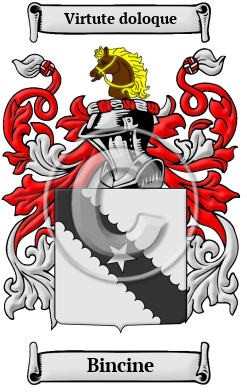
The motto was originally a war cry or slogan. Mottoes first began to be shown with arms in the 14th and 15th centuries, but were not in general use until the 17th century. Thus the oldest coats of arms generally do not include a motto. Mottoes seldom form part of the grant of arms: Under most heraldic authorities, a motto is an optional component of the coat of arms, and can be added to or changed at will; many families have chosen not to display a motto.
Motto: Virtute doloque
Motto Translation: By valour and craft.
- Polson, Alexander, The Romance of Scottish Crests and Mottoes. Inverness: Walter Alexander, Inglis Street 1929. Print
- Smith, George (ed), Dictionary of National Biography. London: Smith, Elder & Co., 1885-1900. Print
 |