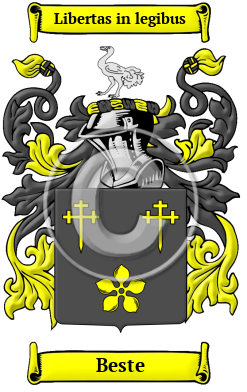
| ![Show Contents]() Beste History, Family Crest & Coats of Arms Beste History, Family Crest & Coats of Arms
Etymology of BesteWhat does the name Beste mean? The name Beste is of Anglo-Saxon origin. It was name for a strong or resourceful man. The surname Beste is derived from the Old English Old French word beste, and ultimately comes from the Latin word bestia, which means beast. 1 2 3 The surname Beste may also be a metonym referring to some one who was employed as a herdsman. However, two sources claim the name is more probably of Norman stock, having been derived been an abbreviation of the name Bessett. 4 5 Early Origins of the Beste familyThe surname Beste was first found in Somerset, where William Best was listed in the Assize Rolls for 1201. Years later, Wilkin le Best was listed in the Assize Rolls for Cheshire in 1260 and later again, John Besteman was found in the Subsidy Rolls for Essex in 1327. 6 The Hundredorum Rolls of 1273 proved the widespread use of the name: Richard le Beste in Cambridgeshire; William Best in Buckinghamshire and Walter Best in Oxfordshire. Thomas Best and Agnes Best were both listed in the Yorkshire Poll Tax Rolls of 1379. Robert Beast or Best was Sheriff of Norwich in 1495. 3 In Ireland, "the Irish Bests came from Kent, England and settling in Leinster in the seventeenth century became prominent in Carlow and adjacent counties." 4 In Scotland, "a booth was leased to John Best in Edinburgh, 1457. John Best was a skinner in Edinburgh, 1603 - the only one of the name in this record. Thomas Best was admitted burgess of Aberdeen, 1618 and Agnes Best is recorded in Jedburgh Forest, 1684." 7 Early History of the Beste familyThis web page shows only a small excerpt of our Beste research. Another 92 words (7 lines of text) covering the years 1495, 1570, 1572, 1576, 1577, 1578, 1583, 1584, 1590, 1596, 1598, 1602, 1609, 1638, 1640, 1652, 1657, 1659, 1687, 1709, 1740, 1826, 1840, 1847, 1856, 1871, 1890, 1946 and 1959 are included under the topic Early Beste History in all our PDF Extended History products and printed products wherever possible. Beste Spelling VariationsSpelling variations in names were a common occurrence before English spelling was standardized a few hundred years ago. In the Middle Ages, even the literate spelled their names differently as the English language incorporated elements of French, Latin, and other European languages. Many variations of the name Beste have been found, including Best, Beast, Beste, Bestman and others. Early Notables of the Beste familyGeorge Best (d. 1584?), English navigator who accompanied Martin Frobisher in the three voyages undertaken (in 1576, 1577, and 1578) to discover the North-west Passage. There is some confusion as to the date of his death as "a George Best, servant to Sir Christopher Hatton, was killed in a duel, about March 1583-1584, by Oliver St. John, afterwards Viscount Grandison. This person is doubtless to be identified with the writer of the 'Trve Discovrse.' Another George Best, fellow of Jesus College, Cambridge, was instituted to the vicarage of All Saints, Cambridge, in 1572, and to the rectory of St. Dunstan-in-the-East, London...
Another 159 words (11 lines of text) are included under the topic Early Beste Notables in all our PDF Extended History products and printed products wherever possible. Migration of the Beste family to IrelandSome of the Beste family moved to Ireland, but this topic is not covered in this excerpt.
Another 540 words (39 lines of text) about their life in Ireland is included in all our PDF Extended History products and printed products wherever possible. Migration of the Beste familyFamilies began migrating abroad in enormous numbers because of the political and religious discontent in England. Often faced with persecution and starvation in England, the possibilities of the New World attracted many English people. Although the ocean trips took many lives, those who did get to North America were instrumental in building the necessary groundwork for what would become powerful new nations. Among early immigrants of the Beste surname to cross the Atlantic and come to North America were: Christopher Best who settled in Virginia in 1623; John Best who settled in New England in 1634; Thomas Best settled in Virginia in 1635; William Best settled in Virginia in 1643.
| Contemporary Notables of the name Beste (post 1700) | + |
- Henry Digby Beste (1768-1836), English writer and aristocratic convert to Catholicism
- Esther Beste, Actress
- Conrad Beste, German screenwriter
The motto was originally a war cry or slogan. Mottoes first began to be shown with arms in the 14th and 15th centuries, but were not in general use until the 17th century. Thus the oldest coats of arms generally do not include a motto. Mottoes seldom form part of the grant of arms: Under most heraldic authorities, a motto is an optional component of the coat of arms, and can be added to or changed at will; many families have chosen not to display a motto.
Motto: Libertas in legibus
Motto Translation: Liberty in the law.
- Smith, Eldson Coles, New Dictionary of American Family Names New York: Harper & Row, 1956. Print
- Harrison, Henry, Surnames of the United Kingdom: A Concise Etymological Dictionary Baltimore: Geneological Publishing Company, 2013. Print
- Bardsley, C.W, A Dictionary of English and Welsh Surnames: With Special American Instances. Wiltshire: Heraldry Today, 1901. Print. (ISBN 0-900455-44-6)
- MacLysaght, Edward, Supplement to Irish Families. Baltimore: Genealogical Book Company, 1964. Print.
- The Norman People and Their Existing Descendants in the British Dominions and the United States Of America. Baltimore: Genealogical Publishing, 1975. Print. (ISBN 0-8063-0636-X)
- Reaney, P.H and R.M. Wilson, A Dictionary of English Surnames. London: Routledge, 1991. Print. (ISBN 0-415-05737-X)
- Black, George F., The Surnames of Scotland Their Origin, Meaning and History. New York: New York Public Library, 1946. Print. (ISBN 0-87104-172-3)
 |