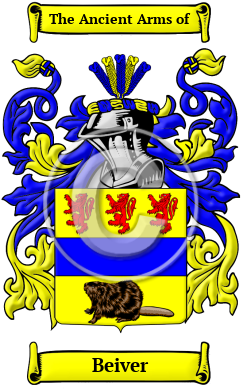
| ![Show Contents]() Beiver History, Family Crest & Coats of Arms Beiver History, Family Crest & Coats of Arms
- Origins Available:
England
Etymology of BeiverWhat does the name Beiver mean? The name Beiver was carried to England in the enormous movement of people that followed the Norman Conquest of 1066. The Beiver family lived in Berkshire. The family name, however, is of other geographical derivations, referring to any of several locations in Normandy called Beauvoir. The name is composed of the Old French roots beu, which means fair or lovely, and voir, which means to see, and indicates the bearer's residence in "a place with a fine view." 1 2 Early Origins of the Beiver familyThe surname Beiver was first found in Yorkshire where Ralph de Belueeir was listed in the Pipe Rolls of 1170. Later, John de Beauveir was listed in the Assize Rolls for 1204 and William Bever, de Beuver in the Curia Regis Rolls for 1207-1208. 3 The Hundredorum Rolls of 1273 included the following: (Prior) de Beuver (Nottinghamshire), or Beauver (Leicestershire); John de Beauver, Yorkshire; and Thurstan de Beauver, Yorkshire. 4 Another early roll notes: John de Beauver, Yorkshire, Henry III-Edward I: Testa de Nevill, sive Liber Feodorum, temp. Henry III-Edward I. 5 Early History of the Beiver familyThis web page shows only a small excerpt of our Beiver research. Another 81 words (6 lines of text) are included under the topic Early Beiver History in all our PDF Extended History products and printed products wherever possible. Beiver Spelling VariationsEndless spelling variations are a prevailing characteristic of Norman surnames. Old and Middle English lacked any definite spelling rules, and the introduction of Norman French added an unfamiliar ingredient to the English linguistic stew. French and Latin, the languages of the court, also influenced spellings. Finally, Medieval scribes generally spelled words according to how they sounded, so one person was often referred to by different spellings in different documents. The name has been spelled Beaver, Beavor, Beavers, Beavors, Beavoirs, Beevers and many more. Early Notables of the Beiver familyMore information is included under the topic Early Beiver Notables in all our PDF Extended History products and printed products wherever possible. Migration of the Beiver familyTo escape the political and religious persecution within England at the time, many English families left for the various British colonies abroad. The voyage was extremely difficult, though, and the cramped, dank ships caused many to arrive in the New World diseased and starving. But for those who made it, the trip was most often worth it. Many of the families who arrived went on to make valuable contributions to the emerging nations of Canada and the United States. An inquiry into the early roots of North American families reveals a number of immigrants bearing the name Beiver or a variant listed above: Matthew Beaver, who arrived in Virginia in 1638; John Beaver, who settled in New England in 1699; Bridget Beavers, who came to Annapolis Maryland in 1730.
- The Norman People and Their Existing Descendants in the British Dominions and the United States Of America. Baltimore: Genealogical Publishing, 1975. Print. (ISBN 0-8063-0636-X)
- Smith, Eldson Coles, New Dictionary of American Family Names New York: Harper & Row, 1956. Print
- Reaney, P.H and R.M. Wilson, A Dictionary of English Surnames. London: Routledge, 1991. Print. (ISBN 0-415-05737-X)
- Bardsley, C.W, A Dictionary of English and Welsh Surnames: With Special American Instances. Wiltshire: Heraldry Today, 1901. Print. (ISBN 0-900455-44-6)
- Testa de Nevill or "Liber Feodorum" or "Book of Fees," thought to have been written by Ralph de Nevill, for King John (1199–1216)
 |