| ![Show Contents]() Beden History, Family Crest & Coats of Arms Beden History, Family Crest & Coats of Arms
Etymology of BedenWhat does the name Beden mean? The west coast of Scotland and the rocky Hebrides islands are the ancient home of the Beden family. The root of their name is the names of Macbeth and Bethune, or Beaton. The Macbeth and Bethune families, who were hereditary physicians to the Chiefs of Macdonald, practiced medicine on the Isles during the Middle Ages and their names merged in English into the one surname of Beaton. The Macbeths were concentrated in Islay and Mull, whereas the Beatons were concentrated in Skye. However, the Beaton family was not restricted to the Isles and it later branched to other counties such as Fraser. Nonetheless, by the 17th century, the Beaton family "ceased to practice the healing art" and the last of the hereditary physicians was Niel Beaton who practiced medicine in about 1763. 1 One source notes the Norman source of the family. "They claim descent from the house of Bethune, Barons of Bethune in Artois, Advocates or Protectors of Arras. This family was descended from the Carlovingian Counts of Artois, and ranked amongst the most potent and illustrious houses in Europe. The great Duke of Sully was one of its descendants. The Advocates of Arras possessed a barony in England from the Conquest, and left numerous descendants here. From the line of St. Omer, a branch of the same house, descended the Bagots, and Staffords, Duke of Buckingham in England, and many branches bearing the names of St. Omer and Arras." 2 Early Origins of the Beden familyThe surname Beden was first found in the Isle of Islay, where the first of the Islay family on record is Fercos Macbetha, who witnessed and probably wrote the Gaelic charter of 1408. Gilchristus M'Veig, surrigicus or surgeon in Islay is in record. Fergus M'Baithe in 1609 received from James VI certain lands in Islay in his official capacity as "principalis medici intra bordas Insularum," chief physician within the bounds of the Isles. His son, John Macbeath, succeeds in 1628 to the lands, but gave them over to the Thane of Cawdor in following year. The words "Leabar Giolla Colaim Meigbethadh" (book of Malcolm Macbeth) axe written on one of the Gaelic manuscripts in the National Library of Scotland, glossed in the same hand "Liber Malcolml Betune" The Mull Beatons or Betons were hereditary physicians to the Macleans of Dowart. In 1572 Hector MacLaine of Dowart granted a charter to Andrew MacDonil Vikinollif (i.e. son of the doctor) and his heirs of the peuyland of Piencross and Brolas for his skill in the medical art. Martin says that Dr. Beaton was sitting on the upper deck of the "Florida" of the Spanish Armada when it blew up in Tobermory Bay in 1588 and he was thrown a good way off, but lived several years after. 1 In England, the Yorkshire Poll Tax Rolls of 1379 included: Johannes Beton; Beton de Wath; and Beton, servant of Robert, filius Ade. The Hundredorum Rolls of 1273 had only one listing, that of John Betun, Oxfordshire. 3 John Betoun was listed in Colchester in 1311 and Richard Beton was found in the Subsidy Rolls of Derbyshire in 1327. Interestingly, the name is "still used as a Christian name in Cornwall in 1630." 4 Early History of the Beden familyThis web page shows only a small excerpt of our Beden research. Another 347 words (25 lines of text) covering the years 1473, 1494, 1519, 1539, 1543, 1546, 1558, 1569, 1589, 1598, 1600, 1622, 1763 and 1890 are included under the topic Early Beden History in all our PDF Extended History products and printed products wherever possible. Beden Spelling VariationsSpelling variations were extremely common in medieval names, since scribes from that era recorded names according to sound rather than a standard set of rules. Beden has appeared in various documents spelled Beaton, Beeton, MacBeth, MacBeaton, McBee, MacBee and others. Early Notables of the Beden familyJanet Beaton, Lady of Branxholme and Buccleugh (1519-1569) an aristocratic Scottish woman, mistress of James Hepburn, Earl of Bothwell, had five husbands and was accused of being a witch, immortalized as Sir Walter Scott's Wizard Lady of Branxholm in his "Lay of the Last Minstrel"; Cardinal David Beaton (c.1494-1546)...
Another 48 words (3 lines of text) are included under the topic Early Beden Notables in all our PDF Extended History products and printed products wherever possible. Migration of the Beden family to IrelandSome of the Beden family moved to Ireland, but this topic is not covered in this excerpt.
Another 71 words (5 lines of text) about their life in Ireland is included in all our PDF Extended History products and printed products wherever possible. Migration of the Beden familyAncestors of many of the Dalriadan families who crossed the Atlantic still live along the east coast of the United States and Canada. Some Scottish settlers arrived in Canada during the American War of Independence as United Empire Loyalists, while others stayed south to fight for a new nation. The descendants of Scottish settlers in both countries began to rediscover their heritage in the 19th and 20th centuries through Clan societies and highland games. An inquiry into the early roots of North American families has revealed a number of immigrants bearing the name Beden or a variant listed above: Richard Beaton who settled in Nevis in 1654; Thomas Beaton settled in Virginia in 1630; William Beaton settled in Barbados in 1635; Margaret Beeton settled in New England in 1773..
| Contemporary Notables of the name Beden (post 1700) | + |
- Beden Stroud (1795-1865), American politician, Member of Texas Republic Senate from District of Milam and Robertson, 1838-41 5
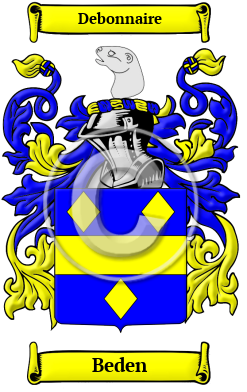
The motto was originally a war cry or slogan. Mottoes first began to be shown with arms in the 14th and 15th centuries, but were not in general use until the 17th century. Thus the oldest coats of arms generally do not include a motto. Mottoes seldom form part of the grant of arms: Under most heraldic authorities, a motto is an optional component of the coat of arms, and can be added to or changed at will; many families have chosen not to display a motto.
Motto: Debonnaire
Motto Translation: Graceful
- Black, George F., The Surnames of Scotland Their Origin, Meaning and History. New York: New York Public Library, 1946. Print. (ISBN 0-87104-172-3)
- The Norman People and Their Existing Descendants in the British Dominions and the United States Of America. Baltimore: Genealogical Publishing, 1975. Print. (ISBN 0-8063-0636-X)
- Bardsley, C.W, A Dictionary of English and Welsh Surnames: With Special American Instances. Wiltshire: Heraldry Today, 1901. Print. (ISBN 0-900455-44-6)
- Reaney, P.H and R.M. Wilson, A Dictionary of English Surnames. London: Routledge, 1991. Print. (ISBN 0-415-05737-X)
- The Political Graveyard: Alphabetical Name Index. (Retrieved 2015, October 20) . Retrieved from http://politicalgraveyard.com/alpha/index.html
 |