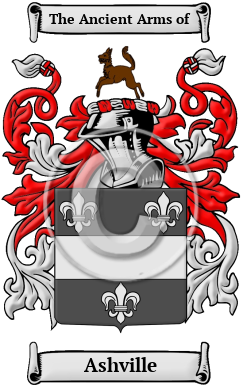
| ![Show Contents]() Ashville History, Family Crest & Coats of Arms Ashville History, Family Crest & Coats of Arms
Etymology of AshvilleWhat does the name Ashville mean? The ancestors of the bearers of the Ashville family name are thought have lived in ancient Anglo-Saxon England. They were first found in Ashfield, which means the open field with ash trees. It is a place-name appearing in Lancashire, and is were the family originated, though they became centered in Suffolk. Early Origins of the Ashville familyThe surname Ashville was first found in Suffolk, at Ashfield, which dates back to the Domesday Book of 1086 when it was listed there as Assefelda. 1 Great Ashfield, Suffolk was also listed there as Eascefelda. 2 To complicate matters more, Ashfield is revival of an ancient village originally named Esfeld in 1216. It is now a local government district in western Nottinghamshire formed in 1974. And today, Ashfield is a suburb in the Inner West of Sydney, in New South Wales, Australia. This latter local was established shortly after the First Fleet arrival in 1788. Early History of the Ashville familyThis web page shows only a small excerpt of our Ashville research. Another 95 words (7 lines of text) covering the years 1506, 1559, 1560, 1569, 1570, 1576, 1578, 1599, 1604, 1620, 1660 and 1690 are included under the topic Early Ashville History in all our PDF Extended History products and printed products wherever possible. Ashville Spelling VariationsUntil quite recently, the English language has lacked a definite system of spelling rules. Consequently, Anglo-Saxon surnames are characterized by a multitude of spelling variations. Changes in Anglo-Saxon names were influenced by the evolution of the English language, as it incorporated elements of French, Latin, and other languages. Although Medieval scribes and church officials recorded names as they sounded, so it is common to find one person referred to by several different spellings of his surname, even the most literate people varied the spelling of their own names. Variations of the name Ashville include Ashfield, Ashfields and others. Early Notables of the Ashville familySir Edmund Ashfield (c. 1506-1578) of Ewelme, Oxfordshire, an English politician, High Sheriff of Berkshire and Oxfordshire (1559-1560), High Sheriff of Bedfordshire and Buckinghamshire (1569-1570.)
Edmund Ashfield (1576-c. 1620), was an English Catholic from Tattenhoe in Buckinghamshire. In 1599 he travelled to Edinburgh to meet James VI of Scotland. He was mistakenly kidnapped by the English Ambassador from England in the belief that Ashfield was an agent of James VI and working to further his succession to the English throne. His kidnappers were...
Another 82 words (6 lines of text) are included under the topic Early Ashville Notables in all our PDF Extended History products and printed products wherever possible. Migration of the Ashville family to IrelandSome of the Ashville family moved to Ireland, but this topic is not covered in this excerpt. More information about their life in Ireland is included in all our PDF Extended History products and printed products wherever possible. Migration of the Ashville familySearching for a better life, many English families migrated to British colonies. Unfortunately, the majority of them traveled under extremely harsh conditions: overcrowding on the ships caused the majority of the immigrants to arrive diseased, famished, and destitute from the long journey across the ocean. For those families that arrived safely, modest prosperity was attainable, and many went on to make invaluable contributions to the development of the cultures of the new colonies. Research into the origins of individual families in North America revealed records of the immigration of a number of people bearing the name Ashville or a variant listed above: James Ashfield settled in Virginia in 1636; John Ashfield settled in West New Jersey in 1664; and Henry Ashfield settled in Maryland in 1776.
| Contemporary Notables of the name Ashville (post 1700) | + |
- Gilbert Ashville Pierce (1839-1901), American Republican politician, Member of Indiana State House of Representatives, 1869; Governor of Dakota Territory, 1884-86; U.S. Senator from North Dakota, 1889-91; U.S. Minister to Portugal, 1893 3
- Williams, Dr Ann. And G.H. Martin, Eds., Domesday Book A Complete Translation. London: Penguin, 1992. Print. (ISBN 0-141-00523-8)
- Mills, A.D., Dictionary of English Place-Names. Oxford: Oxford University Press, 1991. Print. (ISBN 0-19-869156-4)
- The Political Graveyard: Alphabetical Name Index. (Retrieved 2016, February 11) . Retrieved from http://politicalgraveyard.com/alpha/index.html
 |