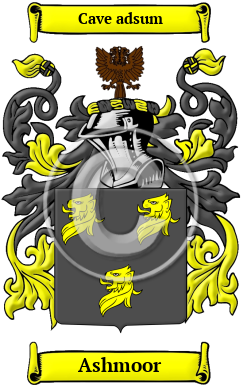
| ![Show Contents]() Ashmoor History, Family Crest & Coats of Arms Ashmoor History, Family Crest & Coats of Arms
Etymology of AshmoorWhat does the name Ashmoor mean? The ancestors of the Ashmoor surname lived among the ancient Anglo-Saxon culture. The name comes from when they lived in the counties of Dorset and Wiltshire. The family name Ash is of topographical derivation and indicates that members of the family once lived in close proximity to an ash tree. 1 Early Origins of the Ashmoor familyThe surname Ashmoor was first found in the counties of Dorset and Wiltshire in the south of England. 2 Ashmore is a parish, in the union of Shaftesbury, hundred of Cranborne, Shaston division of Dorset. "The church, erected in 1433, is a plain edifice of stone and flint. " 3 The Ash in this case was in ancient Saxon a spear, and became the name of one who was adept in the handling of a spear. Sifting though archival materials, we found Elias de Asmore in the Subsidy Rolls for Sussex in 1296, and later as de Ashmer in 1327. Early Wiltshire records show William Asschmere there in 1349. 4 Early History of the Ashmoor familyThis web page shows only a small excerpt of our Ashmoor research. Another 69 words (5 lines of text) covering the years 1584, 1585, 1587, 1588, 1592, 1621 and 1773 are included under the topic Early Ashmoor History in all our PDF Extended History products and printed products wherever possible. Ashmoor Spelling VariationsBefore English spelling was standardized a few hundred years ago, spelling variations of names were a common occurrence. Elements of Latin, French and other languages became incorporated into English through the Middle Ages, and name spellings changed even among the literate. The variations of the surname Ashmoor include Ashmore, Ashmoor, Aschmoor, Aschmore and others. Early Notables of the Ashmoor familyJohn Ashmore (fl. 1621), who was the first who attempted a translation into English of selected odes of Horace. In 1621 he published 'Certain selected Odes of Horace Englished, and their Arguments annexed.' To the translations are added a number of epigrams and anagrams. The translations show considerable facility of versification, and are by no means devoid of grace; but the translator's choice is for longer measures, and there is a want of light lyric speed. Many of...
Another 78 words (6 lines of text) are included under the topic Early Ashmoor Notables in all our PDF Extended History products and printed products wherever possible. Migration of the Ashmoor family to IrelandSome of the Ashmoor family moved to Ireland, but this topic is not covered in this excerpt.
Another 67 words (5 lines of text) about their life in Ireland is included in all our PDF Extended History products and printed products wherever possible. Migration of the Ashmoor familyA great wave of immigration to the New World was the result of the enormous political and religious disarray that struck England at that time. Families left for the New World in extremely large numbers. The long journey was the end of many immigrants and many more arrived sick and starving. Still, those who made it were rewarded with an opportunity far greater than they had known at home in England. These emigrant families went on to make significant contributions to these emerging colonies in which they settled. Some of the first North American settlers carried this name or one of its variants: William Ashmore settled in Maryland in 1634; Anthony Ashmore settled in Barbados in 1635; John Ashmore settled in Maryland in 1634; and another John Ashmore settled in Pennsylvania in 1680.
The motto was originally a war cry or slogan. Mottoes first began to be shown with arms in the 14th and 15th centuries, but were not in general use until the 17th century. Thus the oldest coats of arms generally do not include a motto. Mottoes seldom form part of the grant of arms: Under most heraldic authorities, a motto is an optional component of the coat of arms, and can be added to or changed at will; many families have chosen not to display a motto.
Motto: Cave adsum
Motto Translation: Beware I am here.
- Harrison, Henry, Surnames of the United Kingdom: A Concise Etymological Dictionary Baltimore: Geneological Publishing Company, 2013. Print
- Barber, Henry, British Family Names London: Elliot Stock, 62 Paternoster Row, 1894. Print.
- Lewis, Samuel, A Topographical Dictionary of England. Institute of Historical Research, 1848, Print.
- Reaney, P.H and R.M. Wilson, A Dictionary of English Surnames. London: Routledge, 1991. Print. (ISBN 0-415-05737-X)
 |